
Storing cheese – how to keep it fresh for longer
Whether it’s Mascarpone, Gorgonzola or Pecorino – cheese in all its various forms is something that many people enjoy eating every day. Even the Greek poet Homer back in ancient times had Odysseus feasting on the dairy product, and the holes in the cheese have prompted many a philosophical pondering. But how do you store this food correctly?
The key points
- Store it in the refrigerator ideally in the BioFresh Meat & Dairy safe at just over 0 °C.
- Semi-hard cheese will stay fresh for weeks; hard cheese and cream cheese can be frozen.
- Cut away a good chunk of any mould on hard cheese, but dispose of soft and cream cheese completely if it’s mouldy.
- Always wrap up cheese: cheese paper for hard cheese, wax paper or cheese tins for semi-hard cheese, cream cheese in its original packaging.
- Temper for 20–30 minutes before eating, apart from cream cheese.
Cheese as an age-old method of preservation
Cheese is itself a method of preserving. Our ancestors are said to have discovered the dairy product by chance in the Mesolithic age and then used it to be able to keep easily-perishable milk for longer. Some cheeses do actually keep for several months without a refrigerator. However, this applies mainly to the entire wheel of cheese which is protected by the rind surrounding it. A single piece of cheese or even cream cheese should be kept in the refrigerator.
The right refrigerator compartment for every type of cheese
The dairy product will keep for a very long time when stored in the BioFresh Meat & Dairy safe. With its low level of humidity and temperature of slightly above 0 °C, it produces the ideal conditions for slowing cheese’s ripening process and therefore ensuring it can be enjoyed for longer. In this way, semi-hard cheeses such Gouda or Leerdammer will keep fresh for several weeks.
Some types of cheese such as hard cheese or cream cheese are also suitable for freezing. At -18 °C, their shelf life can be increased by several months. Incidentally, finely grating hard cheese before freezing makes it really easy to use afterwards. For example, it can simply be sprinkled on your pasta or casserole if required. If you do not wish to slow the maturing process of hard cheeses such as Parmesan or alpine cheese varieties and prefer to consume them quite soon, then these should be stored instead at the top of the refrigerator or in the VarioBox.
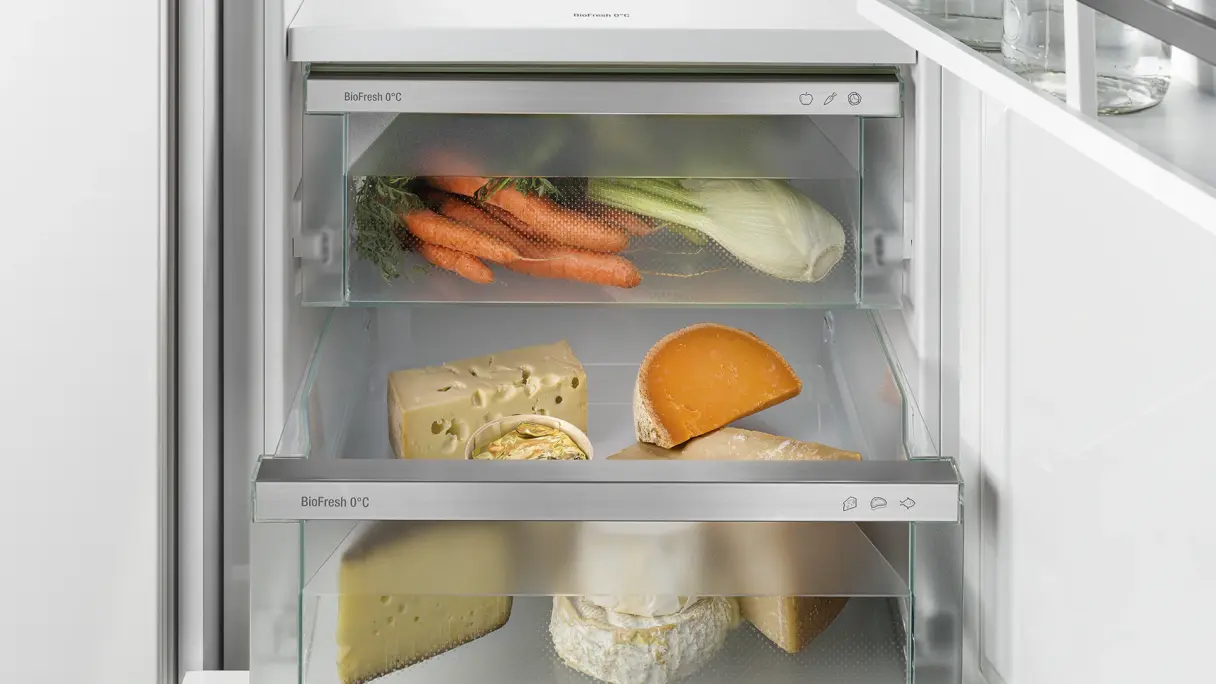
The BioFresh Meat & Dairy safe provides the ideal conditions for storing cheese.
How to deal with mould growth?
If mould does start to form on a piece of cheese, you don't actually have to dispose of it straight away. If, for example, hard cheese goes mouldy, just make sure the affected area is cut away sufficiently. You can consume the rest without concern. However, soft cheese or cream cheese must be disposed of entirely if mould starts to grow.
Edible mould, as in the case of Camembert or Roquefort, is what gives cheese its specific flavor. While the milk is already inoculated with the mould cultures in the case of many types of white mould cheeses, with blue mould cheeses it’s the cheese curd which first comes into contact with the cultures.
During the maturing process, the cheese is pierced with needles in order to feed in oxygen so that the blue edible mould thrives. These types of mould are delicacies and are intended for consumption.

The edible mould of some types of cheese, as with the blue mould cheese shown here, is regarded as a delicacy.
Which packaging is suitable for cheese?
Cheese should never be placed in the refrigerator or in the DrySafe without packaging because otherwise it will dry out. Various types of packaging are best depending on the type of cheese you want to store. For hard, semi-firm and firm cheeses such as Parmesan, Edam or Gouda, cheese paper is ideal for storage. The coating on the inside prevents direct contact with the air, while the paper on the outside allows through the oxygen needed for breathing. If you do not have cheese paper at home, it is possible to perforate cling film with a knife and wrap the cheese in this. In this past, these types of cheeses were also wrapped in a cloth soaked in salt water. The cloth was replaced every two to three days in order to maintain moisture.
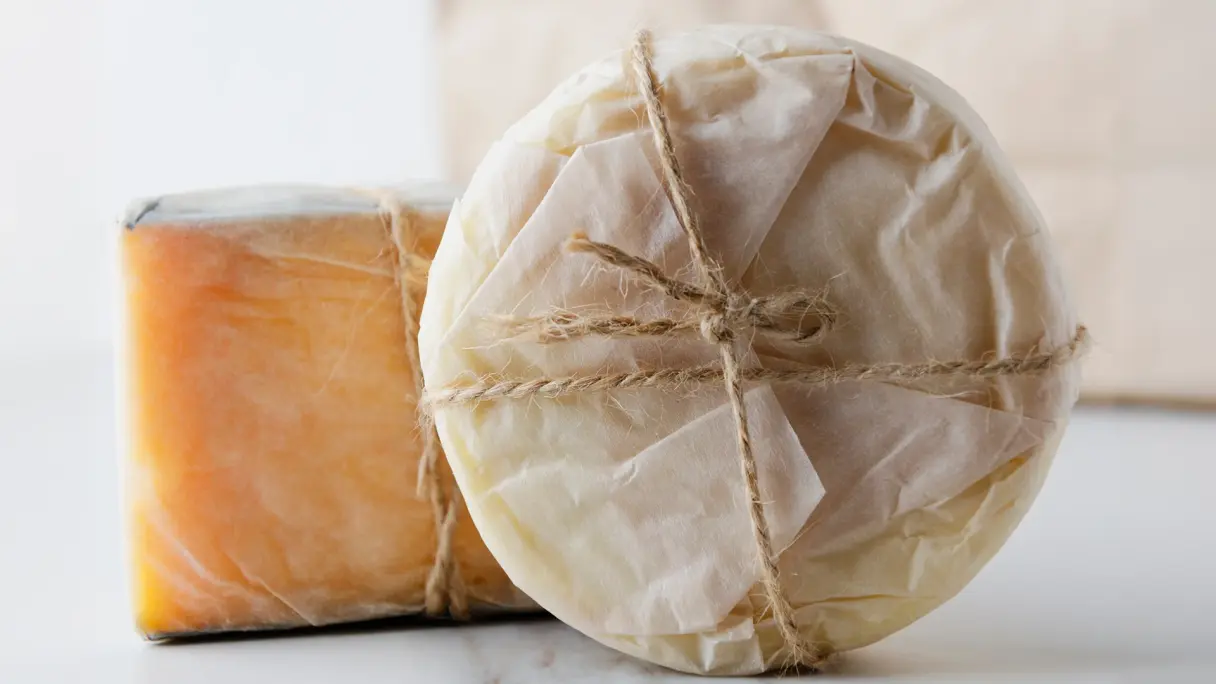
Cheese is at its best when kept in the correct packaging.
Semi-hard cheese by contrast will keep for a particularly long time in wax paper or in plastic boxes. However, you should make sure that condensation does not form in the packaging and that the cheese is able to breathe. Specialist cheese dishes, however, are also ideal for storage and these also prevent the smell of the cheese transferring over to other food.
Soft cheese such as Brie or Camembert is best kept in cheese paper while cream cheese such as mascarpone, feta, quark or ricotta are ideally left in their sales packaging. The containers protect these types from drying out and from the effects of air.
Cheese is eaten ... and served
In order for cheese to properly develop its flavor, it should be taken out of the refrigerator and packaging 20 to 30 minutes before being consumed. The flavors unfold particularly well at room temperature. The exception to this are cream cheeses such as quark. These do not need to acclimatize and should be used or consumed immediately. Incidentally, when serving cheese, boards made from spruce are best because the wood absorbs the moisture and is able to release it again if needed.