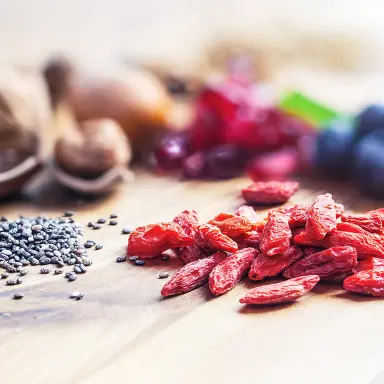
Goji berries – the effect of the reputed wonder fruit
Bright red, small and round: this is how you could describe the new superfood that has taken the world’s shop shelves by storm in no time at all. We are talking about the goji berry and its effects. But what is behind all the hype surrounding this little berry? We reveal what the goji berry is all about and its alleged effects.
The key points
- Rich in vital nutrients: goji berries provide vitamin C, beta-carotene, calcium and secondary plant substances such as lutein and zeaxanthin.
- Traditional medicinal plant: used in Chinese medicine for thousands of years – for example, to strengthen the immune system.
- High calorie content: dried goji berries contain approximately 325 kilocalories per 100 g.
- Be careful about origin and intake: possible pesticide contamination, as well as interactions with blood-thinning medication.
Goji berry: nutrients and nutritional values of red berries
The goji berry, also known as boxthorn fruit, lucky berry or wolfberry, originally comes from China and Mongolia. Goji berries have been used for thousands of years in traditional Chinese medicine. For example, these berries which can grow up to 1 cm in size, supposedly strengthen the immune system, protect cells from dangerous environmental influences, alleviate sleeping disorders and can even prevent cancer. But what effect does the goji berry really have, and which nutrients are responsible for this?
One thing for certain is that goji berries have an abundance of healthy substances, such as vitamin C, calcium, vitamin A in the form of beta-carotene, and all manner of secondary plant substances, such as lutein and zeaxanthin. That goji berries are however mostly only available in dried form in many countries, and the usual quantity of the berries consumed is rather low, puts the healthy substances of the goji berry into perspective. In addition, goji berries are high in calories, with around 325 calories per 100 grams, which should be taken into account if consumed regularly. Berries such as raspberries and blueberries are a cheap, low-calorie and fresh alternative and can be easily stored in the refrigerator.

Are goji berries really that healthy?
As already mentioned, goji berries can have a positive effect on health. However, caution is advised when taking blood-thinning medication such as phenprocoumon or warfarin. Several studies have proven that the innocuous seeming berries can interact with some medications and can intensify their effects! Additionally, in some growing regions, such as China, pesticides and other dangerous pollutants are often used, so exposure to these is not that rare. That's why we always recommend buying organic berries or growing your own.
You should store dried fruit in a jar placed in a dry and dark place. However, if you have bought or harvested fresh berries, consume them as quickly as possible or freeze them in your freezer so that you can enjoy the goji berries and their benefits for longer.