Chinese cabbage: nutritional values and vitamins of this cabbage
The East Asian leafy vegetable is now also a popular source of vitamins in Europe. Chinese cabbage has valuable nutritional values and is extremely versatile in the kitchen. Perhaps this exotic arrival has also made its way onto your plate – or even into your own vegetable patch. We’ll show you what’s behind the salad-like cabbage. Just see what this fresh vegetable has to offer!
Storage time*
| BioFresh Fruit & Vegetable safe just above 0 °C with high humidity | 20 days |
| EasyFresh safe 7 °C with air regulation plate | 10 days |
| Refrigerator compartment 7 °C | 8 days |
The key points
- Rich in vitamins and minerals: Chinese cabbage contains a lot of vitamin C, folic acid, potassium, calcium and magnesium – and all with very few calories.
- Well-tolerated and easily digestible: with around 95 % water content and a mild flavor, Chinese cabbage is ideal for sensitive stomachs and calorie-conscious diets.
- Versatile: whether it’s raw in a salad, cooked or fermented as kimchi – Chinese cabbage is flexible and quick to prepare in the kitchen.
- Focus on how it’s stored: store Chinese cabbage upright on the stalk in the refrigerator – ideally separate from ripening fruits.
Chinese cabbage – list of contents
These vitamins and nutrients are found in Chinese cabbage
Its name clearly indicates its origins. Chinese cabbage is an ancient Chinese crop from the 5th century A.D. and first made its way to Korea, Beijing and into other East Asian countries. These countries are still the main focus of cultivation today, as here it is one of the most important vegetable crops. But Chinese cabbage, with its nutritional values, is also becoming increasingly popular in the USA and Europe. But how do Chinese cabbage and its nutritional values differ from other types of cabbage?
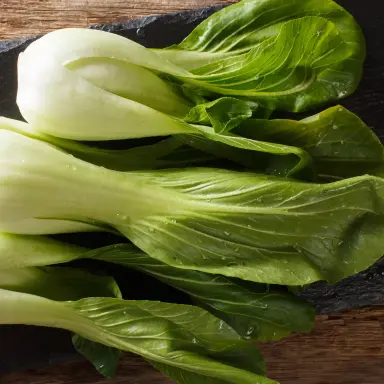
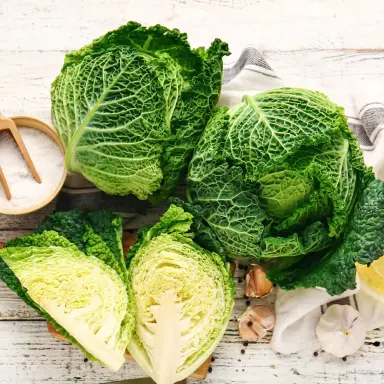
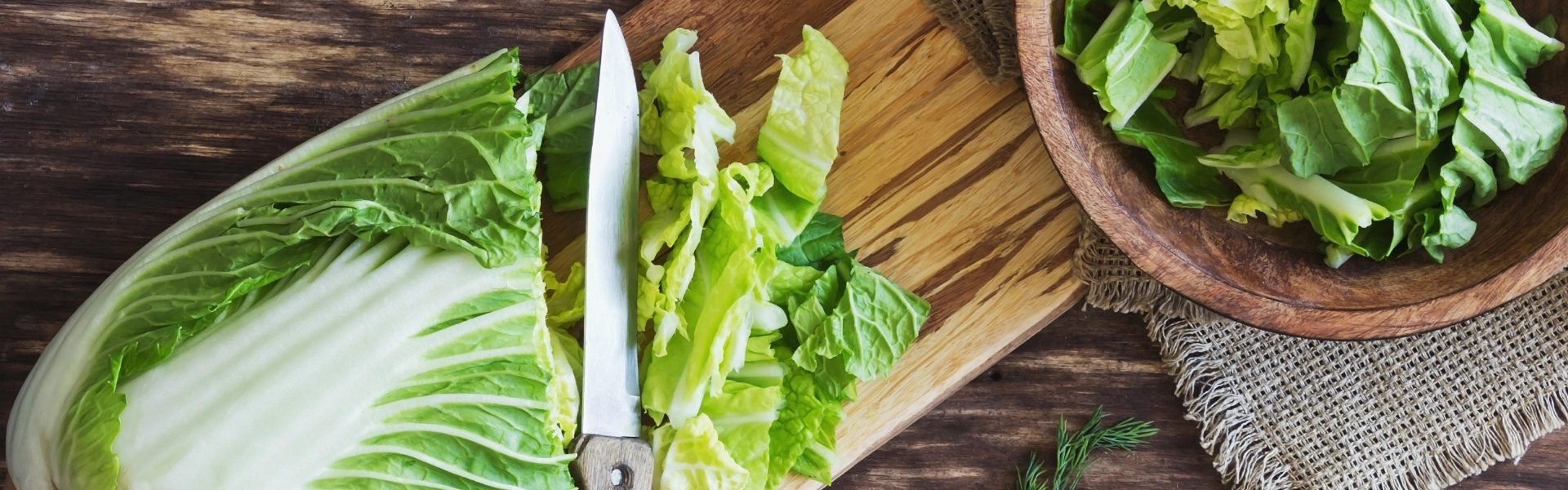
Although they all belong to the same botanical family, Chinese cabbage is only distantly related to white and hispi cabbage. The East Asian vegetable, for example, was originally created as a cross between the closely related bok choy and the turnip. In contrast to white and hispi cabbage, Chinese cabbage has no stalk. Its curled leaves can be either loose or tightly closed. In terms of flavor, it is also much milder than white and hispi cabbage and it is even quicker to cook and easier to digest than the hispi cabbage. This makes Chinese cabbage very well suited as a raw vegetable to fresh salads. It also livens up stewed, steamed or cooked dishes. Besides this, it also comes as kimchi.
In terms of its nutritional values, Chinese cabbage scores points with its high content of vitamins and minerals while being very low in calories. Chinese cabbage contains a lot of vitamin C, folic acid and potassium and is also rich in fiber. This makes it particularly suitable for a calorie-conscious diet. The water content is around 95 percent, which makes it easy to digest and particularly juicy. Thanks to its easy digestibility, Chinese cabbage is also suitable for sensitive stomachs.
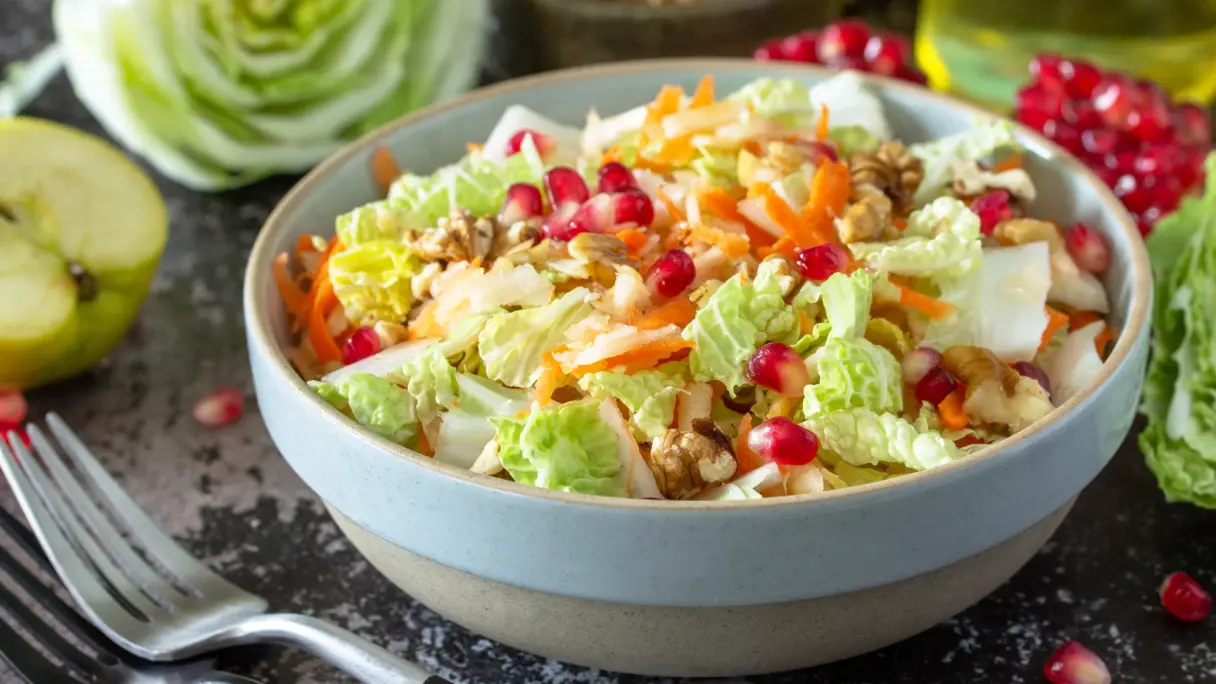
The effects of Chinese cabbage: how healthy is this vegetable?
In addition to its wonderful freshness, eating this easily digestible cabbage in its raw state has another benefit: the vitamins in Chinese cabbage are mostly preserved. In addition to vitamin C and B vitamins, cabbage also contains valuable minerals such as calcium and magnesium, although the amounts are lower than in other types of cabbage. The nutritional values of Chinese cabbage are in its large quantity of valuable amino acids, i.e. the protein components. Due to its high protein content, Chinese cabbage is particularly popular among vegans and vegetarians.
Despite the many benefits of Chinese cabbage, the following applies: to consume it in moderation and not on a daily basis. Chinese cabbage contains, like some other leaf vegetables, quite a lot of nitrate. However, the intake of nitrate can be reduced slightly by removing the stems and outer leaves before eating and by choosing vegetables which have been grown outdoors. The key to your diet Is to enjoy the colorful variety and vary the vegetable types. Chinese cabbage is definitely a valuable addition to your diet.
After harvesting or after purchase, store the heads upright so that they stand on the stalk. Otherwise the leaves may rot prematurely. In addition, to preserve its nutritional values and integrity, Chinese cabbage should be stored away from ripening fruits or vegetables. In any case, storage should be in the refrigerator. At a temperature of just above 0 °C and high humidity, such as in the Fruit and Vegetable safe of the BioFresh drawer of your Liebherr appliance, Chinese cabbage will stay fresh for up to 20 days. In a conventional refrigerator at about 7 °C, Chinese cabbage will last for about eight days. With proper storage, you can benefit from Chinese cabbage and its nutritional values for a long time.
*All specifications given are to be considered as guideline values, and depend in each case on the type of food and on the proper storage without interruption of the cold chain from harvest/production through to the Liebherr appliance. Should food products have information about minimum shelf life, the date on the packaging always applies.