Halloumi – everything you need to know about this delicious grilled cheese
Halloumi is a firm to semi-firm cheese that is particularly well suited to grilling or frying, which is precisely why it is so popular. Originally from Cyprus, this tangy grilled cheese has long since earned its place on the grill in this country too. But what exactly is halloumi? How healthy is it, and how many calories does it contain? You will also learn about the differences between halloumi and other grilled cheeses.
Storage time*
| BioFresh Meat & Dairy safe just above 0 °C with low humidity | 40 days |
| Fridge compartment 7 °C | 10 days |
| Freezer compartment -18 °C | 4 months |
The key points
- Calories: 320–370 kcal per 100 g; 22 g fat, 2 g carbohydrates, 20 g protein
- Nutrients: rich in calcium, phosphorus, B2, D and B12
- Salt content: approx. 2–3 g per 100 g; enjoy in moderation
- Heat resistance: does not melt when grilling or frying
- Milk-based: mixture of pasteurised sheep’s, goat’s and cow’s milk
- Often not vegetarian (animal rennet)
What are the nutritional values of halloumi and how healthy is it?
The nutritional values vary slightly depending on the manufacturer, but on average, the cheese contains around 320 to 370 kcal per 100 g. It contains approx. 22 g fat, around 2 g carbohydrates and 20 g protein, making it a good source of protein.
It is rich in micronutrients such as calcium, phosphorus and vitamins B2, D and B12. These are particularly essential for bones, teeth and nerve function. However, halloumi contains relatively high levels of salt (around 2–3 g/100 g), which is why it should be enjoyed in moderation, especially by people with high blood pressure.
Always store halloumi in the fridge to keep it fresh and flavourful for longer. It even stays fresh for up to 40 days in the BioFresh Meat & Dairy safe. If you value quality, you should also choose organic or original Cypriot halloumi, as these often contain less added salt.
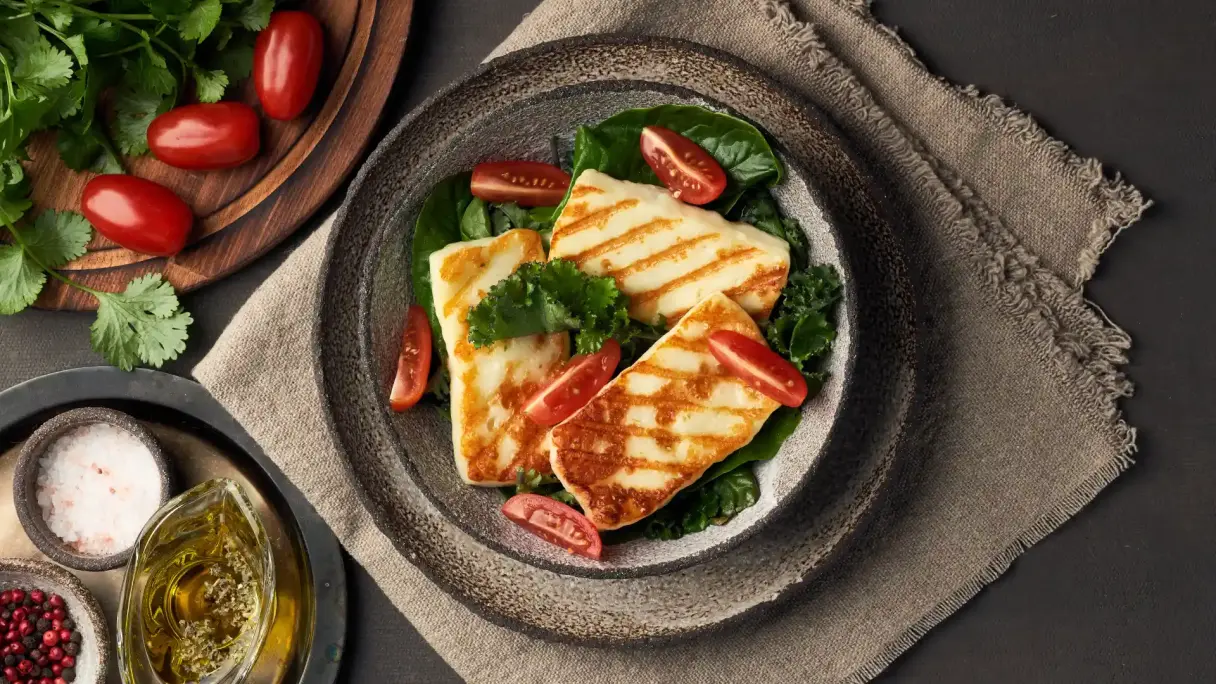
Halloumi – characteristics that make it a barbecue favourite
Halloumi is very popular as a grilled cheese because it retains its shape when grilled and does not require any additional fat, which reduces its calorie content compared to breaded cheeses. For a balanced meal, we recommend combining halloumi with fresh vegetables or salad.
Lightly salted or low-fat varieties are good alternatives for reducing calories. Soaking briefly in water before frying can reduce the salt content and improve the taste.
What types of milk are used to make halloumi?
Halloumi is usually made from a mixture of pasteurised sheep’s, goat’s and cow’s milk. Pasteurisation ensures that any germs are killed, making halloumi longer-lasting and safe to eat. People with lactose intolerance should check the milk composition on the label.
For vegetarians, it is important to know that halloumi contains animal rennet and is therefore not vegetarian.
FAQ – halloumi
Halloumi doesn’t melt because it is heated during production and then placed in brine. This changes its protein structure so that the cheese remains firm when fried or grilled. This characteristic makes halloumi ideal as a grilled cheese.
Halloumi does not need to be washed, but can be rinsed briefly in cold water before preparation to remove excess salt. If you prefer your cheese particularly mild, soak it in water for a few minutes and then pat it dry.
*All specifications given are to be considered as guideline values, and depend in each case on the type of food and on the proper storage without interruption of the cold chain from harvest/production through to the Liebherr appliance. Should food products have information about minimum shelf life, the date on the packaging always applies.