



Earthmoving
In the earthmoving product segment, Liebherr recorded €2,586 million in revenue in the 2025 business year, which translates to a €71 million or 2.7 % decrease year-on-year.
Revenue in € m from 2.657 | - 2.7% |
|---|---|
Employees from 9.430 | + 0.9% |
Revenue by sales regions
- 66.2%European Union
- 12.4%Non-EU countries
- 9.9%North America
- 2.4%Central and South America
- 3.1%Asia and Oceania
- 6.0%Africa, Near and Middle East
Strained market situation in the earthmoving segment
In the 2025 business year, the global market for earthmoving machines registered a slight upswing for the first time in three years. The cooling in the economy, alongside geopolitical and commercial considerations, had a varied impact on market developments: while the markets in Africa and Asia grew, the markets of Europe, America and Oceania all witnessed a downward trend.
This market dynamic led to Liebherr seeing differentiated growth in its sales regions. In the European Union, the Group recorded a minor increase in revenue. In what is traditionally considered the most important market for the segment, it was the contribution from Germany as a single market that was particularly felt. By contrast, non-EU countries saw a decline in revenue. In the region of Asia and Oceania, business performance was unable to maintain the previous year’s trend. On the American continent, Liebherr registered a major loss: revenue in both Central and South America and in North America fell in the 2025 business year. However, the economic region of Africa, Near and Middle East saw strong growth – primarily driven by first-time sales in the single market of Oman.
By unveiling the first autonomously operated wheel loader, Liebherr brought a world innovation to Bauma 2025, under-pinning its claim to be raising the bench-mark in terms of quality and technological innovation.
Bauma year of many innovations
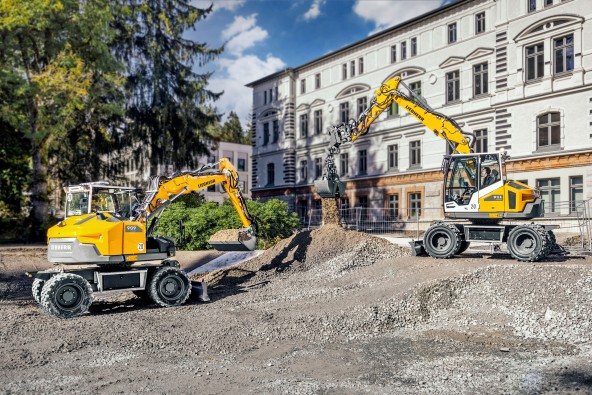
At the world’s leading exhibition for construction machines – Bauma 2025 in Munich (Germany) – Liebherr gave the public a first look at various new products and features from the earthmoving product range. In the area of wheeled excavators, the A 909 Compact and the A 911 Compact added two completely new models to the 9- and 11-tonne classes. The portfolio also saw the addition of the A 918 Compact, the first wheeled excavator of the new Generation 8. Like the two smaller excavators, this new model features the updated Intuitive User Interface (INTUSI) and the new emCab operator’s cab.
Additionally, Liebherr presented the prototype of its first electrically driven wheeled excavator – the battery-electric A 918 E. A further innovation was on display as part of the machine show at Bauma 2025 in the shape of an autonomously operated wheel loader prototype. This takes as its basis the newly developed ‘Liebherr Autonomous Operations’ system, which will facilitate driverless operation in the future. Another highlight of the business year was the Generation 6 telescopic handler. The T 48-8s model saw Liebherr take its first step in the 8-metre class, thereby expanding its product range in the industrial segment.
In terms of digitalisation, the Group launched the Skyview 2.0 assistance system for the medium and large machines of the wheel loader portfolio. The system gives the driver a 360° view around the machine, so that they can identify potential hazards early on and prevent accidents.
The current geopolitical situation and protectionist measures implemented by individual countries have had major adverse effects on global economic policy in 2026 as well. This stands in contrast to announced investments in the infrastructure and the advancement of technological innovations. In light of this area of conflict, Liebherr’s outlook for the 2026 business year in the earthmoving machine segment is cautious.