



Maritime cranes
In 2025, revenue in the maritime cranes product segment reached €1,246 million, representing a €234 million or 23.1 % increase on the previous year’s levels.
Revenue in € m from 1.012 | + 23.1% |
|---|---|
Employees from 4.152 | + 0.9% |
Revenue by sales regions
- 24.2%European Union
- 6.7%Non-EU countries
- 16.5%North America
- 8.8%Central and South America
- 20.4%Asia and Oceania
- 23.4%Africa, Near and Middle East
Resilience secures revenue growth
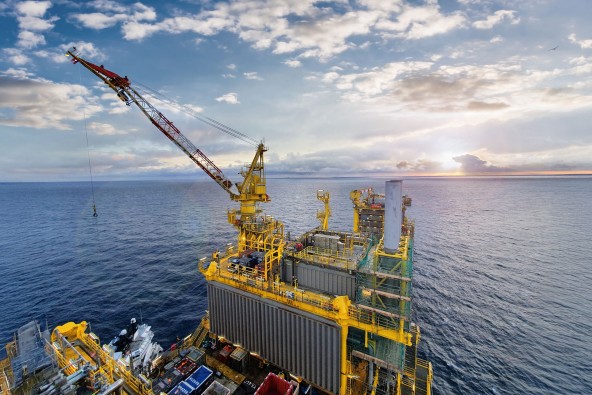
Geopolitical and economic uncertainties posed challenges for the maritime crane market in 2025. After investment activity in the mobile harbour crane segment initially fell, demand grew in the second half of the year and brought Liebherr additional market shares. The ship crane sector saw a sideways shift in freight and charter rates, which had a positive impact on the market. The global container crane market also remains robust, with the sector continuing to focus its efforts on decarbonisation, electrification and automation. In the offshore segment, stability in fossil energy operations meant increased crane needs and global demand for general purpose offshore cranes provided greater momentum than in previous years. Positive revenue development was registered in customer service through an extensive range of services, spare parts and other service products.
Liebherr proved resilient in the face of challenges. In North, Central and South America, the Group registered a significant increase in revenue, especially by virtue of the strong demand for container cranes in the USA. Despite positive results in Germany, the European Union as a whole experienced a decline in business, as did the non-EU countries. Liebherr made gains in the regions of Africa, Near and Middle East and Asia and Oceania. This was in part due to sales of container cranes in South Africa as well as ship cranes and offshore cranes in China.
Despite challenging external factors, Liebherr is determined to remain resilient and flexible, and is focusing on digitalisation, electrification and safety innovations.
Digitalisation, electrification and safety
In the maritime cranes product segment, Liebherr focused its 2025 activities on digitalisation, electrification and safety innovations. One milestone reached in this regard was the delivery of two models of all-electric ship crane, namely the CBG 500 E and the LS 800 E. With the launch of the LHM unplugged, the portfolio of mobile harbour cranes grew to include models that produce zero local emissions. Alongside electrification, digitalisation efforts were also a central focus: the Distance Alert assistance system introduces active environment detection for the first time, for enhanced safety during operation. The year also saw the extensive market launch of LiSIM move, a mobile simulator for a safe training environment away from the harbour.
The simulator is also available for use with container cranes in the form of LiSIM ROS (Remote Operator Station). Hamburger Hafen und Logistik AG (HHLA) have been supplied with one of these simulators through its partnership with the Group. This collaboration also saw Liebherr supply the company with the first batch of automated dual trolley ship-to-shore container cranes. These cranes were delivered partly assembled and raised up using a proprietary winching system by Liebherr. Furthermore, the rubber-tyre gantry crane range was enhanced to include a modular and simplified construction. The focus is on electric and hybrid models, with many hybrid models already having been delivered to customers globally.
In the offshore sector, various RL cranes (ram luffing cranes) were transitioned into the next generation. This standardisation reduces the maintenance work required and also simplifies the supply of spare parts.
At the end of the reporting year, Liebherr prepared the Sunderland site (United Kingdom) for closure. The decision is based on, among other factors, the growing demand for larger crane types, which cannot be produced in Sunderland. The production is being relocated to other factories within the segment.
Despite challenging external factors, Liebherr is determined to remain resilient and flexible, yet still anticipates a slight downturn in the maritime cranes product segment in the year 2026.