

Corporate Responsibility
Long-term responsibility
As a family-run company, Liebherr thinks in terms of generations and bases its actions on long-term success, sustainable development, stability, and reliability. These principles shape the value-oriented corporate culture and the self-image of the Liebherr Group, and are also reflected in its responsibility to employees, business partners, society, and the environment.
To fulfil this responsibility and to face both current and future challenges, the corporate responsibility activities of the Liebherr Group focus on four key fields of action: products and services, environment and energy, employees and society, and sustainable business practices.
Shaping tomorrow: Corporate Responsibility at Liebherr Appliances
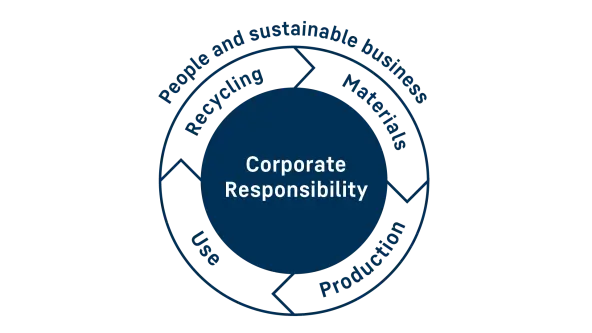
The corporate responsibility strategy of Liebherr-Hausgeräte builds on the understanding of responsibility and the fields of action of the Liebherr Group. It combines the sustainability aspects that are particularly relevant for the fridges and freezers product segment and organises them into five key areas. These provide orientation and focus our activities on topic areas where we are able to make an impact and shape developments.
From material selection and production through to the usage phase and recycling, we take into account the various effects of business activities throughout the value chain. Research and development play an important role: for decades, we have developed our products with efficiency and durability in mind and, as part of this, we take the different phases of the life cycle into account during the decision-making process. Our corporate responsibility strategy also includes other topics, such as procurement, circular economy, our employees, and sustainable business practices.
We see sustainability as a continuous process. The five key areas provide the framework for fulfilling our responsibility in the long term and the continuous development of our corporate responsibility activities.
As at: fiscal year 2025
“Our business decisions are always made in harmony with the economy, environment, and society.”
Steffen Nagel | Management Board, Managing Dir. Sales & Marketing

Materials
We are dedicated to reducing the ecological impact of our operations by preparing products for the circular economy. This means using renewable materials and recyclates while actively reducing material variety to facilitate recycling.
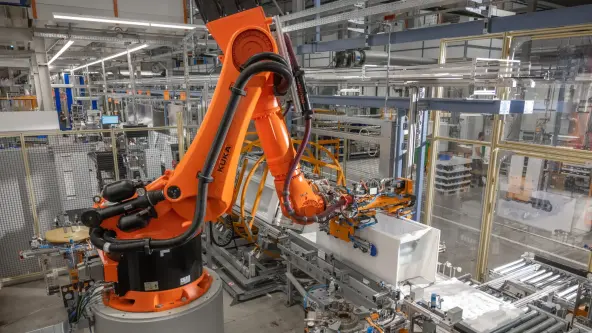
Production
Environmental aspects are an important part of our production processes. That’s why we implement measures to decrease energy consumption at our production sites and expand the use of renewable energies. We also take into consideration topics such as responsible water management, waste reduction, and measures to prevent environmental pollution.
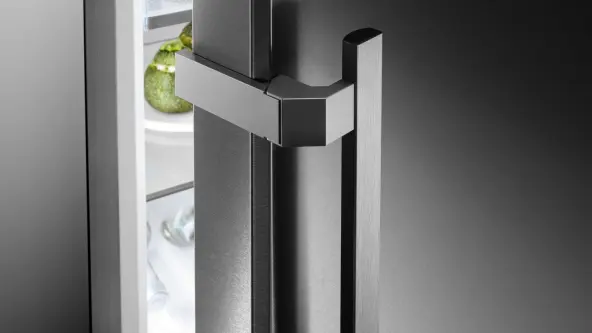
Usage
With fridges and freezers, the usage phase accounts for a substantial proportion of the environmental impact. A key factor here is the energy consumption during operation, which is affected by the useful life and usage conditions, among other things. Energy efficiency is therefore an important part of our product development. In addition, we attach huge importance to durability, storage safety, and reducing food waste.
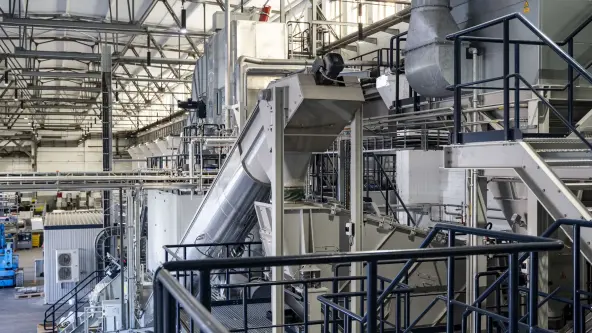
Recycling
When developing our products, we also take into consideration recyclability at the end of their life cycle. This includes, for example, using recyclable materials, reducing material complexity, and collaborating with recycling partners. By adopting these measures, we aim to support the recovery of resources and promote aspects of the circular economy.

People and sustainable business
The people at Liebherr-Hausgeräte play a decisive role in shaping our company: through their knowledge, experience, and commitment. As a family-run company with a long-term focus, we are convinced that the success of the business is inextricably linked to economic, ecological, and social responsibility. That is why we place great value on creating a working environment that is characterised by safety at work, development opportunities, diversity, and equal opportunities. At the same time, we see sustainable business practices as a key aspect of responsible corporate management. Integrity, respecting human rights, and responsible procurement practices are therefore important elements of our conduct.
Moving forward – step by step
For us, taking responsibility means continuously questioning the status quo and remaining open to new perspectives. The following examples provide an insight into selected measures, figures, and developments from our corporate responsibility activities and demonstrate how we address and develop different topics throughout the value chain.
Environment and resources
We were able to reduce Scope 1 and Scope 2 emissions across our five production sites from 36,047 tonnes of CO₂e in 2022 to 30,576 tonnes of CO₂e in 2024, which corresponds to a reduction of around 15 percent.
We have been using hydrocarbon refrigerants since 1997. Depending on the appliance, today we use different hydrocarbon-based refrigerants with GWP values (global warming potential) between 0 and 3, such as R600a. These support reliable cooling thanks to their thermodynamic properties.
We were able to reduce total energy consumption across our five production sites from 70,958 MWh in 2022 to 64,319 MWh in 2024, which corresponds to a reduction of around 9 percent.
We have been implementing different water management measures at our production sites since the 1990s. Examples of this are optimised cooling processes, reusing process water, and using deep well and rainwater systems.
Production innovations
When developing our fridges and freezers, we are continuously working to improve energy efficiency. Various products from our range already achieve the top energy efficiency classes in their respective segments, in accordance with the EU energy label. Information on energy efficiency and the annual energy consumption of individual appliances can be found on the respective EU energy label and in the product data sheet.
When we patented our BioFresh technology over 30 years ago, it consisted of one zero-degree compartment. This, being a global innovation, set an international standard in cooling.
BluRoX, our patented perlite vacuum insulation, is the result of years of research and development work. The technology combines high-performance insulation with a product design focused on recyclability, and is an excellent example of the continuous development of our refrigeration and freezing technology.
In our fridges and freezers, electronic controls and temperature sensors are used to control cooling processes as required. Functions such as SmartDevice also allow appliance settings to be monitored and adjusted remotely. For example, temperature values can be adjusted to meet individual requirements, which can have an impact on the energy consumption of the appliance.
Introduced in 2016, BluPerformance technology enhances appliance performance and comfort by incorporatinginnovativerefrigeration technology into the plinth, which resultsin increased storage capacity while maintaining the same exterior dimensions of the appliance.
Employee well-being
Our health management comprises different measures for promoting health and well-being in the workplace. These include cross-site health initiatives as well as local offers related to exercise, prevention, and ergonomics. With this, we are creating a framework designed to support our employees in different life and work situations.
Our health programme includes a wide range ofinitiatives, with a strong focus on preventativecare.
Recognitions and awards
Our Health Management has received multiple awards and quality seals at various production sites – for example, gold status in the Workfit Company Awards 2022 and the European Network for Workplace Health Promotion (ENWHP) quality seal at the Ochsenhausen site, as well as the Quality Seal for Workplace Health Promotion 2023-2025 at our Lienz site.
Training is of great importance at Liebherr-Hausgeräte. That’s why we provide opportunities to build and develop professional and personal skills. The achievements of our trainees have been repeatedly recognised by external institutions in previous years. This recognition honours their personal commitment and emphasises the importance of promoting training for our company.
Supply chain and logistics
With our production centered in Europe, 78 % of our purchasing volume also comes from within Europe to keep delivery routes short.
An environmental management system is in place at 86.5 % of our suppliers as of 2024.
95 % of lorries operate at full load capacity, improving transport efficiency and lowering environmental impact.
Corporate Responsibility documentation 2024
For more comprehensive insights, data and in-depth details, see our full Corporate Responsibility documentation.