


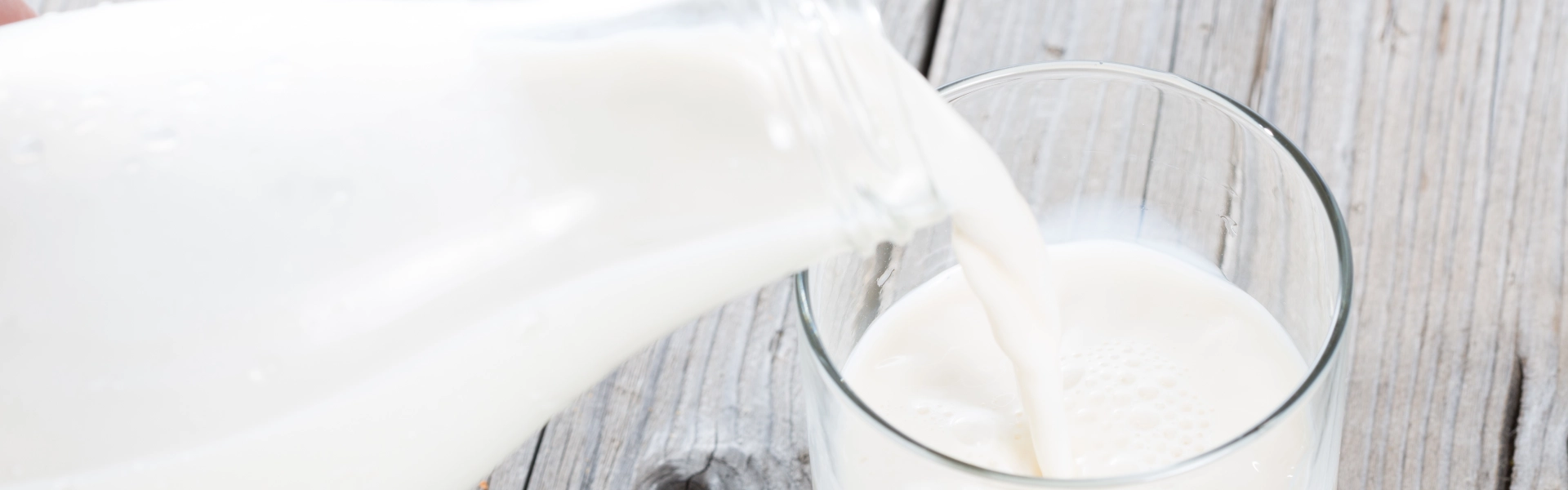
Milk – protein and fat as a source of nutrients
Milk provides nutrients such as protein, calcium and vitamin B2 and has been an integral part of our diet for centuries. Nevertheless, it continues to be a topic of debate – whether due to intolerances, varying fat content or questions about shelf life. In this article, you will learn why some people experience stomach pain after consuming milk, how fat content affects taste, and what processes are used to extend milk’s shelf life.
Storage time*
| BioFresh Meat & Dairy safe just above 0 °C with high humidity | 12 days |
| Fridge compartment 7 °C | 3 days |
| Freezer compartment -18 °C | 2 months |
The key points
- Milk provides high-quality protein that the body can easily utilise.
- Lactose intolerance is caused by a lack of the enzyme needed to break down milk sugar, resulting in digestive problems.
- The fat content mainly affects the taste, but not the nutritional value.
- Special processes and pasteurisation make milk longer lasting – once opened, it is important to keep it cool.
Lactose – stomach ache after drinking milk inevitable?
In addition to high protein content, milk contains 4.7 grams of milk sugar – also known as lactose – per 100 grams. Lactose is a so-called disaccharide consisting of glucose and galactose which has to be broken down by the body into the two components during the digestive process. This requires an enzyme (lactase). It is this which is lacking in people affected by lactose intolerance.
Instead, the lactose is broken down by bacteria in the gut – this creates gases which produce a bloated feeling and occasionally also stomach pains. We normally only have the enzyme required, to be able to break down lactose from the breast milk, as babies. However, in northern European countries, cows’ milk and milk from other mammals has been an important dietary component for a long period and as a result many people have continued to produce the enzyme. For this reason, the proportion of people with lactose intolerance in more southern countries – for example in African and Asian countries – is also much higher.
More fat content in the milk means more flavour
Cows’ milk fresh from the cow’s udder has a natural fat content of 3.8 to 4.3 %. In a supermarket however, we generally have a choice between a fat content of 1.5 % or 3.5 %. Why is this the case? Over the course of processing, the fat content is altered to the desired percentage. More fat, the more intense the flavour.
The German Association for Nutrition (DGE) recommends that adults consume 200 g to 250 g of milk and dairy products each day. This is mainly due to the high-quality protein in milk, as well as calcium and vitamin B2. The calcium and protein content of milk is independent of its fat content and processing.
From cow to supermarket – how is milk preserved?

Nowadays, the journey from the barn to the fridge is usually quite long – once milked, the milk, with all its protein and nutrients, must be preserved so that it can survive its onward journey. For this purpose, it is heated (to at least 72 °C, depending on the process, or even more) in order to kill off unwanted germs – this process is called pasteurisation. On chilled milk in the supermarket, we usually find the information “longer shelf life”. This indicates that the milk concerned is ESL milk. ESL stands for extended shelf life.
As soon as the milk is opened – regardless of whether it is fresh milk, ESL milk or UHT milk – it will generally only keep for a few days and should always be stored in the fridge. Milk stays fresh for significantly longer in Liebherr appliances, retaining all its protein and nutrients. Our BioFresh safes maintain particularly low temperatures just above the freezing point and precisely regulated humidity. These conditions significantly slow down the growth of microorganisms and the natural spoilage process. As a result, even opened milk stays fresh longer than in a conventional fridge – without any additional preservatives.
If the milk smells or tastes sour, or is thickening, this indicates an increased formation of micro-organisms. Having said that, this doesn't necessarily mean that it is hazardous to health. Groups at risk, for example pregnant women, the elderly and the sick, are advised to be on the safe side and not to consume sour milk. Others are able to check using a boiling test whether it has soured to the extent that it is no longer appropriate to use for cooking or baking. To do this, boil up some milk in a saucepan – if it curdles then it is no longer fresh.
*All specifications given are to be considered as guideline values, and depend in each case on the type of food and on the proper storage without interruption of the cold chain from harvest/production through to the Liebherr appliance. Should food products have information about minimum shelf life, the date on the packaging always applies.
*All specifications given are to be considered as guideline values, and depend in each case on the type of food and on the proper storage without interruption of the cold chain from harvest/production through to the Liebherr appliance. Should food products have information about minimum shelf life, the date on the packaging always applies.