Storing radishes, freezing them and enjoying them for longer
Crisp, sharp and intense in flavour – that's radishes. The small tubers are not just delicious, they’re also a real power food. This article will teach you how to store radishes so that they stay fresh and full of vitamins for as long as possible.
The key points
- Radishes are best stored in the fridge. Because they stay fresh for longest at low temperatures and high humidity:
- by not drying radishes and placing them still moist in an airtight container in the fridge, you create a higher humidity, meaning that the tubers stay crisp for longer.
- Do not store the root vegetables in a bunch, and remove the leaves.
- In a normal fridge compartment at around 7 °C and low humidity, radishes will stay fresh for 2 days.
- In the BioFresh Fruit & Vegetable safe of a Liebherr fridge at around 1 °C and high humidity, radishes will stay fresh for 10 days.
- Because of their high water content, radishes can become mushy and have a glassy consistency when frozen and thawed again.
Storing radishes
Like most vegetables, you should use radishes as soon as possible after buying or harvesting them. This is when they are particularly aromatic and crunchy. But if you store your radishes properly, you can keep the root vegetables wonderfully fresh for a few days longer. Make sure you choose plump, fresh specimens when you buy them, because these last much longer than cracked, soft ones. And remember, the fresher the leaves, the fresher the tubers.
It’s better to cut the leaves off the radishes before storing, as otherwise the tubers lose moisture and become soft more quickly. Tip for using leftovers: the leaves can also be eaten and are a wonderful addition to a mixed salad, smoothies or pesto. Wash the seasonal vegetables to remove any soil that has stuck to them – running water is sufficient for this. You should refrain from using a water bath so as not to wash out any nutrients.
Before storing your radishes, sort out any spoiled tubers. You can recognise these by their wrinkled or cracked surface, brown spots and wilted, discoloured foliage. You can test the hardness by poking them with a finger. If the radishes are mouldy or badly spoiled, they should be discarded. Tubers that have only softened a little can be pepped up again with a brief salt bath. To do this, add the seasonal vegetables to a large bowl containing half a litre of water and a teaspoon of salt to create an isotonic solution. After a few hours, the tubers will be crisp and fresh again, but some nutrients and flavour may be washed out at the same time.
Storing radishes in the fridge
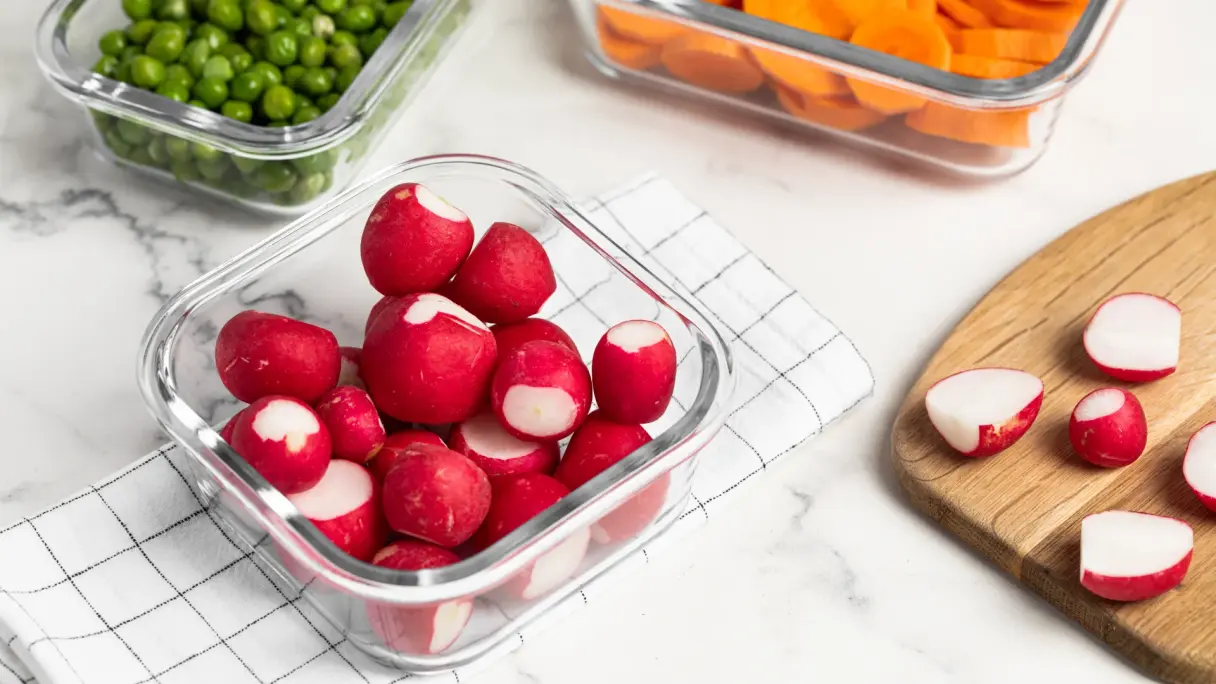
Radishes are best stored in the fridge Because they stay fresh for longest at low temperatures and high humidity:
- in a normal fridge compartment at around 7 °C and low humidity, radishes will stay fresh for 2 days.
- In an EasyFresh safe from Liebherr at around 7 °C, the moisture in the radishes is retained in the safe thanks to the airtight seal. This keeps them fresh for up to 3 days.
- In the BioFresh Fruit & Vegetable safe of your Liebherr fridge at around 1 °C and high humidity, radishes will stay fresh for 10 days.
If you want to store your radishes in the fridge, the first step is to wash the seasonal vegetables to remove any soil that has stuck to them.
Storage tip for fridges without BioFresh safes, which provide the optimum temperature and humidity for radishes and many other types of fruit, vegetables and other foods:
By not drying radishes and placing them still moist in an airtight container in the fridge, you create a higher humidity, meaning that the tubers stay crisp for longer. Alternatively, you can wrap your radishes in a damp cloth. Regularly top up the water in the food storage box or re-dampen the cloth. This will allow you to prolong the shelf life, because water loss is what makes radishes start to shrivel in the first place.
The leaves of the radishes should be removed after buying or harvesting. This is because after harvesting, the leaves wither after about two days and then draw the moisture out of the radishes, making them wizened and soft.
Freezing radishes
Fresh radishes are most suitable for eating raw or as a spicy topping in salads. Defrosted radishes are especially good in cooking and soups.
Because of their high water content, radishes can become mushy and have a glassy consistency when frozen and thawed again. To waste less food, it still makes sense to put radishes in the freezer to store them for longer. You should make sure to freeze only fresh radishes.
To keep radishes in a chest freezer, first remove the leaves and any remaining roots. Then clean the tubers under running water. To avoid them sticking together, dry the radishes carefully. You can then put the radishes as whole tubers in an airtight, freezer-safe container or freezer bag.
Deep-freezing alters the consistency of the tubers, which contain water. Using the correct method for defrosting ensures that the taste and appearance are not further affected. To avoid them drying out, place the frozen tubers in a water bath at room temperature. The thawed radishes will typically be glassy and taste watery. This is normal and not a sign of spoiling or incorrect freezing. You can still whip up excellent recipes from the thawed radishes.