In Germany, there are legal limits on pollutant levels in industrial exhaust gases. Previously, higher limits were permitted if the pollutants were already present in the processed raw materials. This applied, for example, to cement works. With the KAREm project, Holcim has decided to further develop its flue gas treatment system so that this exemption will no longer need to be invoked in future. The project name KAREm stands for ‘No exceptions for raw material-related emissions’.
Flue gas treatment is energy-intensive
In the cement industry, flue gas treatment is usually carried out using thermal processes that require additional energy. In Dotternhausen, it has been demonstrated that a specialised oxidation catalyst system offers a more efficient, site-integrated solution. SCR (Selective Catalytic Reduction) is used to reduce nitrogen oxides. In addition to nitrogen oxides, the plant also catalytically converts volatile organic compounds and carbon monoxide (RCO, Regenerative Catalytic Oxidation). The catalytic process does not require the 850 °C heat generated by natural gas combustion, but manages with around 300 °C. This temperature is available in Dotternhausen as waste heat from the rotary kiln.
Georg Lechner from the plant manufacturer Scheuch explains the favourable conditions for this approach in Dotternhausen: “The raw material from the Plettenberg quarry contains only small amounts of substances such as sulphur, which would impair the catalytic processes. Furthermore, the raw material is relatively dry, meaning that the kiln’s waste heat is available for the catalysts used in flue gas treatment. With moister lime, the energy is primarily used for drying the raw material.”
A challenging construction site
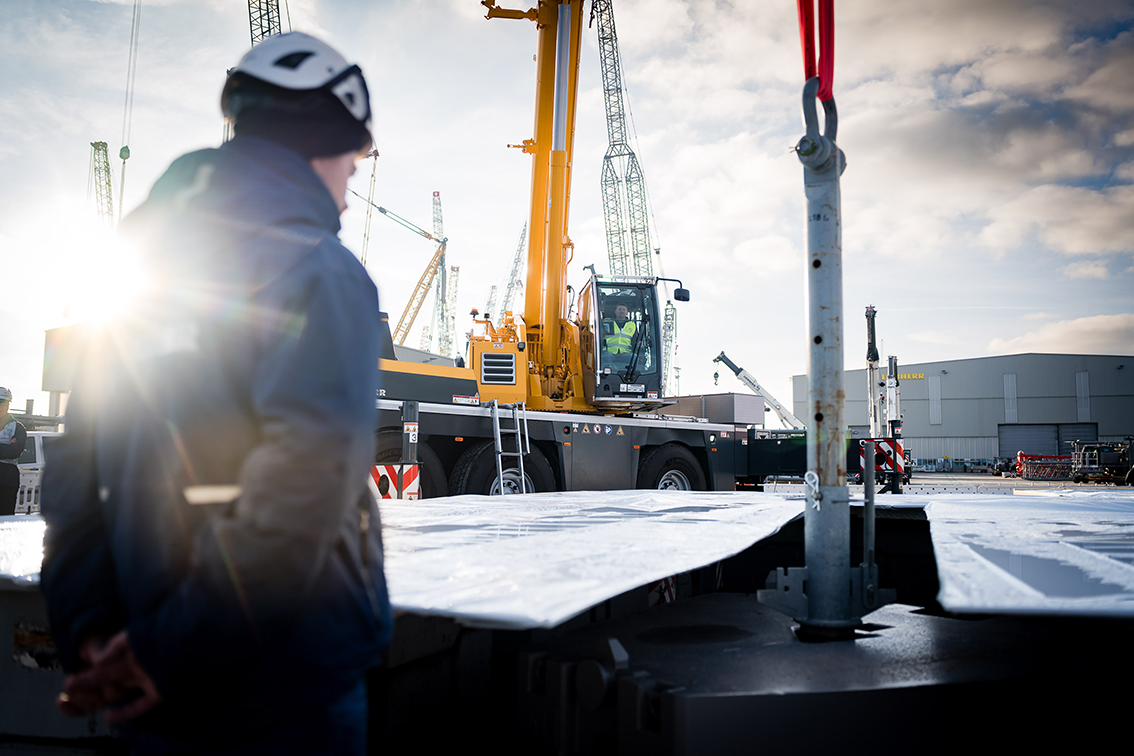
Following several years of planning by Holcim and the plant engineer Scheuch, old factory buildings that were no longer required were first demolished to make way for the KAREm plant. Parts of the future plant site had basements, and additional support pillars had to be installed. A total of around 2,000 tonnes of steel is being used in the plant. Various Liebherr cranes with lifting capacities of up to 400 tonnes are being used for the steelwork and plant construction.
Precision work with 33 tonnes
The most spectacular lift involved installing two pipes up to 38 metres long and 2 metres in diameter. The Liebherr LTM 1650-8.1 mobile crane, operated by Wiesbauer from Bietigheim, was used for this task. Project manager David Neher explains: “The 700-tonne crane was configured with 155 tonnes of counterweight and a 42-metre luffing jib to lift the pipes, each weighing 33 tonnes, into the plant at a height of 30 metres with a 39-metre reach.” This required a great deal of finesse, as crane operator Ralf Hoffmann explains: “The two pipes had to be threaded under an existing pipeline on one side. There was then only a few centimetres of space left for the slings. During the lift, the second pipe – running parallel to the first – obviously had to avoid colliding with the one already in place. Thanks to the precise LICCON control system and professional guidance from my colleague Jannik Weigle, however, it all went smoothly despite the wind.”
Why are the pipes so thick? “The thicker the pipes, the lower the flow resistance, and the less power is needed to pump the flue gas through the pipe,” says Michael Obermailänder, project manager at Holcim. So here, too, everything is geared towards energy efficiency.
Utilising existing process heat
The process combines catalyst-based exhaust gas purification with the utilisation of existing process heat. The system therefore operates without external fuels and the associated CO₂ emissions. Furthermore, the plant’s cooling water requirements are reduced, and electricity and district heating are generated for surrounding communities. Obermailänder sums up: