


Liebherr undercarriage solutions: the foundation of performance
Millions of operating hours in a wide range of mining environments have shaped Liebherr’s undercarriages. We spoke with Robin Florence, Liebherr Mining’s product manager for service, to better understand how extensive field experience helps us engineer undercarriage solutions for reliability in demanding mining conditions.

Robin Florence has been product manager for Liebherr Mining’s service department since 2023. Before that, he spent six years supporting Liebherr’s D98 mining engine range in engineering, technical support and key account management roles. In his current position, he is responsible for the Mining Service portfolio, which includes support and parts for Liebherr mining equipment. As undercarriage solutions are an important part of this portfolio and Liebherr's scope of supply, we invited him to share his perspective on what makes Liebherr's undercarriage solutions so effective.

Robin Florence, product manager, service, Liebherr-Mining Equipment Colmar SAS
What does it mean to offer a complete undercarriage solution?
For us, offering a complete undercarriage solution means supporting customers through the entire undercarriage life cycle. We take the time to understand each customer’s operating conditions and challenges then deliver a tailored solution that can include components, logistics, installation, servicing and complete system refurbishment.
Our global service network helps with this. Through that network, our customers have access to personalised, ongoing support and solutions that can include our modular maintenance and remanufacturing programs as well as genuine Liebherr components and retrofit options. By bringing these services together, Liebherr helps customers extend undercarriage life, maintain machine availability and manage total cost of ownership. Undercarriages and wear parts account for a significant portion of a machine’s life cycle cost – up to 25%, depending on the application and operating conditions – which has a direct impact on total cost of ownership. Their performance also impacts machine availability and the frequency of planned and unplanned shutdowns.
Why do we tailor undercarriage track components to each application?
Operating conditions vary significantly from one mine to another. But our undercarriage track components must perform in any environment. This is why they are defined as per machine size and optimised following customer requests and site conditions.
Liebherr has extensive experience across mining excavators with operating weights from 100 to 800 tonnes. This is what has enabled us to design specific track components for our ultra-class machines. In fact, we have a patented design for the track chain of the R 9600 excavator to optimise contact pressure, which results in better operational control, lower wear rates and increased component life.
How do we customise our complete undercarriage solutions so they suit each customer?
Liebherr engineers work closely with our regional sales and service companies as well as our customers so that they have direct visibility of how machines and components perform in real mining conditions. Rather than relying on a standardised design approach, engineering decisions are continuously informed by field inspections, customer feedback and operational data from mines around the world. This close collaboration enables continuous design improvements and the development of solutions tailored to mining operations.
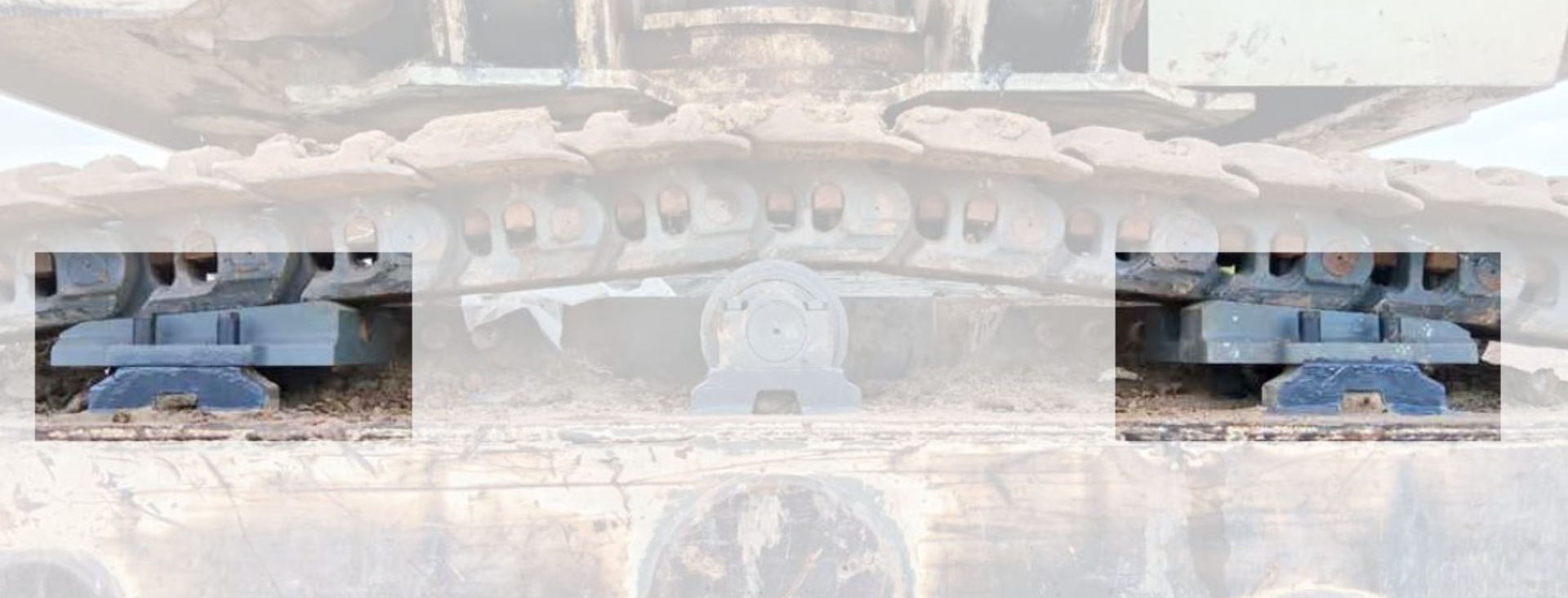
These sliders help this R 9200 excavator to travel more easily in Indonesia’s muddy conditions
For example, we have numerous customers working with R 9200 excavators in Indonesian coal mines where, due to the intense rainfall in these areas, mud is a real problem. This accumulation of mud blocks the carrier roller, resulting in premature failure. To solve this issue, we introduced a specific configuration with a large single carrier roller combined with two sliders that helps our excavators to run smoothly in these muddy environments. This gives peace of mind to customers using our R 9200 undercarriages and illustrates why our familiarity with the field conditions our machines work in allows us to offer the best solutions.

Our patented track chain design for the R 9600
How do we ensure our undercarriages solutions can withstand the harsh conditions often found on mine sites?
It's vital that our undercarriage track components are as durable as possible. Not only are these the most heavily loaded components in a mining machine, but they also represent a significant share of life cycle costs. Each and every component – from chains and rollers to shoes and frames – must perform under extreme loads and abrasive conditions. To reach this level of performance, our engineering team analyses customer feedback from millions of operating hours in the field to continuously improve our design. This approach has helped us to achieve significant milestones, such as some of our ultra-class excavators exceeding 30,000 operating hours in coal mine applications.
Another key factor influencing undercarriage life is heat treatment. Liebherr continuously refines its induction hardening processes to maximise the depth of the hardened layer in critical wear components. This hardened surface provides the high wear resistance required in demanding mining applications. By extending the depth of this protective layer, components maintain their performance for longer before wear reaches the softer core material, which can contribute to a longer service life. This is one of the areas where Liebherr's engineering and manufacturing expertise can make a tangible difference compared with many aftermarket alternatives.
What is the direct impact for customers?
Improving the durability of undercarriage track components reduces maintenance costs and increases machine availability across the equipment life cycle. But durability is only one piece of the life cycle cost puzzle. To further reduce these costs, we also offer a range of remanufacturing options for key undercarriage wear components in our 400- to 800-tonne excavators, such as travel drives, sprockets, carrier rollers, bottom (track) rollers and track tensioning systems comprising idlers, grease tensioners and hydraulic cylinders. Remanufacturing wear components during maintenance, rather than buying brand-new ones, can reduce replacement costs for our customers while delivering high levels of performance.

How are our undercarriage track components maintained?
Because we take a modular approach to the design of our undercarriages, maintenance teams can handle the undercarriage as a complete unit, rather than as dozens and dozens of discrete track components and parts. In regions where our modular maintenance program is available, this means that complete undercarriage modules can be removed for refurbishment, while a fully remanufactured one is walked in underneath the machine. Not only does this save on downtime, but it also makes it possible for maintenance personnel to schedule servicing around the site’s production requirements.
Our standard approach to this service is to refurbish the modules at the local Liebherr branch. But this isn’t always feasible, particularly for customers in the most remote locations. We recently worked with a customer in Indonesia who was interested in modular maintenance for the track frames of the four R 9350 excavators in their fleet. But because of the remote location of their site, transporting the track frames to and from the local branch just wasn’t practical. So, rather than sticking to our usual process, we found a way to adapt it to suit their needs – which meant doing the refurbishment on site. To accomplish this, the local Liebherr team provided the technical expertise and spare parts needed to ensure the refurbished track frames were restored in line with Liebherr quality standards.
To further simplify maintenance, we’ve also developed pre-assembled components, such as track roller frames for the PR 776 dozer. Much like the machine modules in our modular maintenance program, these components can be removed, reconditioned and replaced as complete units, rather than being handled as individual parts. This allows a previously refurbished component to be installed immediately so the machine can get back to work sooner, while the removed component is reconditioned for future use.
These maintenance approaches, combined with our global network of technical specialists, service teams and spare parts support, mean we can provide our customers with the knowledge and resources they need, whenever they need us.
Published October 2026