


Measuring on a higher level
Take a breath. Feel your lungs expand, the invisible air rushing in. That simple act ties you to a rainforest thousands of kilometres away – the Amazon. It is not just trees and rivers; it is a living regulator of the planet’s breath and yours.
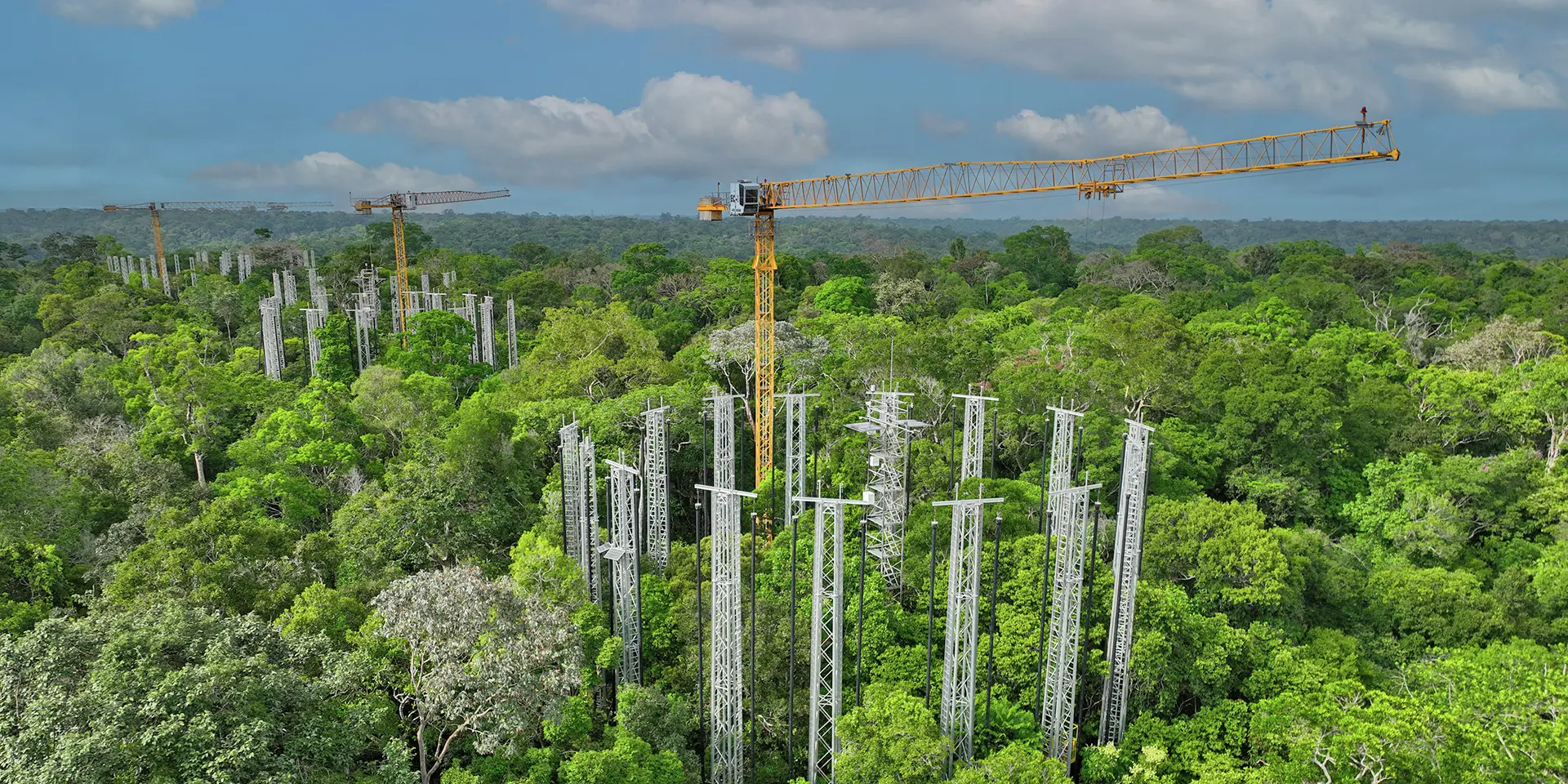
But as carbon dioxide levels rise to heights unseen in human history, scientists are asking: can the Amazon keep absorbing and recycling carbon at the pace our survival demands? To find answers, researchers launched the AmazonFACE programme in 2014, with the infrastructure completed in 2025, creating a pioneering experiment deep inside a protected section of rainforest dedicated to scientific research, near Manaus (Brazil). Step deeper into the forest and look up: six steel rings rise above the canopy.
Inside each ring, 16 towers release carefully controlled amounts of carbon dioxide, raising the concentration inside the ring to levels expected several decades from now. The forest within the circle remains completely intact — no trees cut, no soil disturbed. Inside and around the rings, hundreds of sensors track how the forest responds.
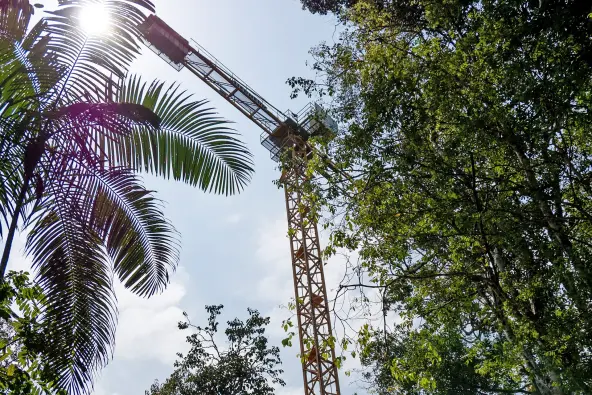
To reach the treetops and collect vital measurements, scientists and researchers rely on the steady ascent of the Liebherr tower cranes on site. Each 45-metre ascent carries knowledge and data that could decide the Amazon’s fate.
This video only contains an AI generated narrator voice.
Choose your path
The Amazon is vast, ancient and fragile. Its billions of trees and millions of people sustain life locally and globally. If it falters, the upheaval will be felt everywhere.
This story does not unfold in a straight line. Like the forest itself, it opens into many paths. These paths exist because so many stand together: scientists and researchers from the AmazonFACE team, government organisations from Brazil and the UK, universities, funders and institutions such as the National Institute of Amazonian Research (INPA), Unicamp and the Met Office.
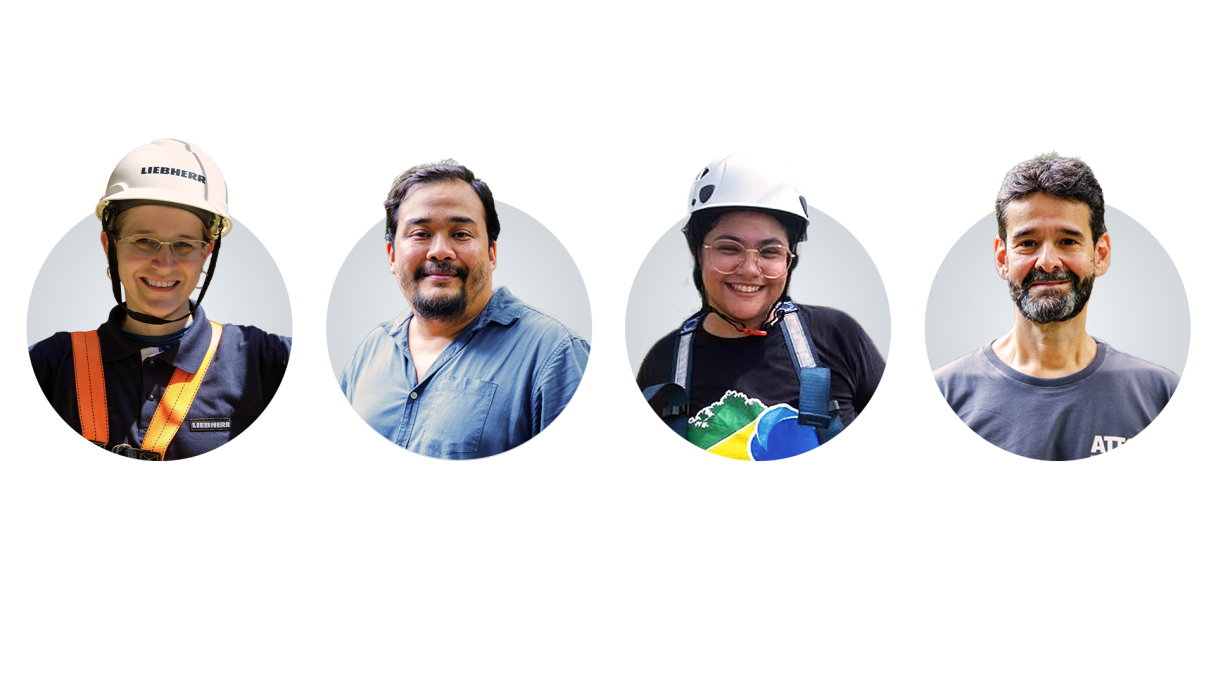
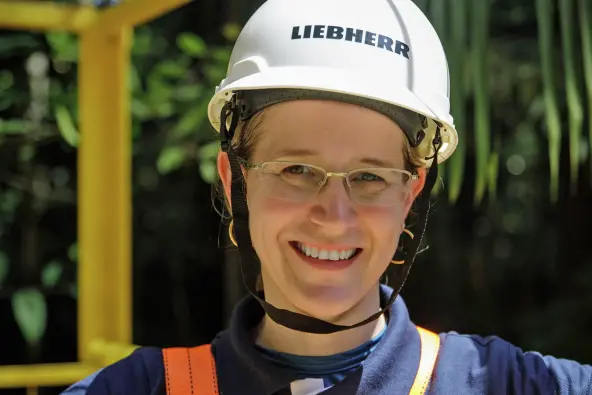
Bruna Prisco, application engineer, Liebher Brasil LTDA
Her children weren’t sad that she was leaving for the Amazon. They were sad they couldn’t come along. Bruna Prisco, an application engineer working at Liebherr in Brazil and mum of two children, told her son and daughter about the significance of the AmazonFACE programme. The cranes she works with will not be lifting steel or concrete, but engineers like herself and scientists, carrying them high above the forest floor to study the future of the rainforest. As a child, Bruna dreamed of many careers: from an aeronautical engineer to a transportation business owner, to a maths teacher, but always something rooted in the exact sciences.
Now, standing at the edge of the Amazon, she feels those childhood dreams have converged into something far greater. ‘The first time I heard about this project, my thought was ‘‘Wow!’’ Because it’s a totally unusual use for crane operators.’ For her children, who already love cranes and dream of construction machines, it sounds like the adventure of a lifetime.
Workdays without a script
Bruna is 37 years old and comes from Guaratinguetá, a smaller city in the interior of São Paulo that is also home to Liebherr Brasil LTDA. With a population far smaller than the vast metropolis of São Paulo, her hometown gave her a grounding in community and perseverance. Her professional journey began at 15 with a technical course in mechanics, followed by a degree in civil engineering from UNESP, or São Paulo State University and later postgraduate studies in project management.
She joined Liebherr in 2013, drawn by the chance to combine her civil engineering background with mechanical expertise. Over the years she has become the first point of contact for clients in tower cranes after sales. Bruna’s workdays rarely follow the script. She relishes the rhythm of change and having to adapt to shifting priorities. ‘A typical day is usually atypical, because we arrive with one task in mind and during the day other demands arise, often more urgent than the demand I had in mind.’
More than machinery
Bruna’s role in the AmazonFACE programme shows her that cranes can serve purposes far beyond construction. ‘Here in the Amazon rainforest, the use of the cranes is so that scientists can study nature conservation more efficiently. The four Liebherr 85 EC‑B 5b tower cranes were chosen precisely because they can withstand the extremes of heat and humidity and not disturb the habitat.’ Daytime temperatures regularly reach 31-33°C, with humidity close to saturation, and heat waves can push above 35°C. The cranes’ flat-top head design eliminates the traditional A-frame, reducing height above the jib and allowing multiple cranes to operate in close proximity without interfering with one another — a critical advantage in the dense rainforest canopy. The compact design also protects critical systems, while corrosion-resistant materials ensure reliability in the wettest climate on Earth. With frequency controlled drives providing smooth, vibration free lifting and slewing, sensitive scientific instruments can be transported safely through the forest layers to measurement height.
Equally important, the cranes occupy a minimal ground footprint, reducing their impact on the forest floor to the lowest possible level. This was vital for AmazonFACE, where preserving the surrounding ecosystem is as important as conducting the science itself.
Bruna plays a key role in preparing crane operators for success. She organises training sessions at Liebherr Brasil LTDA and on-site in the rainforest, ensuring operators are equipped with the technical knowledge and safety skills needed to work in such challenging conditions. For her, this task is more than technical; it reflects the same empathy and dedication she brings to every part of her life. Her expertise is deeply connected to her love of nature, whether cycling, hiking or simply being outdoors. ‘I feel extremely proud to have contributed to this application. It is what I will carry with me for the rest of my life and tell everyone – my children, my relatives and my friends.’
Bruno Takeshi - operations lead, AmazonFACE programme
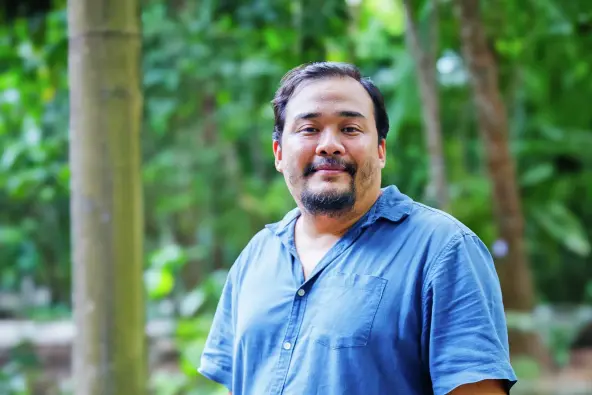
Bruno Takeshi remembers the moment he realised the Amazon was changing. Rainfall patterns that once seemed eternal became chaotic. Heat waves grew relentless. Droughts arrived too often. Fires crept into areas that had never burned before. The forest of his childhood, the one he dreamed of studying, was no longer behaving like the stable ecosystem the world depended on. ‘Some phenomena that occurred very rarely began to be very frequent. The entire climate of the region started to become very abnormal.’
From an early age, Bruno was captivated by one question: what does the Amazon truly mean for the world? As operations lead of the AmazonFACE programme, he now steers one of the most ambitious scientific efforts ever undertaken in the tropics. The programme was created by the Brazilian Ministry of Science, Technology and Innovation with a single purpose: to discover how resilient the Amazon truly is in the face of climate change.
For decades, researchers only had mathematical models to guess how the forest would react in the future. Through controlled experiments, Bruno and his team generate forecast data that offers a glimpse of the forest 30 to 40 years into the future.
Reaching the treetops for the first time
When Bruno finally rose above the treetops in a Liebherr crane, it felt like flying. The sun was setting, vapours were rising from the forest floor and he saw clouds forming directly from the trees. ‘It was a once-in-a-lifetime experience. A magical moment in my career.’ Below him, waves of treetops moved like a living sea. At sunset, golden light revealed vapours rising from the forest, drifting upward in slow spirals. These were the beginnings of the ‘Flying Rivers’, the invisible highways of moisture that feed up to 30 % of the rain falling over central and southern Brazil.
Before the cranes, no one could safely reach the canopy to study its processes. Now, Bruno and his team capture daily measurements on photosynthesis, water transport, energy exchange and plant hydraulic behaviour across different canopy layers. With this access, the AmazonFACE team of over 150 specialists is uncovering how the ecosystem truly works.
Let the data guide us to keep the Amazon rainforest intact, support community stewardship, choose deforestation-free supply chains and sustain open monitoring and thoughtful restoration. With patience and respect, the forest will keep working for everyone.
Understanding the stakes through science
AmazonFACE allows scientists to observe how rising CO2 at global atmospheric levels affects plant growth, leaf survival and water transport and how evapotranspiration sustains the ‘Flying Rivers.’ ‘Twenty-five to thirty per cent of the rain that falls in the Midwest and Southeast of Brazil comes from water vapour generated in the Amazon.’
More than 15 international research partners rely on its findings to guide climate discussions, including Brazil’s scientific contributions to COP30. Bruno carries a profound responsibility: the data generated today will help guide political decisions, shape conservation strategies and influence the future of entire populations. His message is clear. The Amazon must remain standing. The world depends on it more than most people realise. ‘AmazonFACE is a laboratory with doors open to the open sky in the forest, remote yet essential to understanding global science.’
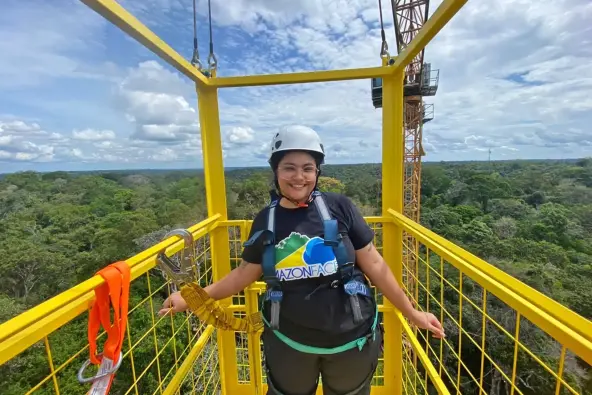
Civil engineer Maria Juliana Monte never expected that her career would pull her away from the typical construction site in the city and place her deep inside the Amazon rainforest. She describes it as ‘an environment where traditional construction machines do not fit easily,’ a place where everything she knew about engineering was redefined by nature. When she began a Master’s degree in Climate and Environment at the National Institute for Amazonian Research (INPA), she studied forest dynamics. A new path opened up. That programme led Maria Juliana to a field discipline that required visiting a forest reserve, an experience that, as she puts it, ‘made me understand its behaviour better.’
Although she was born and raised in the Amazon, working within the forest changed the way she understood her home. ‘You don’t expect to be so close to the forest. And then I’m working within it … you can understand its real importance very well.’ Through AmazonFACE, she began to see the rainforest not only as a place of childhood memories but as a global and regional climate regulator, essential for society’s future.
Maria Juliana Monte – site engineer, AmazonFACE programme
The eighth wonder
The Amazon is a constant source of awe for Maria Juliana and much more than a workplace – it is, in her words, ‘one of the most beautiful things in the world, the eighth wonder of the world.’ Even after many climbs, the feeling remains the same: ‘standing above the canopy, seeing the sheer magnitude of a single tree and the vast green immensity around it. Every ascent is another chance to marvel at the Amazon and the cycles that shape it.’
One of her most powerful memories happened in the rainy season. After slipping through difficult trails with the hydrology team, she questioned why she came – until the rain started. ‘In the forest, the rain is very real. I looked up and saw the water coming out of the trees almost immediately. It felt like a reward for the difficulty I’d just gone through.’ These moments cemented her belief that her path into the forest wasn’t accidental: ‘I never imagined working in the forest, but I think it was fate that brought me here.’
To contribute to the conservation of the rainforest, carry the forest into your daily routine. Repair, reuse and pick durable goods over disposable ones. Less demand for quick replacements means fewer trees are felled.
Keeping the forest alive for the world
Today, Maria Juliana is the site engineer responsible for the CO2 enrichment system, the heart of the AmazonFACE experiment. She oversees everything from the injection system to campaign logistics, ensures safety and supports researchers who arrive to study the forest’s behaviour. ‘My role is to embrace everyone and make the experiment flow really well, enough so the world begins to see what I see every day.’
From root growth to leaf photosynthesis, from soil respiration to micrometeorological instrumentation, she keeps the forest-scale experiment running so scientists can understand how the Amazon responds to rising CO2. And she knows exactly what would change if more people could witness what she sees: ‘If people could see what I see in the forest every day, they would understand it as a place of survival, where food, health and daily life depend on its harmony. The Amazon is not a distant wilderness but a living home.’
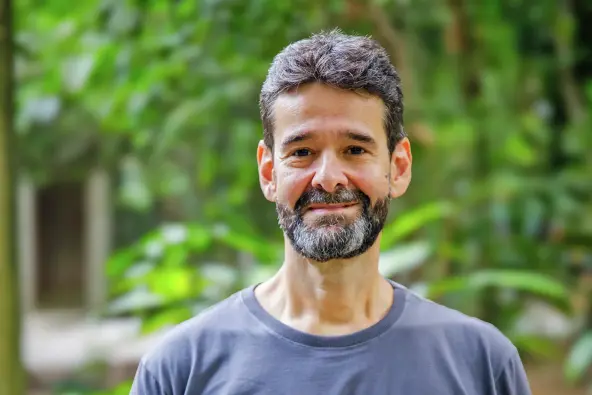
Growing up in the savannah of Central Brazil, Carlos Alberto Quesada – known as Beto – spent his childhood steeped in profound curiosity about nature. While his family focused on crops and cattle on their farm, he found himself transfixed by the ecosystem around him – the rhythms of soil, plants and climate. That fascination became a lifelong calling for ecological sciences. ‘The Amazon was always on my mind, calling me. At the first opportunity I had, I left the savannah and came to the rainforest.’ Studying forestry engineering and later pursuing a PhD, Beto realised how tightly vegetation and climate are bound together.
Small changes in rainfall or temperature could trigger cascading effects across ecosystems, altering the balance of the planet itself. This awareness shaped his career as a soil scientist, probing the hidden layers beneath the forest floor. Roots, fungi and microorganisms became his focus, because they hold the key to whether the Amazon can withstand rising carbon dioxide. Nutrient limitations such as phosphorus, nitrogen and others may decide whether the forest grows stronger or falters.
Carlos Alberto Quesada - senior researcher, AmazonFACE programme
The forest as a time machine
As Beto dives into the complexities of climate science, he acknowledges a pressing urgency: ‘We have the ability to understand processes that lead to understanding these impacts.’ Through the AmazonFACE programme, the Amazon transforms into a time machine, enabling scientists to simulate future atmospheric conditions. Beto warns that the local climate is changing, highlighting shifting rainfall patterns and rising temperatures. ‘The impacts lead to an impact on humanity as a whole,’ he emphasises, reminding us that the Amazon's fate is deeply intertwined with our own.
His research probes the question of whether extra carbon will genuinely help trees thrive. While increased photosynthesis might occur, without nutrients, trees cannot convert carbon into lasting growth. The Amazon has already lost 30 % of its carbon absorption capacity over the past three decades. Beto’s work traces these fragile pathways, exploring how photosynthesis connects to soil chemistry. Each measurement he takes offers a preview of the Amazon’s potential futures – a forest that endures and renews or collapses.
Protect the forest by tending the soil under your feet. Garden peat-free, compost food scraps and choose slow-release fertilisers. These choices keep carbon and nutrients cycling so that the Amazon can endure.
A flicker of hope
In the midst of this daunting reality, Beto finds a glimmer of hope. The potential for trees to adapt to increased CO2 in the atmosphere intrigues him. ‘With more CO2, it is possible that trees will become more productive and use water more efficiently,’ he muses, envisioning a scenario where the forest's resilience could be bolstered, allowing it to withstand the anticipated droughts.
However, he remains mindful of the uncertainties that lie ahead. ‘We are at a crossroads,’ he reflects. Will we find in the experiment a little more energy for the Amazon, so that it can hold out a little longer? Beto's journey reveals that while the challenges are immense, there is still a chance for the Amazon to flourish, provided we act with urgency and intention. ‘Science gives me a little hope,’ he concludes, reminding us that through understanding, we can still chart a path towards recovery and sustainability for this vital ecosystem and our world.
Top 5 facts about the Amazon rainforest
Contains 390 billion trees across 16,000 species – more than half of the world’s remaining rainforests
Spans 5.5-6.7 million km2 across nine countries, with 60 % in Brazil
The Amazon’s ecosystems have been evolving for over 55 million years
30 million people, including 2.2 million Indigenous peoples from over 500 groups, depend directly on the forest for food, medicine and livelihoods
Ecosystem services valued at trillions annually


Transparency note
The tower cranes used in the AmazonFACE programme were acquired based on technical and operational criteria, aimed at meeting the specific infrastructure needs of the experiment. The mention of Liebherr-branded equipment is purely informative and does not represent any form of institutional, commercial, or reputational endorsement of the company or its corporate practices. The AmazonFACE programme, which is scientifically coordinated by INPA, Unicamp and the Met Office, and supported by the Brazilian and UK governments, remains committed to science, transparency and integrity in all its actions.