

5 minutes - magazine 01 | 2026
Sophisticated bridge construction
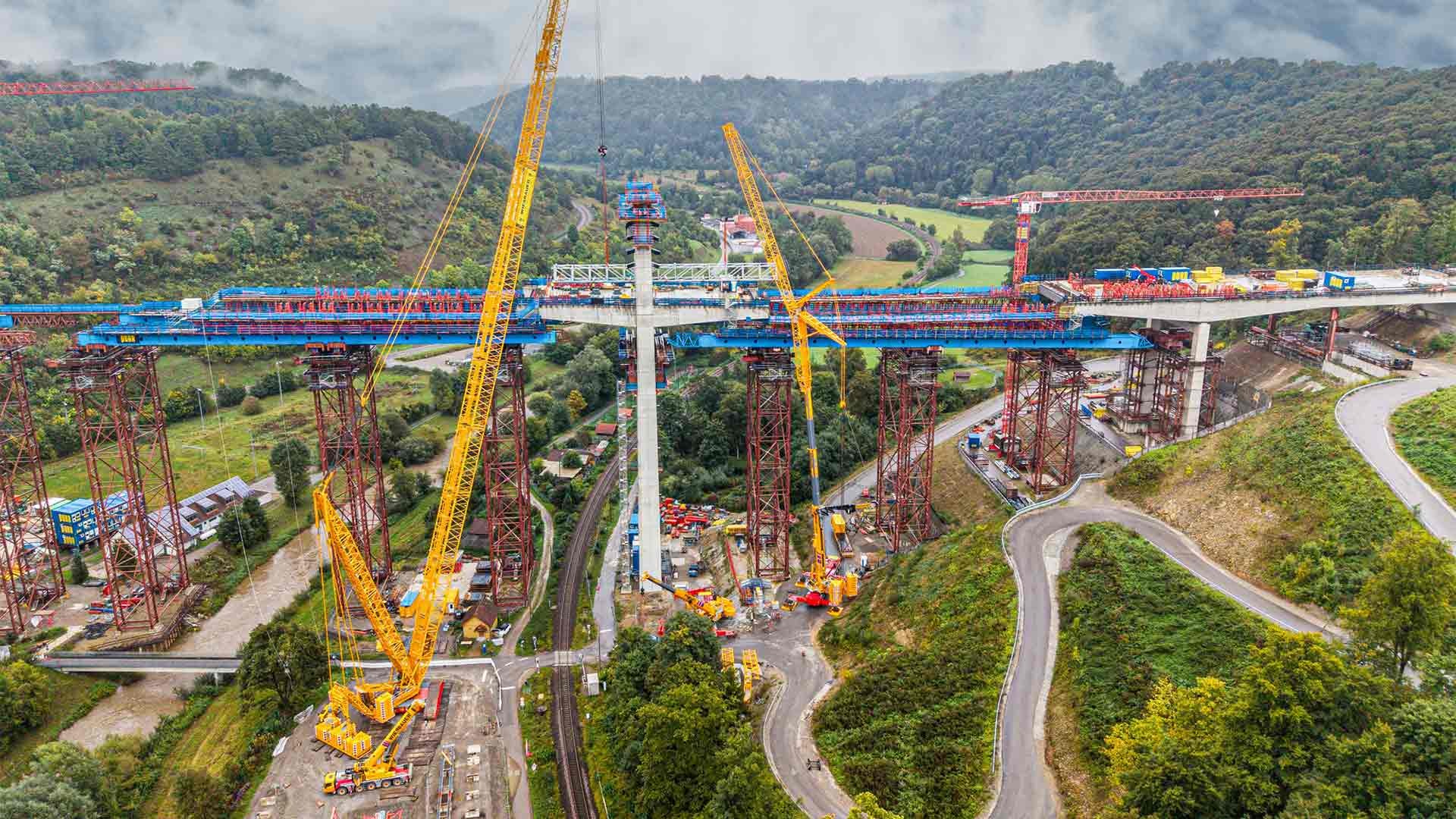
The town of Horb lies picturesquely in the Neckar valley in Germany, nestled between the Black Forest and the Swabian Alb. An impressive structure is being built here – high above the Neckar: A 667-metre-long and roughly 65-metre-high extradosed bridge is not only a long-awaited local bypass, but also a prime example of modern bridge construction and a world-class crane job.
At the limits of what is possible: bridge construction in the Neckar valley
Extradosed? It sounds like haute couture for engineers – and it really is! This construction method combines the elegance of low pylons with the strength of prestressed concrete and stay cables.
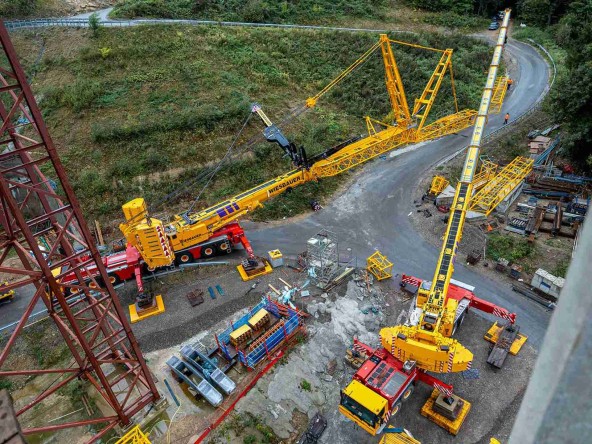
Narrow, winding roads and confined space conditions were a challenge for the team and cranes.
To ensure that the structure does not buckle under the weight of the first lorry despite its slim silhouette, continuous steel plates are installed on the underside of the road, which are firmly connected to the concrete using thousands of headed stud anchors. However, these “plates” are by no means thin: With a thickness of between 7 and 14 centimetres and lengths of up to 157 metres, these are solid steel plates.
Instead of welding single short plates onto the bridge – which would have blocked construction work for weeks – they were welded into long steel plates on the ground in parallel with the other construction work so that they could then be lifted as complete units. However, this increased the weight of each element by up to 70 tonnes. To prevent the plates from sagging and bending when lifted, they were attached to a lattice crossbeam. Including fastening equipment, this resulted in loads of 85 and 102 tonnes, which had to be lifted from the valley onto the bridge under construction at a height of 65 metres.
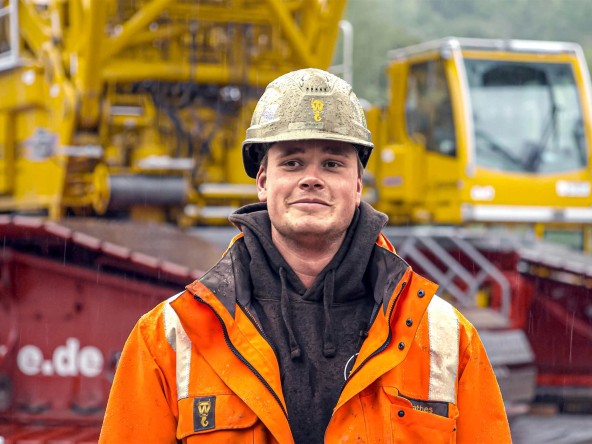
Jonathan Mattis, Wiesbauer
Wiesbauer used an LR 1700-1.0 with a 132 metre main boom, a 12-metre fixed jib and up to 375 tonnes of ballast as well as an LTM 1650-8.1 with Y guying, 155 tonnes of ballast, 16-metre telescopic extension and 38.5-metre luffing jib.
“The LR 1700-1.0 crawler crane was perfect for this job, as the crane had to move to pick up the plates and then swivel into the correct position on the bridge with the plates on the hook,” explains Jonathan Mattis, crane operator at Wiesbauer. “A total of four large plates needed to be fitted. For two of them, the support of an LTM 1650-8.1 was necessary because longer distances had to be covered.” The LR 1700-1.0 was set up roughly in the centre of the valley directly in front of the bridge section. “The LR 1700-1.0 initially placed the 85-tonne load in an accessible position on the bridge. There, the fastening equipment was repositioned and swivelled to its final position together with the LTM 1650-8.1 and set down accurately to the very last millimetre,” explains Mattis.
My favourite is Liebherr – best technology and easy to operate.
Precise technology and millimetre-accurate coordination
The combination of VarioTray and V-Frame made the LR 1700-1.0 a decisive tool in confined job conditions: depending on the boom radius, the ballast radius could be continuously adjusted between 13 and 21 metres. The ballast radius had to be constantly adjusted during the entire lifting process to maintain the exact balance. Mattis emphasises: “A minimum ballast radius of 13 metres was necessary for swivelling. To set down the load on top of the bridge, the suspended ballast had to be pushed out again. Fortunately, this works perfectly with the Liebherr crane.” The lift placed the highest demands on the control and interaction between the two machines. With the tandem lift, the working radius of the crawler crane reached up to 96 metres.
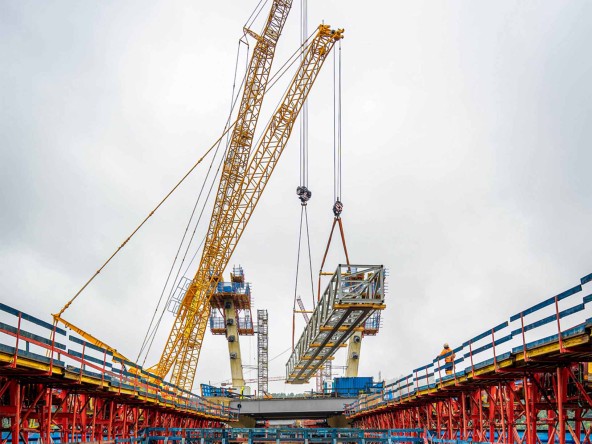
To prevent the plates from sagging and bending when lifted, they were attached to a lattice crossbeam.
Logistics at the limit
The assembly of the cranes also required logistical expertise. The job site was in a narrow valley – the Neckar to the north and a railway line to the south. An alternative assembly was not possible. All components had to be reloaded onto 8-axle flatbed trailers to safely negotiate the winding roads to the crane site in the valley. “The assembly was already precision work,” reports Ralf Hofmann, driver of the LTM 1650-8.1. “To install the luffing jib, we only had one metre of space to the end of the path.” It was impossible to position it closer to the bridge – the interfering edge only left about one metre of space for the lift.
Wiesbauer had calculated various options, including the use of a more powerful crawler crane. “Our LR 11000 could have handled the load alone at the location,” says project manager Jochen Wiesbauer, “however, the ballast radius would have required it to be swivelled across the river – and that was not possible.” A larger mobile crane had also been considered, as the LTM 1650-8.1 was working at its limit. However, the dimensions of the 9-axle LTM 1750-9.1 did not allow it to drive down into the valley.
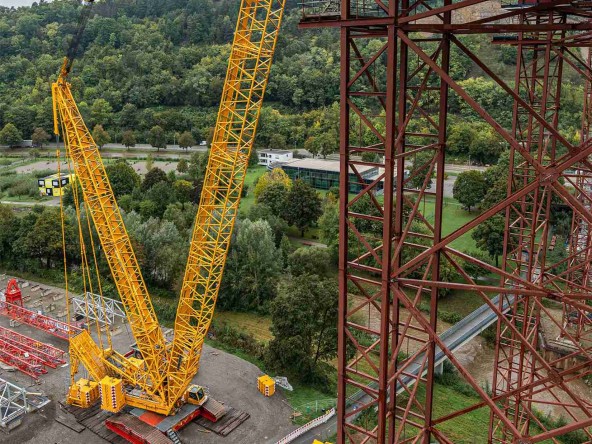
Without the Liebherr innovations VarioTray and V-Frame, the job would not have been possible.
Planning with system and experience
The assignment was planned using the Liebherr LICCON job planner and a CAD system to precisely simulate all movements and loads. Nevertheless, some of the work was left to experience – especially the precision tuning of the cranes in tandem operation.
“Experience is indispensable here,” emphasises crane operator Tim Moll. “All of that cannot be calculated in advance. Good judgement is decisive when picking up the load and positioning the ballast pallet.” After several days of intensive work, all four plates were firmly mounted – a success that combined precision, technology and teamwork.
This article was published in the UpLoad magazine 01 | 2026.