
Digging deep for customised bucket solutions
There’s no such thing as a one-size-fits-all approach to designing and manufacturing buckets for mining excavators. There’s not even a one-size-fits-most approach. The countries, commodities and conditions our excavators work in are so varied that it’s not possible to offer an ‘off-the-shelf’ bucket. The solution? Customisation.
Customisation is a collaborative process. Different teams from within Liebherr Mining – often spanning multiple countries – as well as the customer themselves are involved in designing and manufacturing our buckets. Each of the different teams brings with them their own valuable experience and expertise that, when combined, allow us to provide the perfect bucket solution to our customers every time.
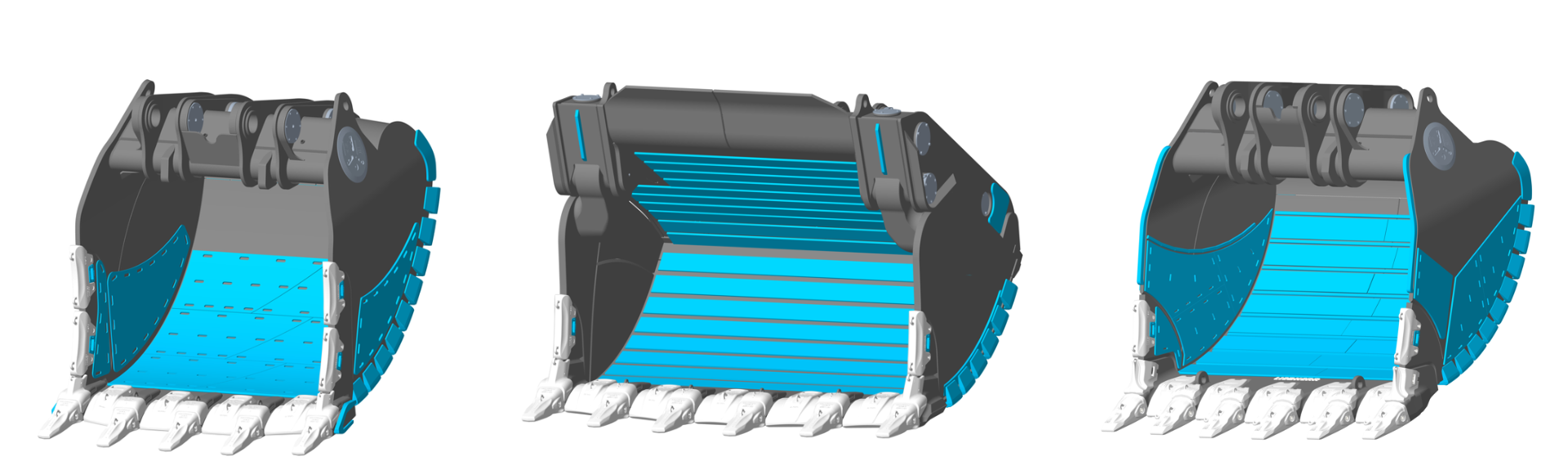
A few examples of buckets designed for our customers all over the world!
The foundations of customisation
We first start looking at ways to customise the buckets for our excavators during mining companies’ tender processes. When a mining house comes to market with the desire to add a new excavator to its fleet, our proposal always details how our machine and its bucket will be the perfect solution, down to the bucket’s capacity, GET (ground engaging tools) and wear package.
‘We’re one of just a few OEMs that manufactures both our excavators and our buckets in-house,’ explains Martial Vicq, group leader, undercarriage, GET and buckets, Liebherr-Mining Equipment Colmar SAS. ‘Because of this, we are acutely aware of how different bucket configurations can impact the performance of our excavators and so we only suggest combinations that provide the best possible productivity and reliability.’
To make absolutely sure we’re offering mining companies the perfect bucket solution for their specific needs, we need data. Detailed, high-quality data about the application the bucket will be working in. Without this, it’s impossible to build a bucket that will properly serve the customer.
‘We need to have a comprehensive understanding of the material the bucket will be moving to design the right bucket. Not just what the excavator will actually be lifting, but what’s the material’s bank density, loose density, swell factor? How well is it fragmented? And which commodity is actually being extracted on site?’ explains Vicq. ‘We also need an understanding of how other excavator buckets have fared on site. What’s the average lifespan of the other buckets? How long do the teeth last? Once we have all of this information, we can start designing an appropriate bucket.’
We’re one of just a few OEMs that manufacture both our excavators and our buckets in-house.
Designing the perfect solution
The engineering team at our excavator production facility in France – Liebherr-Mining Equipment Colmar SAS – uses this data to further tweak the initial design proposition. The updated design is then passed along to the customer as well as the relevant manufacturing team for that region as a CAD (computer-aided design) file so that they can all provide their feedback.
Sometimes there can be several exchanges with the different teams to get the design just right. Manufacturing may have comments about how the bucket needs to be welded to accommodate certain design features. There can also be instances where the customer has specific ideas for the bucket that the design doesn’t quite capture. While feedback from the customer is always taken on board, it isn’t always possible to implement.
‘While we value our customers’ experience and expertise, our job is to provide a product that will thrive on site. If a customer’s idea has the potential to jeopardise productivity or the integrity of the machine in any way, we let them know and suggest an alternative,’ says Vicq. ‘This is why clear communication, respect and true collaboration are vital parts of the bucket design process.’
Building the buckets
Each bucket design needs to be signed off by engineering, the customer and manufacturing before the design can be finalised, a full set of CAD files can be created and the build process can begin. For most customers, the build process takes place at our production facility in France in conjunction with local suppliers, with the customer’s local sales and service company providing the information necessary to customise the bucket. Our sales and service companies in regions with a large number of Liebherr mining excavators – Australia, Indonesia, South Africa and Brazil – build buckets in-country for their customers and sometimes to support neighbouring countries as well.
Our sales and service company in Australia – Liebherr-Australia Pty. Ltd. – was responsible for manufacturing
43.5% of Liebherr’s mining excavator buckets in 2025. All of these buckets were fabricated at Liebherr-Australia’s manufacturing facility in Adelaide, South Australia. With their extensive experience in manufacturing buckets for our mining excavators, the Australian team definitely knows a thing or two about the process! Starting with the fact that all of the steel plates needed to build each bucket are supplied specifically to fulfil the needs of each individual project. These come from trusted local suppliers and are inspected as soon as they arrive to the manufacturing facility to ensure they meet our strict quality standards. For Liebherr-Australia, parts that can be pressed into shape in-house as well as elements of a bucket’s wear package arrive to Adelaide as ‘flat plates’, whereas anything that needs a large-capacity hydraulics press to be formed – like cases, elements of bucket rolls and side plates – arrive pre-rolled. For our other sales and service companies around the world, how parts arrive depends on the capacity of both their manufacturing facilities and the capacity of their local suppliers.
‘All of our buckets are made from the same high-quality materials, regardless of where the bucket is built or the design we’re following,’ explains Steve Smith, fabrication manager, mining, Liebherr-Australia. ‘It’s the configuration of those materials that changes. For example, customers working in highly abrasive materials like gold will require larger wear packages on their buckets than those working in softer materials like coal.’
Fabrication begins with the two main sub-assemblies: the bucket roll and the bearing block. The bucket roll is the curved part of the bucket and is made up of individual, pre- rolled parts that are welded together to become the full component. The bearing block, on the other hand, is the part of the bucket that connects to the excavator attachment. Once the bearing block has been completed, it’s heated to a controlled temperature and held at that temperature for a specified period. It’s then cooled down slowly to relieve the stress in the welds, avoid cracks and extend the lifetime of the bearing block itself. Fabrication then continues with the rest of the steel plates. For Liebherr-Australia, 60–70% of these are supplied fully prepped and formed for welding and their fabrication team takes care of the rest.
‘The fabrication process does differ slightly, depending on the size of the bucket being manufactured. Bigger buckets, like those for the ultra-class R 9600 and R 9800, have more complex welding, heat treatment and machining needs than our smaller buckets,’ says Vicq.
After the welding finishes and the bucket starts to assume its final form, it’s machined at its connection points to ensure it can properly align with the excavator during installation. Next comes the fitting of the bushes and then the whole bucket is compliance tested. To do this, the team installs a testing pin to make sure the bores within the bucket are correctly aligned. This prevents any issues with installing the bucket onto the machine. If the testing pin doesn’t find any issues with the bores, it’s then removed. From there, the GET is fitted and the bucket is painted.
Once the paint has dried, it’s time for the fishing touches: installing the greasing system, painting the lifting points and adding the lifting point, tie-down point and the all-important ‘built by Liebherr’ stickers.
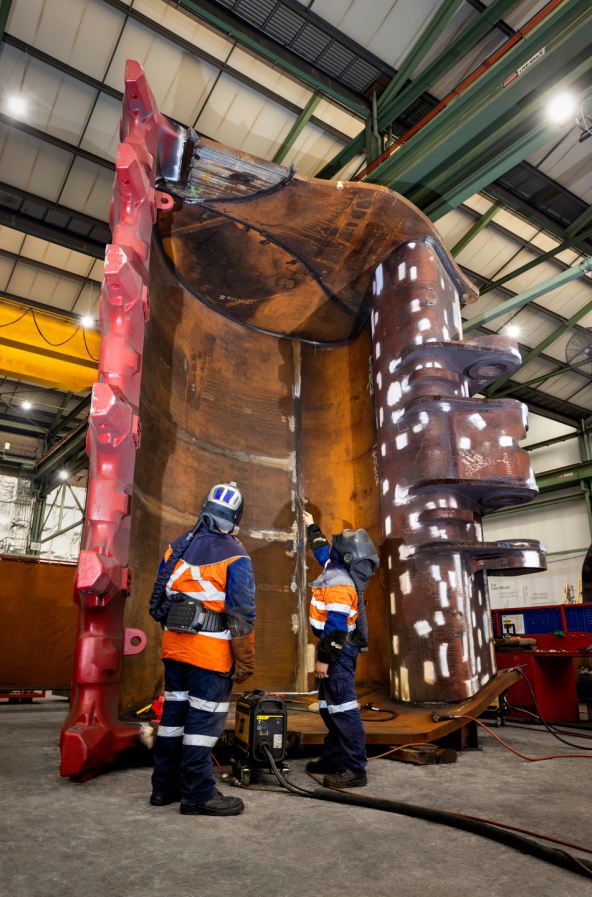
43.5% of Liebherr’s mining excavator buckets were manufactured in Australia in 2025.
Nothing but the best
Because we pride ourselves on providing the highest quality in everything we do, there are multiple hold points throughout the process for quality assurance checks. At each point, two dedicated quality assurance and quality control personnel – who are independent of the fabrication process – check the bucket’s progress and that work completed at each stage meets our rigorous quality standards and norms. On top of that, these personnel also complete a final inspection report for every single bucket upon its completion.
‘Whether our buckets are manufactured by one of our own sales and service companies or by one of our trusted suppliers, the result is always the same: a high-quality bucket, built to our stringent OEM standards,’ says Vicq.
Part of what makes it possible for us to manufacture the highest quality buckets is the cutting-edge technology we incorporate into the manufacturing process. Liebherr-Australia, for example, has introduced automated welding technology in the form of a collaborative robot, or ‘cobot’, into its processes. This technology improves welding consistency while also completing welding tasks six times faster than if they were done by hand.
‘In 2025 alone this cobot saved our team over 2,000 hours in manual labour – the same amount of time it takes to build an entire Liebherr bucket!’ enthuses Smith.
After the bucket has been completed, it’s shipped off to the customer’s site – either to the build pad if the bucket is to be installed on a customer’s new excavator or to the customer’s parts storage if the bucket is to be changed out for an existing worn bucket on site.
Never stop improving
To make sure we always provide our customers with the best possible solutions, we are constantly on the lookout for ways to improve our buckets. Once such way is the EVO bucket for backhoe excavators, which first launched in 2019.
‘With the EVO design we were looking for a way to reduce the global weight of our buckets so customers could increase their productivity while also providing them with the opportunity to better armour their buckets,’ explains Vicq. ‘From what we’ve seen in the field, when customers use this bucket, they increase their productivity by up to 15%!’
Of course, we didn’t stop innovating in 2019. A number of our current projects focus on ways to optimise different aspects of bucket design. One such project is investigating how we can improve the protection of the central lubrication system as well as the profile of our buckets. Another involves the development of simulation models with DEM (discrete element method) to find the optimal bucket configuration – width, depth, number of teeth and type of GET – for each application.
‘There are also instances where we find inspiration from the cutting-edge technologies, maintenance tendencies and materials we use,’ Vicq says. ‘Incorporating these innovations into our processes can extend maintenance intervals or even reduce the weight of our buckets. For example, we use laser cladding, which uses robots to deposit additional material to the target surface, to protect specific areas of the bucket. We also design a lot of linerless buckets for our customers, where the buckets’ wear protection is arranged in a way that reduces maintenance requirements and increases payload capacity by 3%.’