
Better data, smarter logistics
How do you find a mining machine in the middle of the ocean?
This isn’t a riddle, but a genuine question. Once a haul truck, dozer or excavator leaves our hands, how do we continue tracking it across oceans and continents? When our machines and spare parts travel from one side of the world to the other, we typically rely on data from third-party logistics providers, which can sometimes be delayed, inconsistent or incomplete. Additionally, international shipping is always dynamic. Routes shift, vessels change and timelines evolve. So, to improve transparency and customer service, our colleagues at Liebherr Mining Equipment Newport News Co., our production facility in the USA, have begun outfitting shipments with state-of-the-art Decklar (formerly Roambee) BeeSense Max sensors. These devices allow the Newport News team to follow every shipment for themselves in real time.
We sat down with two of our experienced external logistics team members from Liebherr Mining Equipment Newport News Co. — Alain May, divisional general manager, external logistics services, and Holcombe Hughes, external logistics project engineer – to tell us more.
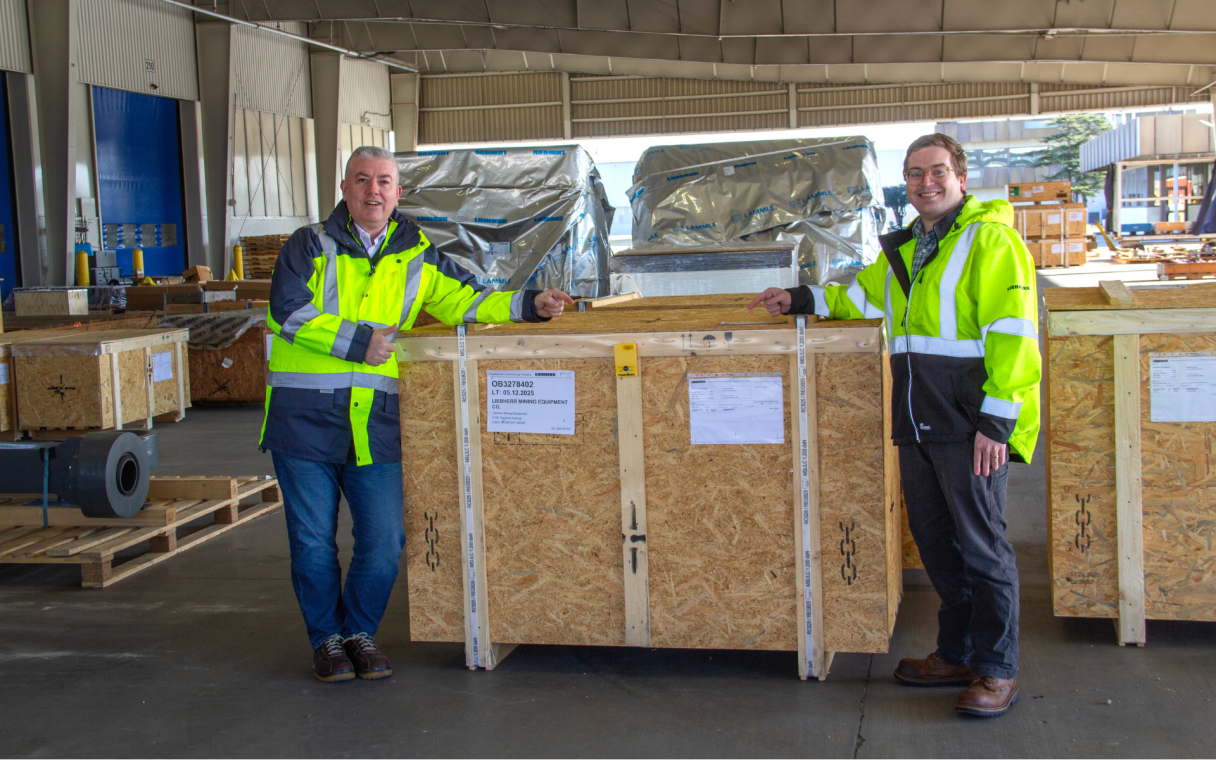
Alain May (left) and Holcombe Hughes (right) sending cargo on its way from our truck factory in Newport News, USA.
Alain, where did the idea to start using trackers on our shipments out of Newport News first originate?
Alain: During the height of the COVID-19 pandemic, it became clear to me in my role as general manager that adding trackers to our shipments could create significant value, both for our customers and for our organisation. During that time, we began experimenting with simple e-commerce tracking devices and soon these early trials showed us how real-time visibility could transform the way we monitor shipping progress across our global supply chain.
This initial insight laid the foundation for exploring advanced solutions such as Decklar, where smart trackers merge with powerful data management capabilities. The result is not just knowing where parts are, but unlocking actionable intelligence that elevates transparency, reliability and the customer experience.
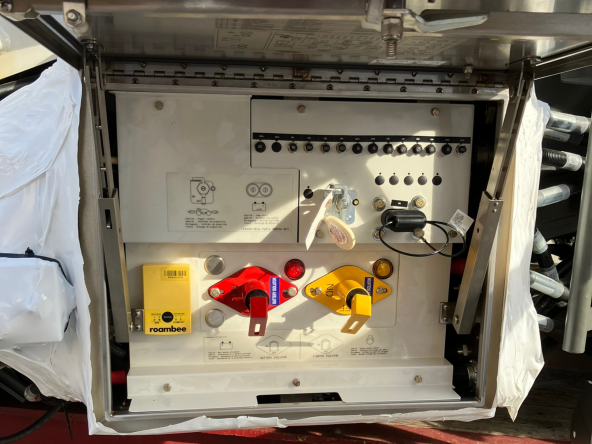
State-of-the-art Decklar BeeSense Max sensors collect in-depth data while attached to our cargo, delivering uninterrupted visibility across the entire global journey.
Can you help us understand some of the biggest challenges of shipping mining equipment and its spare parts?
Alain: Certainly. There are many challenges when we ship our cargoes, which include SKD (semi knocked down) machines and spare parts, to our customers. Procedurally, the biggest hurdles are visibility and transparency. Let’s look at a typical example: when we ship our products from the Port of Norfolk (Virginia, USA) to the Port of Fremantle for our customers in Western Australia, they’re on the water for about eight weeks, travelling thousands of kilometres and crossing several oceans. There are multiple carriers involved throughout the journey. In fact, there are even multiple vessels involved, requiring a trans-shipment in Southeast Asia before continuing onwards to Australia. Additionally, this main stage of ocean freight is just one of many in the intermodal transport chain. We also manage road transportation from the cargo’s point of origin to its port of departure.
In this example, our Australian sales and service company – Liebherr-Australia Pty. Ltd. – is responsible for the foreign land transport from the cargo’s port of arrival to its final destination.
All of these different stakeholders may use their own datasets and methods of tracking cargo. Or there could be delays in transmitting information between the different parties. All of which makes it incredibly challenging to consolidate and validate the tracking details into one accurate and actionable format.
The incidental challenges we face are those you’d expect when sending cargo over vast distances by multiple modes of transport: any number of delays, operational disruptions, mishandling, damage and theft. According to the latest Sea-Intelligence Global Liner Performance report, global schedule reliability has dropped to 62.8%, and the average delay for late vessels has increased to five days. This means time-consuming delays for our customers, who are patiently waiting for their new machines to arrive, be commissioned and start moving material.
The result is not just knowing where parts are, but unlocking actionable intelligence that elevates transparency, reliability and the customer experience.
Holcombe, drawing on your experience as a logistics project engineer, how do Decklar’s sensors help us to overcome these challenges when delivering our mining equipment and its spare parts to customers?
Holcombe: The best way to overcome these challenges is to own the data about our cargo so we know where it is and what state it’s in at any given time. The Decklar BeeSense Max sensors allow exactly that. The devices layer GPS with cellular networks, Wi-Fi triangulation and satellite fallback, delivering uninterrupted visibility across the entire global journey. The incoming data feeds into a central dashboard configured with logistics milestones, geofences, performance indicators and exception triggers. This enables us to monitor transit times, dwell times, delay patterns, route deviations and even environmental conditions.
So how else can the data from these sensors help us to improve our logistics processes?
Holcombe: The granularity of the data allows us to isolate points of failure during the freight journey and propose solutions before these potentialities cause real-world issues. In fact, thanks to the data we collect, we’re better able to forecast possible delays, provide more accurate ETAs and offer better service to our customers. Because all stakeholders can access the same data, we eliminate the need to compare numerous siloed datasets or reconcile conflicting reports. Everyone works from one neutral, reliable and accurate source of truth.
Thanks to the data we collect, we’re better able to forecast possible delays, provide more accurate ETAs and offer better service to our customers.
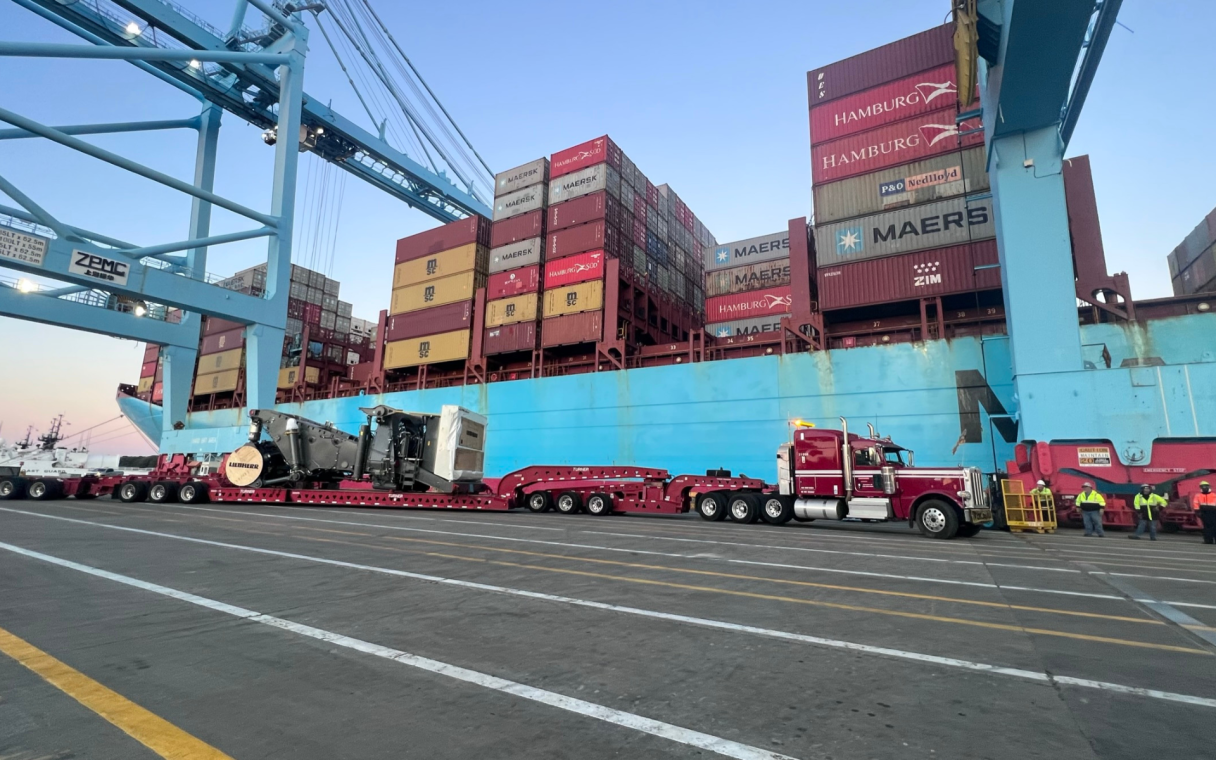
Our cargo travels thousands of kilometres, often crossing multiple oceans and continents, to get to our customers.
With smarter data and smarter logistics, we’re not just tracking machines: we’re reinventing how we deliver them to our customers worldwide.
Are there additional benefits to using this technology?
Holcombe: The devices also bring a range of added value through their embedded sensors and features. For example, if the sensors detect any excess shocks to our cargo, it triggers an immediate notification to let us know that our cargo has potentially been mishandled. Similarly, we are sent an immediate notification if our cargo is opened and the sensor detects the rush of light. This has the dual benefits of letting us know that our products have been opened too early, and therefore may have been tampered with, or that our products have reached their destination and are safely with our customer. They even monitor temperature and humidity, which provide valuable insights about the environmental conditions that our products are subject to during transportation, allowing us to adapt our packaging and preservation processes to better protect our cargo.
We’re also excited to collaborate with Decklar and leverage their expertise with AI to unlock even more value. With growing datasets and new predictive capabilities on the horizon, we’ll be able to analyse performance patterns across trade lanes, implement optimal logistics strategies and react to bottlenecks and disruptions faster. With smarter data and smarter logistics, we’re not just tracking machines: we’re reinventing how we deliver them to our customers worldwide. This is truly just the tip of the iceberg.
How impressive! Have any other production facilities within Liebherr Mining implemented similar solutions?
Holcombe: At the moment, this solution is still being piloted at our Newport News facility. But this is just the beginning! Functionality is still evolving, and the system is actively under development and testing, including new tools, KPI integration and reporting capabilities. Further communication will be shared with all stakeholders in due time as we continue the implementation at scale. There is potential to expand the use of this technology to our production facility in Colmar (France), once the rollout proves successful.