
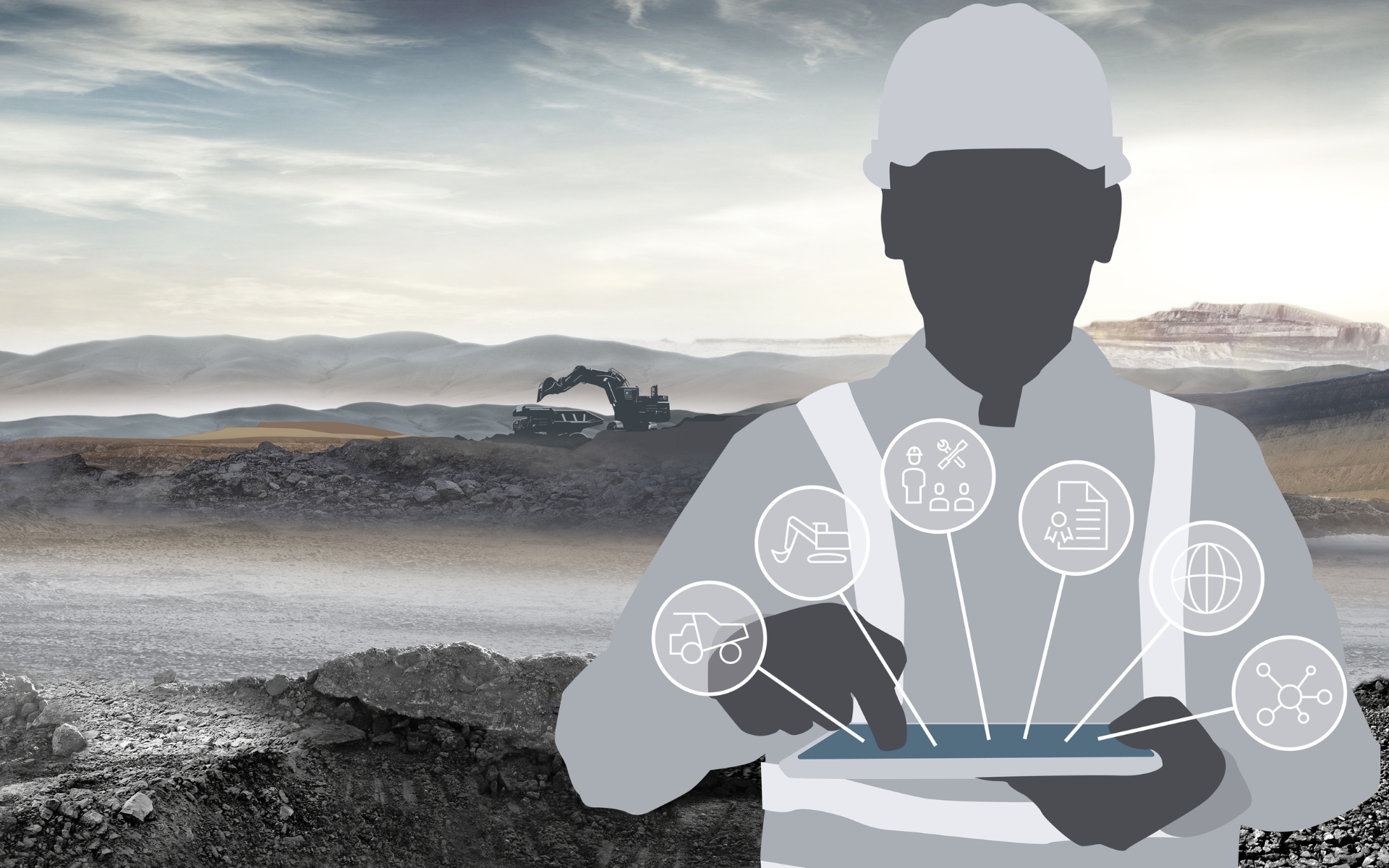
Application engineering: optimising productivity one mine at a time
Productivity is paramount in mining. When a mine is running smoothly, it’s more efficient, more financially stable and better placed to be successful in the future. But sometimes, despite a mine’s best efforts, productivity isn’t where it should be. This is where our global application engineering team can help.
Our application engineers work with customers to make sure that their mining equipment and operational processes are serving their mine’s unique needs to the best of their ability. They’re strategically located around the world to ensure that they are as close to our customers as they can be. When something isn’t working as it should, our application engineers use a range of tools, combined with their technical expertise and practical problem-solving skills, to find the culprit, or culprits. Think of them as productivity detectives.
Tools of the trade
The secret to optimised productivity can be lurking in a number of different places. Not just within the equipment on site but also within the wider context of the mine. Because of that, our application engineers have a bunch of tricks up their sleeves to investigate and provide solutions to customers’ productivity dilemmas, chief among them simulations and application studies.
Simulations, as you might expect, help our application engineers answer ‘what if’ questions for our customers. What if we replaced our existing excavators with Liebherr machines? What if we were to replace our diesel trucks with battery-electric ones? What if there’s a way to reduce operational costs on site?
In order to answer these questions, the engineers need high-quality data specific to the hypothetical situation the customer wants investigated. To simulate how a Liebherr machine would perform on a specific site, engineers would need historical and target fleet output information. To see how running battery-electric trucks would impact operations, engineers would need haul profiles and electrical infrastructure capabilities. And to explore whether different ways of operating may result in a lower cost per tonne, our engineers would need current fleet operating costs. Once all the data has been collected, our engineers then have a comprehensive overview of the present situation on site and can see whether there’s room for growth.
Our application engineers use application studies to assess what’s already happening on site and if there might be a way – or multiple ways – to boost operations. If cycle times are blowing out, if fuel efficiency is too low or if it’s taking too many passes to fill a truck, these studies can help our application engineers to figure out why.
After meeting with the customer to fully understand their expectations, our engineers can formulate a plan to find the information they need. This can involve work area and broader site assessments, which include equipment efficiency studies. Usually, our engineers will also accompany operators in the cab of a machine being investigated and, if necessary, they’ll record GPS data while the machine is on shift. Being in the cab allows our engineers to experience customers’ everyday operations for themselves, while the GPS data allows them to compare actual and theoretical machine speeds to see if there are any places where our machines aren’t running at full speed. Once all relevant site data has been collated, our engineers can conduct more in-depth evaluations in order to answer our customer’s query as thoroughly, and with as much information, as possible.
Providing exceptional advice around the world
Using these tools, our application engineers have helped countless customers improve the productivity of their mines. This article would be far too long if we included them all, so we thought we’d just share some of our all-time favourites.
In Australia, one of our customers reported that their T 264 trucks were less fuel efficient than expected. Through an application study, our engineers discovered that this reduction in fuel efficiency was because the T 264s were getting stuck behind slower non-Liebherr trucks on the haul roads. Due to the T 264s competitive rimpull performance, they accelerate faster on grade than the third-party trucks, meaning the T 264s were catching up to the other trucks on these sections of roads and having to slow themselves down. To solve this problem, our engineers suggested running these different truck models on independent circuits to realise the full production potential – and therefore the competitive fuel efficiency – of the T 264s.
In Indonesia, a customer was looking to increase their mine’s production capacity by increasing the size of their mining fleet. They were specifically looking at 70-tonne dozers as well as excavators in the 200-tonne and 250-tonne classes. The local application engineer conducted production studies on site to help the customer to decide whether our machines or those of our competitors would be the better investment for their application. The results of these production studies, which were verified by the customer’s own measurements, highlighted that our equipment would be the most beneficial choice. These machines performed so well in these studies, and then again when the first units began arriving to site, that the customer has invested in a total of 11 PR 776 dozers, nine R 9200 excavators and three R 9300 excavators – as well as 13 of our 100-tonne R 9100 excavators – for their operations throughout Indonesia.
In Chile, we had a customer who wanted to explore the potential benefits of installing a trolley line on site. Using site data the customer provided, our application engineers ran a simulation that demonstrated that adding a trolley line to the mine would not only significantly reduce fuel consumption but would also considerably shorten cycle times. As a result, Liebherr worked closely with the customer to provide the site with a full trolley solution – from engineering and component supply to training and support – that, once commissioned, became the very first fully operational trolley line in all of Chile.
Moving forward
Continuous innovation is one of our core values as part of the Liebherr Group and is something that our application engineers take to heart. They are constantly finding new ways to improve how they help mining companies make the best, evidence-based decisions for their operations, particularly when it comes to TCO (total cost of ownership) analysis between our machines and those of other OEMs and fleet estimation. In fact, the team has recently developed a new fleet sizing and cost estimation tool that helps our engineers better present the results of high-level fleet estimations and fleet TCO comparisons to customers. This facilitates more engaged discussions with our customers to ensure that they end up with the solution that works best for them.
Our application engineers’ reputation for providing excellent advice to customers has recently resulted in the team starting to collaborate with one of our customers in Colombia. Based on the strength of our engineers’ consultancy for other customers, the local team has been asked to conduct both a site study and a fleet estimation to determine what the customer’s mine needs to succeed over the next decade of operations. This will be an exciting project to watch!