


News | 03/10/2023
Liebherr participated in the IÖB Innovation Platform Challenge "CO2 optimized construction site for Wiener Linien". With its proposal "The Construction Site of Today", Liebherr-Werk Telfs GmbH was able to convince the jury with regard to applicability, novelty and degree of maturity, improvement of the environmental balance and cost indication. Wiener Linien, Vienna’s public transport operator, would like to operate its construction sites in a CO2-optimized or CO2-neutral way in the future, contributing to Austria's goal of being climate-neutral by 2040.
Commitment pays off: By taking part in the challenge "CO2 optimized construction site for Wiener Linien", Liebherr has shown that the Group is innovative and environmentally aware. In mid-December last year, Liebherr-Werk Telfs GmbH, together with Liebherr-EMtec GmbH, presented their idea "The Construction Site of Today". Their proposal convinced the jury including Wiener Linien and Public Procurement Promoting Innovation (IÖB). David Lindenthaler, development engineer for technology and pre-development at Liebherr, worked out a concept together with colleagues from various product segments on how CO2 can be reduced at Wiener Linien construction sites. The construction sites are building and civil engineering projects, such as tram stops or tunnel construction for subways. Construction site processes and procedures, construction site equipment and machinery, as well as materials and resources had to be taken into account.
Research on site at the U2/U5 lines
For the creation of the concept, Josef Ratzinger, development engineer at Liebherr-Werk Telfs GmbH, visited the current construction site at the major traffic junction of the U2/U5 lines in Vienna. "This is a partially open construction site with different levels. We then selected machines from our product portfolio to design tangible solutions," explains Ratzinger. The decision was made in favor of, among others, the R 9XX H2 crawler excavator with hydrogen drive, which is characterized by a particularly high degree of innovation; and the LR 1130.1 unplugged crawler crane, which is ready for series production. In addition, Liebherr presented prototypes such as the T33-10e battery-electric telescopic handler.
"As one of five winners, we presented our solutions during the innovation dialog with Wiener Linien and IÖB," reports Lindenthaler, "Should a joint evaluation of our prototypes subsequently take place with Wiener Linien, cooperation in terms of product development would be conceivable." So, it remains exciting, how the Wiener Linien will proceed in the future and whether the competition will be followed by an order.
You might also be interested in
11/17/2026
Press releases
ESBTP relies on the versatility and robustness of Liebherr machines
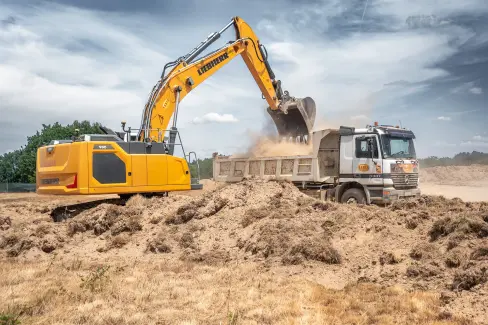
Family-run company ESBTP, based in south-west France, operates in a wide range of sectors, from the extraction and processing of construction materials to earthmoving and infrastructure works. A Liebherr customer for around twelve years, the company now operates nine machines from the construction equipment manufacturer, including a particularly versatile L 586 XPower wheel loader.
11/17/2026
News
Liebherr’s slewing bearings and drive technology: face to face with the markets of the future
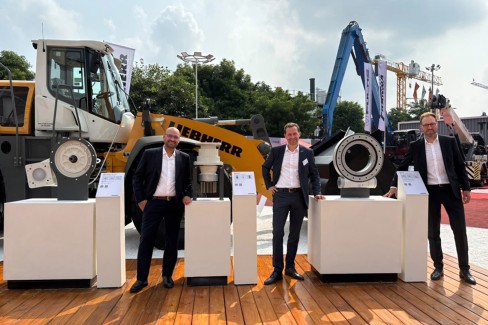
From dynamic growth markets in the construction industry, through the maritime transformation up to wind energy: This year’s trade fairs highlighted diverse opportunities and challenges in the core markets of the two business units of the Liebherr’s components product segment – slewing bearings and drive technology. The following trade fair reviews illustrate the issues that are currently shaping the industries.
11/13/2026
Press releases
Three Liebherr cranes support heritage-compliant renovation of the Dutch government quarter
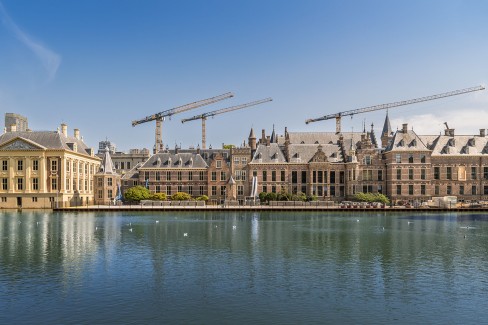
Three Liebherr 340 EC-B 12 flat-top cranes are supporting the renovation of the historic Binnenhof in The Hague. The construction company J.P. van Eesteren has been using the brand-new cranes for material transport and assembly work at the parliament and ministry buildings. Jib lengths of up to 75 metres and a compact design make it possible to work in the confined space of the listed building ensemble.