
Working together – it's only logical
Getting equipment and spare parts to our customers as quickly as possible is one of our highest priorities. But we can’t do it alone! By collaborating with different stakeholders both inside and outside of Liebherr Mining, we can find ways to make our logistics processes as efficient and sustainable as they can be.
Liebherr Mining’s External Logistics Services works tirelessly behind the scenes to ensure our customers get their Liebherr equipment and spare parts when and where they need them. This involves more than just shipping items from our factories around the world to customers’ mine sites. External Logistics Services is also responsible for handling the acquisition of the resources needed for our equipment and spare parts, which includes finding the logistics partners best suited to our business practices and those of our customers. From there, the external logistics teams within our factories handle the storage of those resources, so they’re always on hand when they’re needed. But the work doesn’t stop there. The dedication, rigour and passion for efficiency of our external logistics team means that they regularly find ways of improving logistics processes to make them more streamlined. Many of these optimisations are the result of close collaboration with our logistics partners, both in and out of the Liebherr Group.
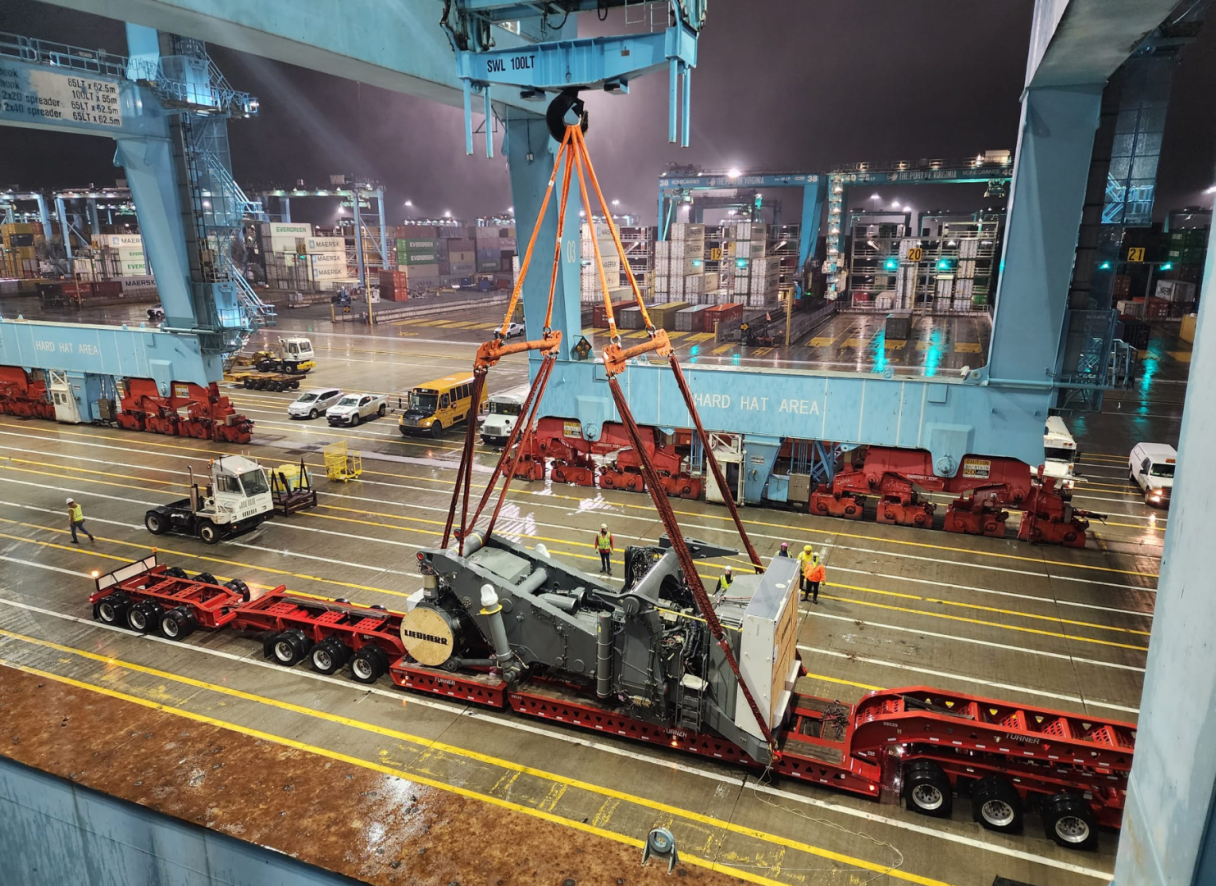
A Liebherr truck at the Port of Virginia, ready to be shipped around the world.
Building a solid foundation
Before Liebherr products leave their respective factory sites – mining excavators from Liebherr-Mining Equipment Colmar SAS in France and mining trucks from Liebherr Mining Equipment Newport News Co. in the USA – External Logistics Services needs to have a clear overview of which items are leaving when and by which methods. And with Liebherr Mining’s growth in the past few years, it was becoming increasingly clear that the external logistics team needed a better way manage the increase in outbound deliveries. So we began looking into which tools would best support Liebherr Mining’s external logistics activities.
‘The initiative to develop an IT tool that supports international logistics began several years ago,’ says Alain May, divisional general manager, external logistics services, Liebherr Mining Equipment Newport News Co. ‘Mining products involve highly specific logistics activities, such as the configuration of machines transported through the SKD [semi knocked down] process and the drop shipment of components directly from suppliers to customers. These complexities demand tailored digital solutions to ensure efficiency and transparency across the supply chain.’
With all of this in mind, our external logistics team decided to implement TMS LP2 – a global transport management system designed to streamline logistics operations, enhance data transparency and support scalable growth.
‘With TMS LP2, we’ll be able to match and allocate transport invoices automatically as well as create BI [business intelligence] reports about lead times along with our rates of cost efficiency, on-time delivery and greenhouse gas emissions,’ says Marc Lagarde, external logistics manager, Liebherr-Mining Equipment Colmar SAS.
‘Our team at the Colmar factory site is part of the pilot testing phase for this system and will be key in both validating and enhancing the system. We’re excited to see how the new capabilities of TMS LP2 help to optimise our external logistics processes,’ adds Amelie Arena, project manager, TMS LP2 implementation, Liebherr-Mining Equipment Colmar SAS.
And there are more developments to come. Liebherr Mining Equipment Newport News Co. is scheduled to implement TMS LP2 in Q2 2026, making the factory site the first non-European Liebherr company to benefit from the new system. On top of that, the Liebherr Group is currently developing a separate IT solution for inbound logistics, to ensure complete end-to-end logistics coverage in the future.
A strategic shift to sustainable barging
Improving efficiency doesn’t always mean introducing new technologies. Sometimes, it’s just finding new ways of utilising existing strategies. One such example is the use of barges for transporting components and equipment to and from Liebherr-Mining Equipment Colmar SAS – a method of transportation that the production facility has used for years. A 2019 study conducted by the external logistics team at Colmar showed that significantly increasing the volume of goods transported by barge would reduce road transport volumes – and therefore the associated greenhouse gas emissions – while enhancing the overall efficiency of the shipping process.
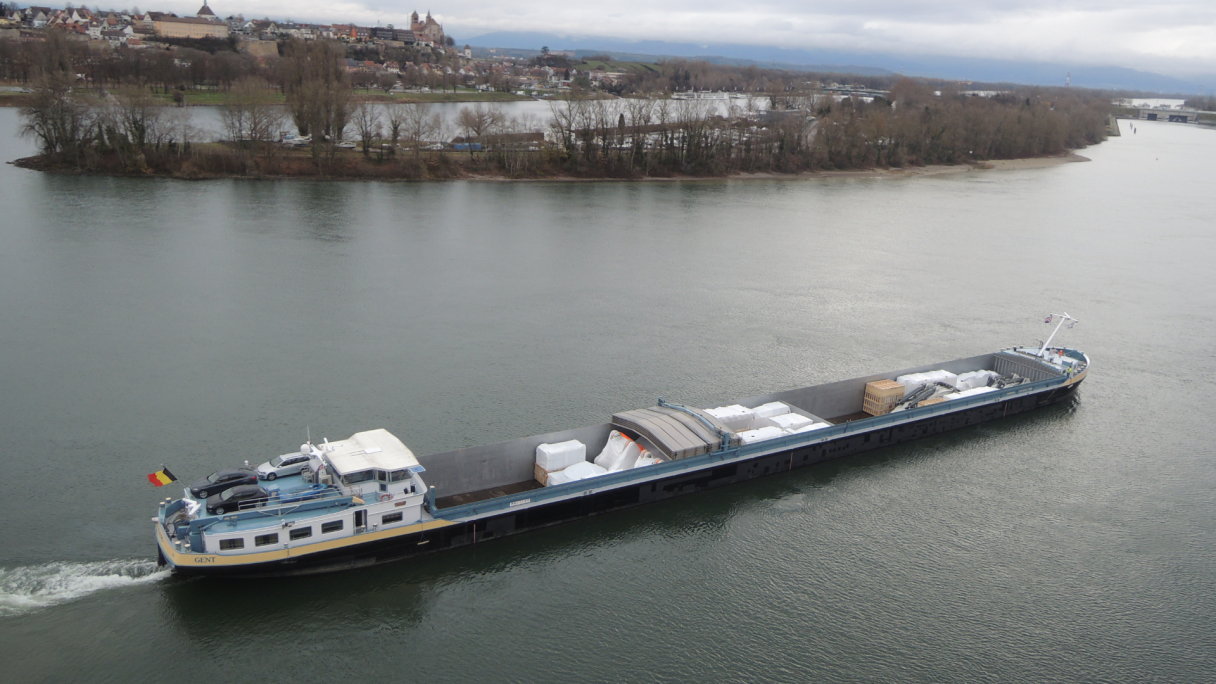
Liebherr Mining has used barge transportation in Europe since 2019, saving up to 600 t of greenhouse gas emissions per year.
‘Our plan was to ship all components via inland waterways, with everything coming together at the Port of Neuf-Brisach, located approximately 30 km from the Colmar factory on the Rhine River,’ explains Lagarde. ‘This solution would allow us to transport oversized components up to 8.5 m long, 6.6 m wide, 4.5 m high and weighing up to 110 t, without the delays and complications associated with road permits, urban restrictions or bridge crossings.’
And so, the Colmar team put together a network of external logistics partners to make this plan a reality. These partners were chosen through a request for proposal process that began in 2019 and was renewed again in 2022. Two experienced carriers in the region – Straumann and Wack – were chosen to handle the road shuttle services between the factory site, local SKD component suppliers and the Port of Neuf-Brisach, which handles barge traffic between France, Germany and Switzerland. Haeger & Schmidt Logistics operates the barge along the Rhine and International Car Operator handles the cargo once it reaches the Port of Antwerp in Belgium, the ideal departure point for freight services that operate on fixed schedules like we do.
By working alongside these strategic partners, this endeavour became a success and is still used at the Colmar facility today.
‘Increasing the amount of barging used in logistics at Colmar has allowed us to improve efficiency and safety during transport by decreasing congestion at the factory site and removing the problem of trucks getting stuck in traffic – all while reducing greenhouse gas emissions by approximately 600 t per year,’ enthuses Lagarde. ‘Considering the success of this project, we hope that other Liebherr facilities will also consider barging as a sustainable logistics solution.’
Electrifying plans for road transport
New technologies also offer the chance to boost operations. In 2025, Liebherr-Mining Equipment Colmar SAS began collaborating with Fried-Sped – Liebherr Mining’s main transportation partner – to explore the use of electric trucks in logistics operations. Incorporating these trucks into processes would support us in our own decarbonisation targets, as well as those of our customers, by significantly reducing greenhouse gas emissions during transport.
However, at present, the batteries in these electric trucks only have a range of 450–500 km, which isn’t enough for a round trip between Fried-Sped’s hub in Ummendorf (Germany) and the Colmar facility. To overcome this, Fried-Sped is testing an e-trailer developed and manufactured by Trailer Dynamics where additional batteries, combined with a propulsion axle installed on the trailer, would extend the truck’s range.
‘We’re excited about the e-trailer innovation and the achieved range extension, but it does come with trade-offs,’ explains May. ‘The added battery weight reduces cargo capacity. But that being said, European authorities are actively working on legislation that may soon allow heavier trucks and trailers on the road and may adjust road usage fees to support infrastructure maintenance.’
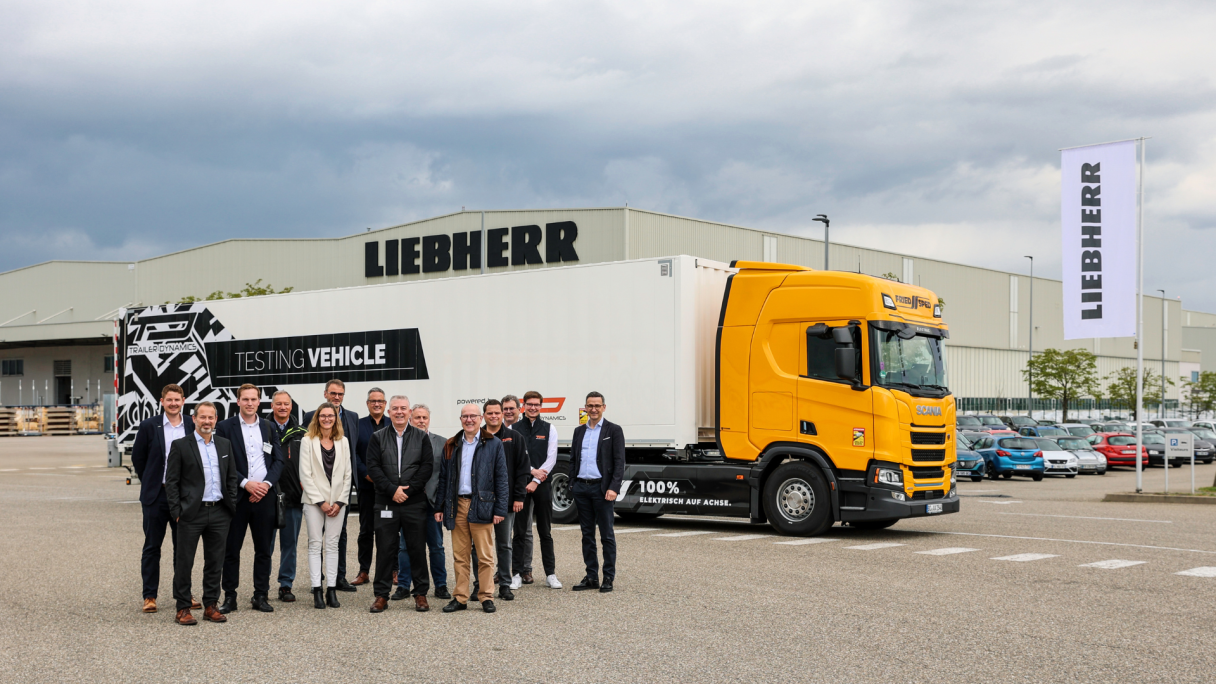
Liebherr Mining and Fried-Sped are collaborating to explore the use of electric trucks in Europe.
Close collaboration in the USA
Optimising our logistics processes isn’t just happening in Europe. The external logistics team at Liebherr Mining Equipment Newport News Co. in the USA is also working hard with strategic partners on the ground. Together, they are finding the most efficient ways of getting products from the Newport News facility in the state of Virginia to customers all over the world.
‘As our production capabilities at Newport News continue to grow, we’ve been working closely with local authorities to ensure we have the operational and regulatory support to succeed in our delivery timeline,’ says George Amos, heavy and specialised transport supervisor, Liebherr Mining Equipment Newport News Co.
The Port of Virginia is continuously optimising its terminals to accommodate the growing output from our Newport News facility. This mutually beneficial alignment between private enterprise and public infrastructure points to a shared vision of robust economic growth powered by global trade.
On top of these changes, the Virginia Department of Motor Vehicles has been working hand-in-hand with Liebherr Mining Equipment Newport News Co. to improve the efficiency of our road transport. Discussions between the two entities has resulted in our Newport News facility being granted an additional super load permit per day in the Tidewater region, which is home to nearby seaports as well as our factory site. This development not only increases throughput but enhances agility in deploying massive equipment to shipping centres, which translates to faster delivery and stronger market competitiveness.
‘Continuous improvement is a mantra we live by at Liebherr Mining. Working with different teams all over the world, whether they’re part of the Liebherr Group or strategic third-party collaborators, allows us to tap into a wide range of expertise that lets us find the best possible solutions for our customers,’ says May.
Published October 2025