Flexible automation for a wide variety of parts
From unsorted raw parts to geared pump shafts: with a highly automated production line, Liebherr-Verzahntechnik GmbH has implemented an end-to-end process chain for the pump manufacturer Rickmeier GmbH in Balve.
The line runs from bin picking at the start, through several machining stations including gear hobbing, all the way to automatic unloading of finished parts. The result is higher productivity, stable processes, and maximum flexibility.
When mechanically driven gear pumps are expected to operate reliably, every detail matters – especially the quality of the geared drive shafts. Rickmeier GmbH, based in Balve in South Westphalia, manufactures these components in-house as part of its own gear pump production. With more than 230 employees, the company is one of the world’s leading manufacturers of gear pumps, valves, and oil supply systems for the international mechanical engineering sector. Development and production are both located at the Balve site.
To meet increasing requirements for productivity and availability, Rickmeier decided to replace an existing partially automated production system. The aim was to achieve a much greater degree of automation and flexibility to handle the broad mix of parts. “We are a relatively small company with a very large variety of products,” explains team leader Elmar Schierhoff. “That means our production has to run flexibly, efficiently, and reliably.”
Seamless automation from the raw part to the finished component
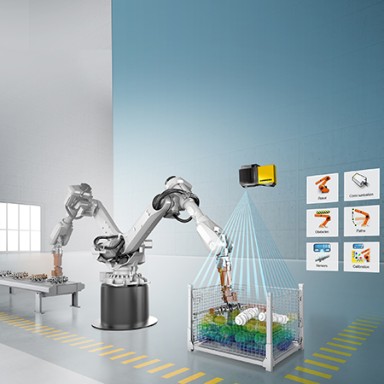
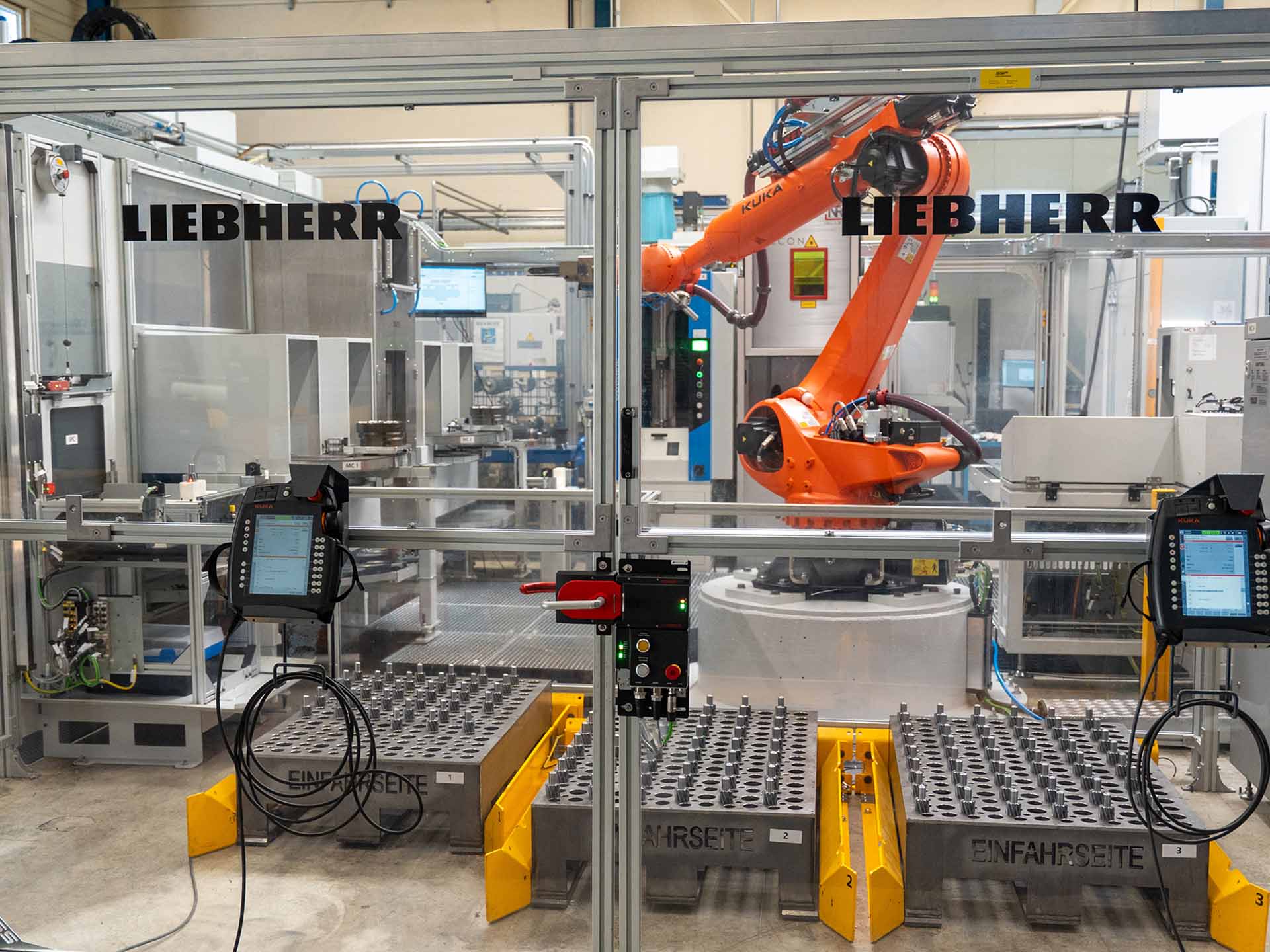
The new system automates the entire manufacturing process for geared shafts. At the line entry, cylindrical raw parts are supplied unsorted; depending on their size, a bin holds anything from 50 to 1,000 pieces. In a bin picking cell equipped with a stationary 3D camera, the LHRobotics.Vision software identifies the position of each workpiece in the container. A robot with a magnetic gripper then removes the parts and, guided by the LHRobotics.Vision software, places them in the correct orientation in a V-block at the deburring unit. There, the blanks are first deburred and face milled – a process step that was previously performed manually.
A second robot then takes over the internal material flow. Using a pneumatic parallel double gripper, it removes the workpieces from the deburring unit and transfers them to one of the two connected turning machines. After machining, it moves the parts to a blow off station for cleaning and then on to a laser station, where a traceability marking is applied.
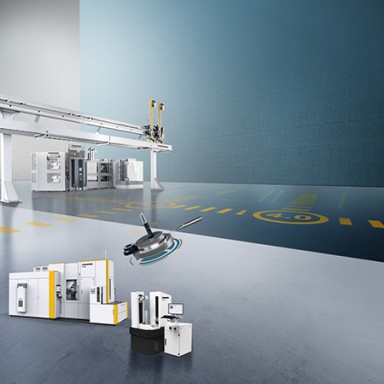
In the next step, the workpieces are inspected at an optical measuring station. The robot then places them onto the integrated plastic chain conveyor (KKB) of the Liebherr LC 300 hobbing machine, through which the machine is automatically loaded with workpieces. After hobbing, the components pass through a washing machine and are finally sorted and placed onto workpiece pallets at the end of the production line.
The integration of the entire system was handled by Liebherr-Verzahntechnik GmbH. In addition to its own machines and systems, Liebherr coordinated the incorporation of equipment from other manufacturers. “Liebherr’s overall concept won us over,” says Elmar Schierhoff. “Experience, expertise, and the combination of gear technology and automation from a single source were decisive for us.”
The challenges of wide part variety and limited space
A major challenge in designing the system was the large variety of parts. Around 50 different raw parts are used to produce roughly 750 different finished variants. To handle this range efficiently, Liebherr developed a flexible storage concept. Revolver type storage units and pallet systems with fixtures of different sizes are used to buffer workpieces between process steps. Rickmeier manufactured the workpiece fixtures in-house, with the designs closely coordinated with Liebherr. “Our goal was a system with the lowest possible setup effort despite the wide variety of parts,” says Marcel Mutzenbach, head of industrial engineering & IT.
An almost greater challenge was the limited amount of space available in production. The entire system had to be installed in a comparatively small footprint – a task that required extremely precise planning. “Every centimeter counted,” says Elmar Schierhoff. “The initial situation was anything but easy for the Liebherr team – but in the end, everything slotted into place perfectly.”
Greater autonomy in production
Alongside productivity and quality, reducing the physical strain on employees was a key factor. The automated bin-picking system now handles even heavy workpieces – individual raw parts can weigh up to 20 kilograms. “Previously, these parts also had to be deburred manually,” says Marcel Mutzenbach. “Today, the system handles this step fully automatically. This allows our employees to focus much more on higher value tasks.” Operator involvement remains low: on average, around 1.5 employees per shift are required for operation, monitoring, and setup work.
We invest continuously in our machinery. And when it comes to future automation projects, we see Liebherr as a reliable partner.
Collaborative project execution
The project began at the end of 2023 and the complete system was handed over at the end of 2025. During this period, teams from both companies worked closely together, with weekly coordination meetings ensuring ongoing communication. “For us, the collaboration was very constructive and pragmatic – something that cannot always be taken for granted,” says Ingo Baldermann, who managed the project at Liebherr-Verzahntechnik GmbH.
Even after commissioning, Liebherr Service continues to provide reliable support. “Response times are very fast, even for remote support,” says Elmar Schierhoff. “You have fixed contacts and can reach the right people directly – if necessary, even outside normal working hours.”
Rickmeier GmbH
Sector:Machine construction
Company headquarters: Balve (Germany)
Employees:approx. 230 employees
Founded:1914
Website: rickmeier.de/en
A foundation for further growth
With the new production line, Rickmeier has expanded its capacity while also improving quality and process control. Laser marking additionally enables full component traceability. For Rickmeier, the system represents not only a technological leap but also a key foundation for future growth. “We invest continuously in our machinery,” says Marcel Mutzenbach. “And when it comes to future automation projects, we see Liebherr as a reliable partner.”