Groundbreaking automation in make-to-order production
Manufacturing of extremely heavy individual parts in small batch sizes is beyond the limits of traditional automation. Hattingen-based company Köppern, which specializes in high-pressure roller presses, restructured its production process to include two Liebherr pallet handling systems, shortened processing times, and significantly increased machine utilization.
Maschinenfabrik Köppern GmbH & Co. KG has been synonymous with high-quality heavy machinery manufacturing for decades. The family-run company from Hattingen, Germany, which employs around 300 people worldwide, has its roots in hard coal briquetting and today has a global presence in the metallurgy, fertilizer, ore and cement industries thanks to its high-pressure roller presses.
Köppern manufactures a wide range of products, primarily to order – from smaller machines to machines with a total weight of over 500 metric tons. The components are correspondingly large, heavy, and mostly produced as individual pieces or in small batch sizes. Traditional automation quickly reaches its limits in such cases. There are also more stringent demands in terms of flexibility, efficiency, and availability. Basic personnel requirements also change, for instance regarding the availability of specialist staff and covering of night and weekend shifts.
For Johannes Deutsch, head of the mechanical production business unit at Köppern, it was clear: “In order to remain competitive in the long-term, we had to increase our productivity and shorten processing times. Our approach aimed to transfer methods used in series production to custom machine production and also to integrate rarely manufactured parts into an automated, digitally controlled production system.” With Liebherr-Verzahntechnik GmbH, Köppern was able to achieve exactly this: thanks to a flexible, smart-controlled pallet handling system and many years of expertise in automation.
Two pallet handling systems for different workpiece weights
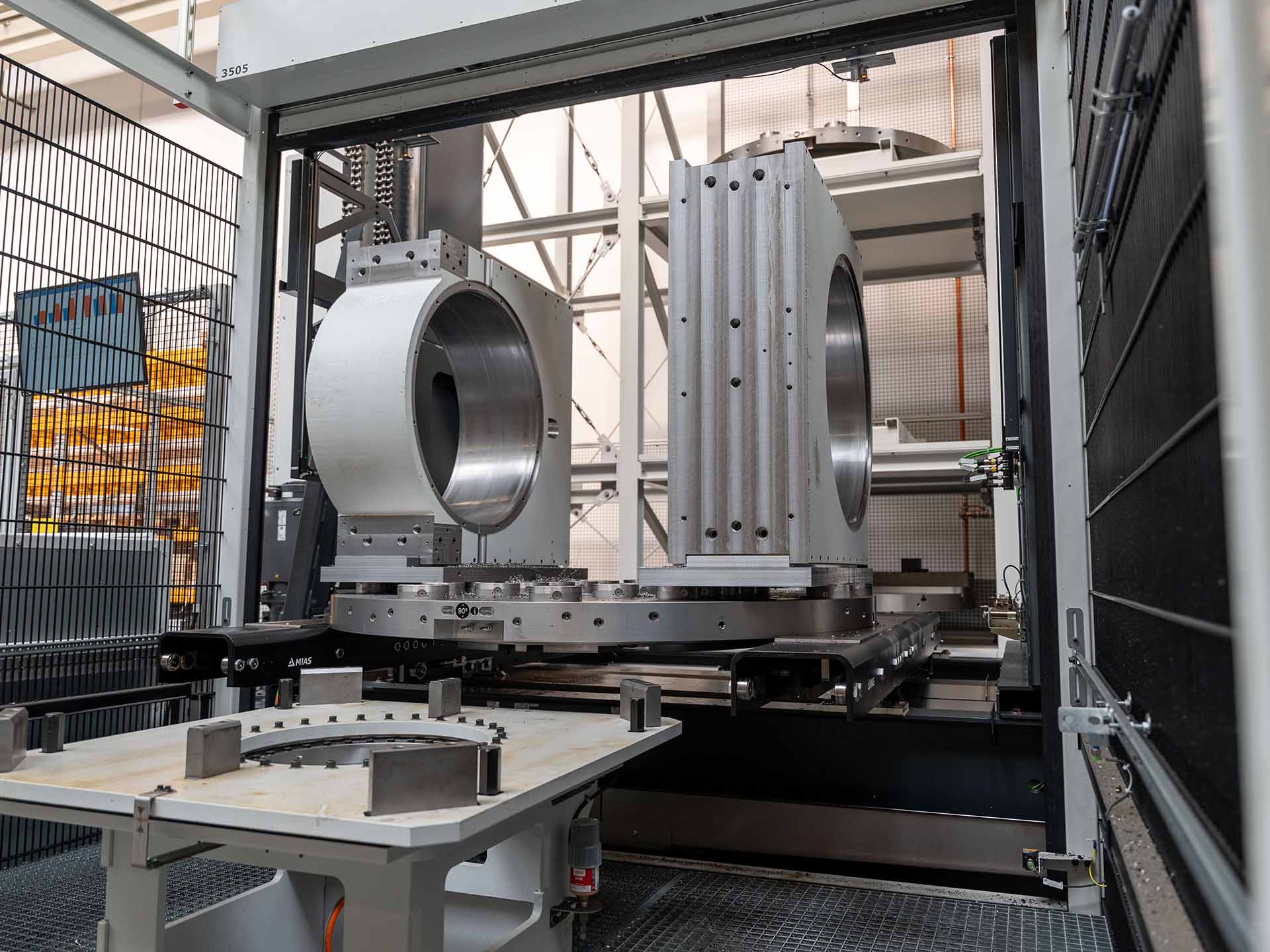
Implemented as a strategic flagship project, the system combines one PHS Pro and one PHS Allround with a horizontal five-axis machining center from Reiden. Both systems are constructed as linear pallet handling systems with shelf magazine, mobile lift modules and setup station, and enable flexible allocation of pallets, machines, and processing sequences. While the modular, scalable PHS Allround is designed to accommodate a wide range of products, the PHS Pro offers additional freedom in terms of layout and integration into available space. The system enables unmanned shifts and setup parallel to machining, thus increasing utilization and cost-effectiveness with fewer staff.
The PHS 3500 Pro, with nine shelves on three levels, can load a Reiden RX18 with workpieces weighing up to five tons. The PHS 3000 Allround with 13 storage places feeds a smaller Reiden RX12. The systems are intentionally designed to be separate, to accommodate different workpiece weights and pallet sizes. The systems are controlled using a PROCAM master computer connected to the ERP system. Zero-point clamping systems enable repeatable clamping and reduce non-productive time during setup.
Fewer clamping fixtures, shorter processing times
The system replaces several existing machines and runs around the clock in three-shift operation. It runs unmanned overnight and at the weekend. Components such as bearing housings, which were previously produced using up to seven clamping fixtures and sometimes on several machines, are now processed in just two clamping fixtures on a single machine. That reduces processing times and sources of errors. At the same time, machine utilization has been increased. Compared to the previous manufacturing process, signficantly fewer staff are required: During the day, one employee is responsible for the entire system. However, Dr. Eggert de Weldige, technical general manager at Köppern, stresses: “No jobs were lost. On the contrary – higher levels of productivity safeguards jobs and creates capacity for new hires.”
Close cooperation on the project
The decisive factor in awarding the contract were site visits to Liebherr in Kempten, where Köppern was able to gain an insight into the systems in operation. “We were able to clarify a lot of details first-hand. That convinced us that Liebherr-Verzahntechnik GmbH could automate even a complex, demanding project like this one – with a large variety of parts, small batch sizes and different clamping devices and tools,” said Johannes Deutsch.
The automation was implemented in close collaboration with Liebherr and Reiden. “It was important to us to have a single central contact person. It was clearly evident that both project partners were working closely together and with a high level of committment to the implementation.” In spite of the complexity, the implementation went smoothly. “The system was even finished and ready for operation a week ahead of schedule,” explains de Weldige.
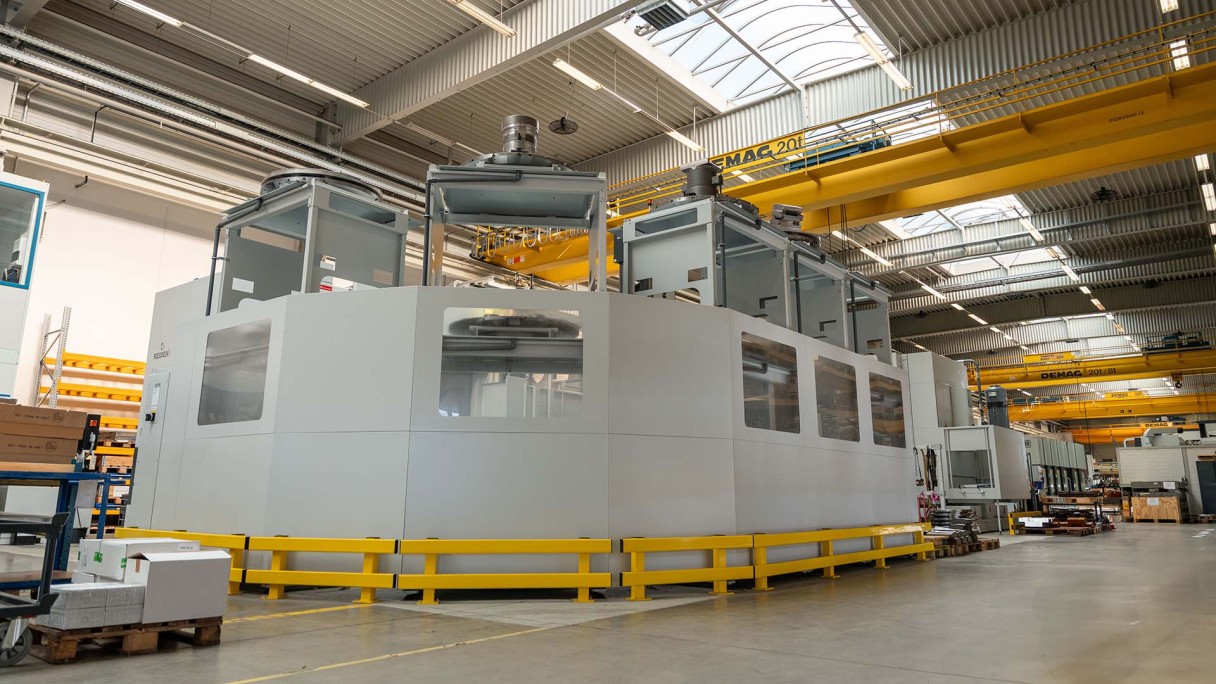
Compact system installation in the manufacturing hall
Integration into existing production environment
Integration into the existing production environment presented considerable structural and organizational challenges. The available space was limited, with pathways for forklifts, existing crane installations and the height of the hall needing to be taken into consideration. At the same time, staff needed to keep an eye on all parts of the system and be able to quickly intervene if necessary. A key factor for success at this point was the early involvement of users. An experienced machine operator participated in the project as a “key user” from the beginning and brought his practical experience to bear on the design. The result is a compact, ergonomically designed installation with short routes and excellent accessibility.
“Completely seamless project execution”
In addition to the technology, Köppern were also particularly impressed by the “completely seamless project execution”, according to Dr. Eggert de Weldige. Transparent planning, dedicated contact persons and clearly coordinated procedures gave the project the required level of assurance. Day-to-day production only serves to reinforce the initial positive impression. Communication is reliable, and modifications are implemented quickly. Support is also provided remotely where necessary and ensures smooth operation.
Köppern
Sector:Machine construction and plant engineering
Company headquarters: Hattingen (Germany)
Employees:approx. 300 employees
Founded:1898
Website:koeppern-international.com/en
Flagship project with a significant message
For Köppern, the system is more than an investment in new technology. It shows how modern, automated individual part manufacturing can be implemented even in heavy machinery production by medium-sized companies. “We have already had numerous visitors, including representatives from renowned companies. Many are impressed with how far we have already come in terms of manufacturing, and the technical and organizational options available these days,” reports Johnannes Deutsch. The investment provides new manufacturing options, increases productivity, and likewise functions as a ground-breaking starting point for further plant automation and digitalization of manufacturing in heavy machinery production.