
Crossing calendars and cultures
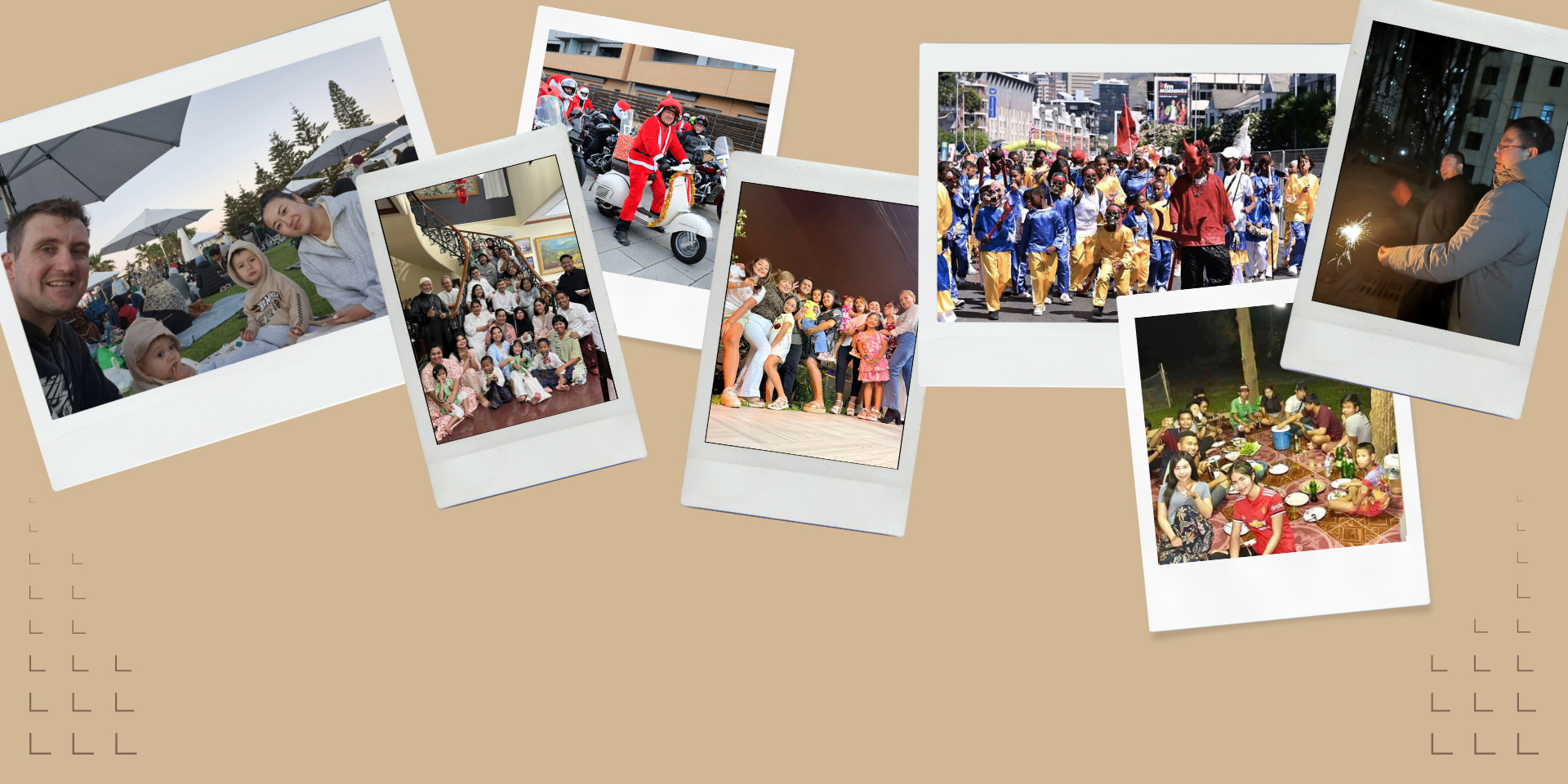
Operating in over 50 countries, the Liebherr Group brings together numerous cultures and traditions. This journey crossing calendars and cultures reveals the regional and religious New Year traditions observed by seven employees from China, Spain, South Africa, Thailand, Chile and Australia.
New Year traditions from around the world
It is the last day of the year and Chris Jamieson is enjoying ice cream while watching a huge fireworks display. In preparation for midnight, Constanza Toro is counting out twelve grapes for each of member of her family. Nadia Thalib, on the other hand, is sitting thoughtfully at home, reflecting on the past few months. Javier Garayoa is also enjoying the peace and quiet of his own living room, but outside, young people are dancing dressed up through the streets of his hometown. Selvin Levendal, Seksan Srakaew and Owen Xu are also celebrating the turn of the year together with friends and family, at tables brimming with culinary delights.
These seven Liebherr employees are seeing in a new year. But they are not celebrating together or in the same place. In fact, in some cases, they aren’t even celebrating on the same day. The way in which the employees mark the turn of the year is as diverse as the Group itself. With their values and customs that they observe at home they also shape the sense of togetherness at Liebherr.
Owen Xu in China: at home for good luck
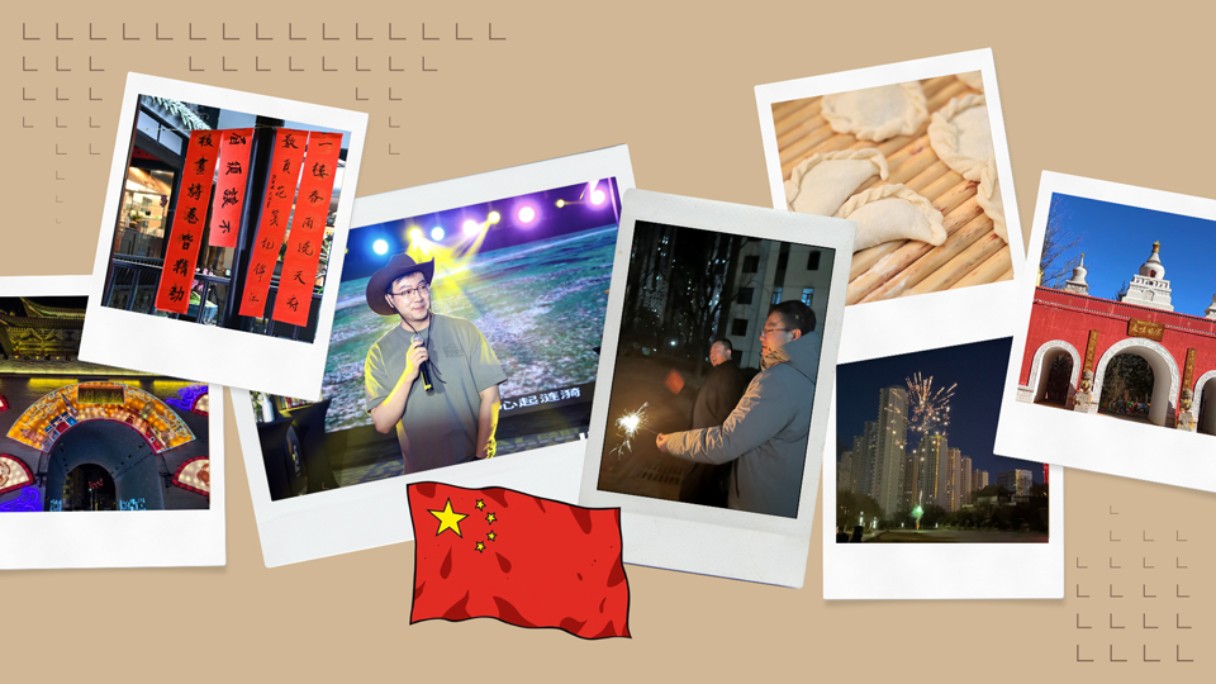
The holidays are just around the corner: Owen Xu has completed all his tasks and leaves the building of Liebherr (China) Co., Ltd. with a smile on his face. He works there as an environment, health and safety engineer, focusing on the sustainable development of the company. His excitement has a specific reason: the upcoming turn of the year. Owen Xu celebrates Chinese New Year, which is based on the lunar cycle. The celebrations are usually held between January and February, according to the Gregorian calendar. At this time, Owen Xu always travels from Shanghai back to his hometown 2,000 km away in the province of Qinghai. Finally, he will get to see his family again. For the youngest, he has packed ‘lucky money’. Traditionally, relatives give children the gift of money in red envelopes, which is said to bring good luck. Just like the ‘red couplets’ on which Owen Xu writes his wishes and attaches to the door of his parents’ home.
Chinese New Year
The Chinese calendar is based on the lunar cycle, with one year consisting of 12 or 13 months. Chinese New Year falls on the second new moon after the winter solstice and lasts for 15 days. According to the Gregorian calendar, this period falls between 21 January and 20 February. Its origins lie customs marking the start of spring. In addition, a legend tells that villagers scared away a monster that haunted them every year with loud noises and the colour red. These elements are still rooted in tradition. Today, Chinese New Year is celebrated not only in China, but in all countries with large Chinese communities.
The family get-together culminates in the reunion dinner, an important tradition for the evening. Owen Xu and his family prepare dumplings and other treats. Sitting around a table brimming with delicious food, they eat and chat. In the background, the official New Year programme plays on TV – until midnight. Then it’s time to head outside, where Owen Xu lights the fireworks. Throughout the neighbourhood, colourful bursts illuminate the sky as people wish each other success and wealth. After that, things turn quieter. Owen Xu and his family visit the temple and, the next day, they deliberately stay at home. ‘We don’t even take the rubbish out in case we chase the good luck away’, explains Owen Xu. So what does the family do all day? ‘We play Mahjong, but I always lose.’ It seems like Owen Xu will have to wait until the second day for the good luck he wished for.
Selvin Levendal in South Africa: between Braai and Carnival
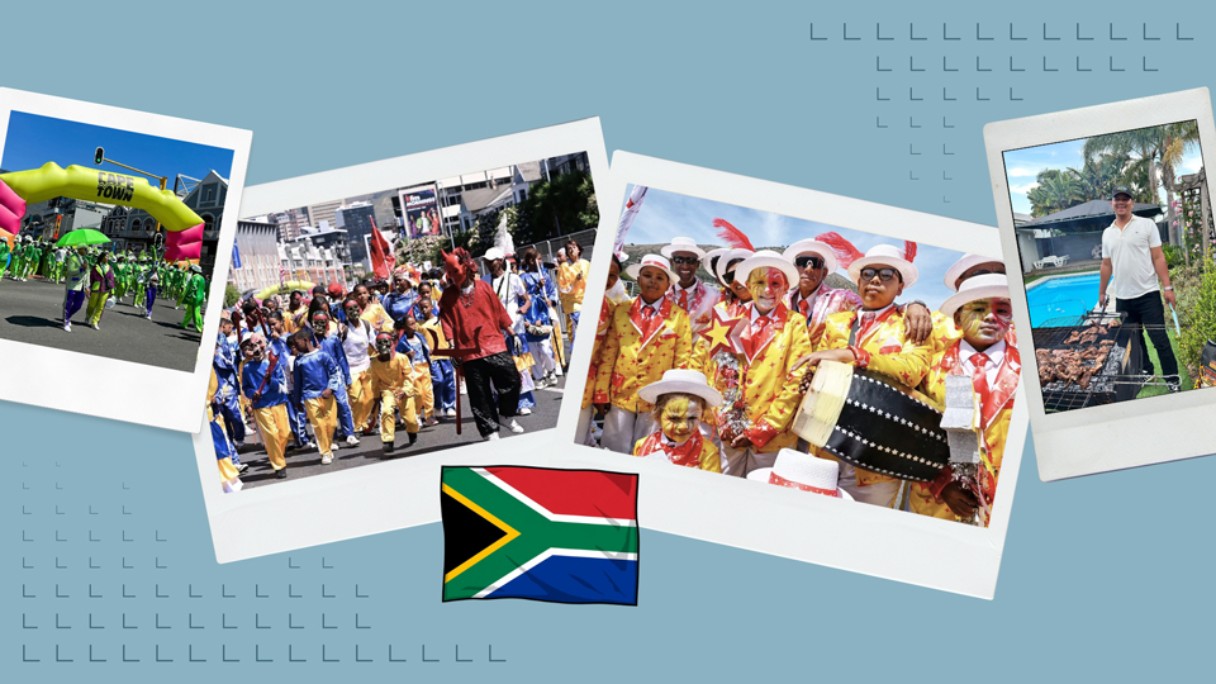
The scent of wood fire, steaks and sweet corn drifts through a garden in Cape Town (South Africa). More than 100 people have gathered on this summer evening, they are laughing and chatting. Women carry plates piled high with food from inside the house, while the sound of meat crackling over the flames fills the air. A few men are standing around the fire. Among them is Selvin Levendal. Normally, he can be found selling spare parts at Liebherr-Africa (Pty) Ltd. But on 31 December, he takes on a different role: the master of Braai – a typical South African barbecue over an open wood fire. Having gone to church earlier in the evening, Selvin Levendal is now at his mother’s house. As the oldest in the family, she is hosting the New Year’s Eve party. Each guest brings something for the feast, most of it destined for the Braai. Selvin stays by the fire the whole night, but he doesn’t go hungry: ‘After all, I have to keep testing the food to make sure it’s good.’
New Year’s Eve/New Year
According to the Gregorian calendar, a solar calendar, the last day of the year – often called New Year’s Eve – is celebrated on 31 December. The start of the new year therefore falls on 1 January, a date established by Julius Caesar. Customs involving fire – now fireworks – were introduced by the Germanic tribes, to ward off evil spirits. As the Gregorian calendar is widely used throughout the world, the majority of countries welcome the next 365 days on 31 December.
Before ringing in the new year, the crowd gathers for a family ritual. ‘Just before midnight, my mother says a few words. A prayer for everyone’s well-being and to remember the relatives who are no longer with us, because not everyone is a regular church goer, explains Selvin Levendal. And then we pop the sparkling wine and celebrate life.’ The party often lasts until the early hours and whoever leaves first has an important job the next morning: to save seats at theKaapse Klopse carnival which is held in the days that follow. This is a street party rooted in South Africa’s history. When slavery still existed, 2 January was the one day slaves didn’t have to work – a chance to celebrate their own New Year. Today, the carnival stretches over several days. Clubs parade through the streets in costume, playing music, and even competing in the stadium. Anyone who wants to spectate has to get there early or get someone to reserve a seat for them. That’s what Selvin Levendal and his family do, so that the party can keep going.
Seksan Srakaew in Thailand: the blessing of the water
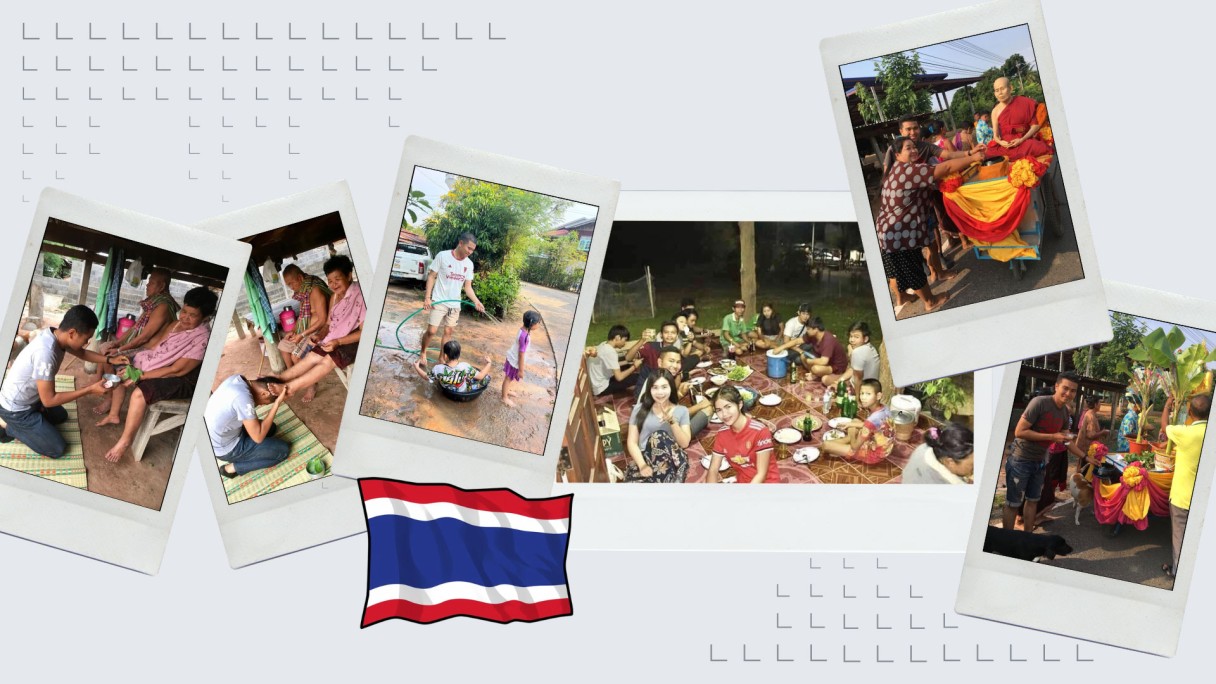
Every 13 April, Seksan Srakaew knows he’ll need a little extra patience on the road. It’s the start of Songkran – the three-day Thai New Year’s festival. The sun beats down on the gridlocked roads filled with people travelling to see their families. Seksan Srakaew has a few days off work from his job as a store officer at Liebherr (Thailand) Co., Ltd. in Rayong. He is making the seven-hour journey to his family in Buriram province. As soon as he arrives, Seksan Srakaew joins a procession. Monks parade through the village on carts and by foot, collecting alms. Seksan Srakaew also makes a donation and gently pours water over the monks’ hands. On Songkran, pouring water over the hands of elders or monks is a mark of respect. Younger people, in return, receive blessings and wishes for good fortune.
Songkran
Songkran, the Thai New Year, is always celebrated between 13 and 15 April. The word Songkran stems from an ancient Indian language and refers to the sun moving into a new zodiac sign. For Thai people, Songkran specifically means the transition from Pisces to Aries, based on the sidereal zodiac. This means that the start of the year falls on 13 April. The festival, with all its customs and rituals, has its origin in various myths. Songkran or a modified form of it is also celebrated in other south-east Asian countries, such as Laos, Myanmar or Cambodia.
Back home, Seksan Srakaew also honours his parents and grandparents with the water ritual. Kneeling before them, he holds a small, silver bowl of water in his hands. It smells of roses and jasmine. Using a leaf, he lets the water trickle over the hands of his elders. To bless her grandson with extra luck, Seksan Srakaew’s grandmother places her feet on his head – a tradition deeply rooted in the family. What began as small cleansing rituals has grown into joyful water battles across Thailand. ‘On the back of my car I keep a container full of water. I use it for water fights with my nephews and nieces. Or to splash people walking past our house, says the store officer. Over the next two days, the Thai New Year celebrations continue to revolve around water – and food. Seksan’s favourite food at Songkran? Papaya salad. A spicy speciality in his hometown.
Constanza Toro in Chile: an empty suitcase full of dreams
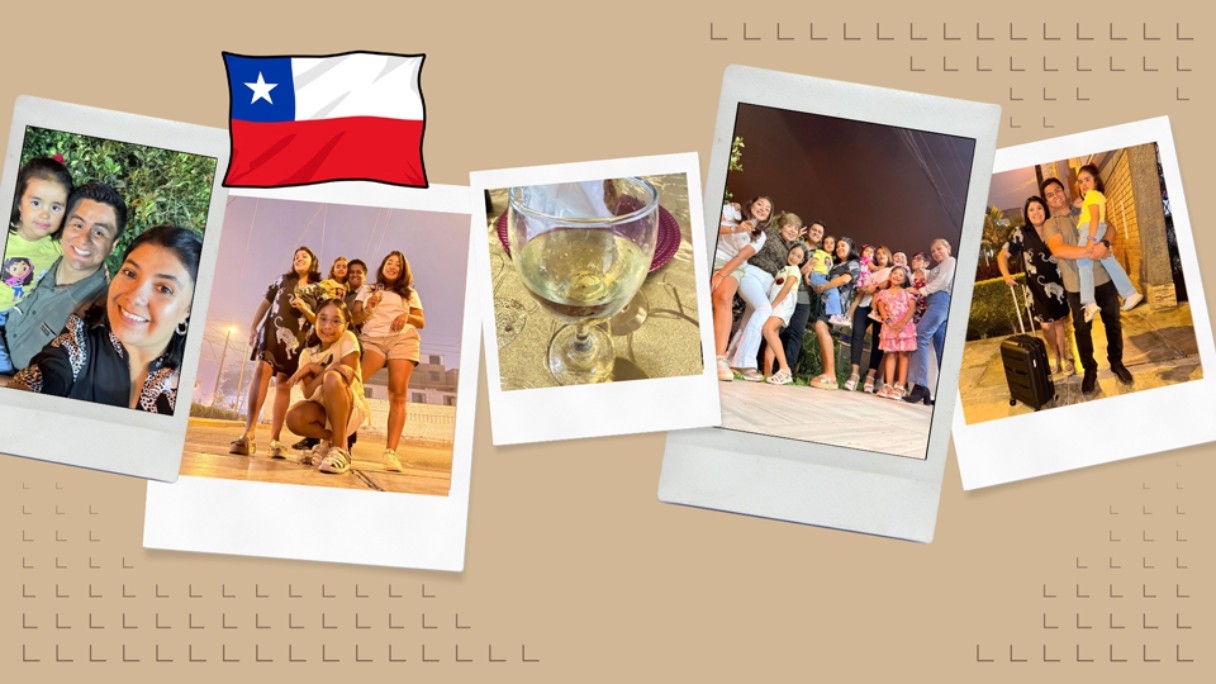
It is just before midnight at Constanza Toro’s home in Santiago de Chile. Everything is ready: her wedding ring rests at the bottom of a champagne glass, several single grapes lie on the table, and empty suitcases wait in a corner. But first, let’s rewind a few hours to the early evening of 31 December. In Santiago de Chile, it’s summer. Constanza Toro, marketing specialist mobile cranes at Liebherr Chile SpA, is standing in the kitchen with her husband and her 5-year-old daughter. ‘My husband prepares baked pork, a speciality from his hometown in Peru. I take care of the side dishes, such as rice, apple sauce or Caprese salad’, says Constanza Toro. She talks with her husband about the past year, what they have achieved, and what their plans for the next 365 days should be. ‘For me, New Year’s Eve means a fresh start’, explains the marketing manager. They continue their conversation over dinner, until the preparations for the stroke of midnight begin. That’s when the ring, the grapes and the suitcases come into play. When the clock strikes 12, Constanza and her husband first toast each other with the champagne glasses holding their wedding rings. This brings eternal love and good luck. Then they eat the twelve grapes, with each one symbolising a happy month of the new year. Finally, it’s the turn of Constanza’s favourite tradition, as she explains: ‘We walk outside the house with an empty suitcase, around the block, to attract a year full of travels.’ The little family is planning their next holiday in Columbia. Constanza is proud that her daughter already joins the tradition: ‘I learned this ritual from my mother when I was little. So I definitely want to pass it on to my own daughter.’
Chris Jamieson in Australia: chocolate ice cream on the beach
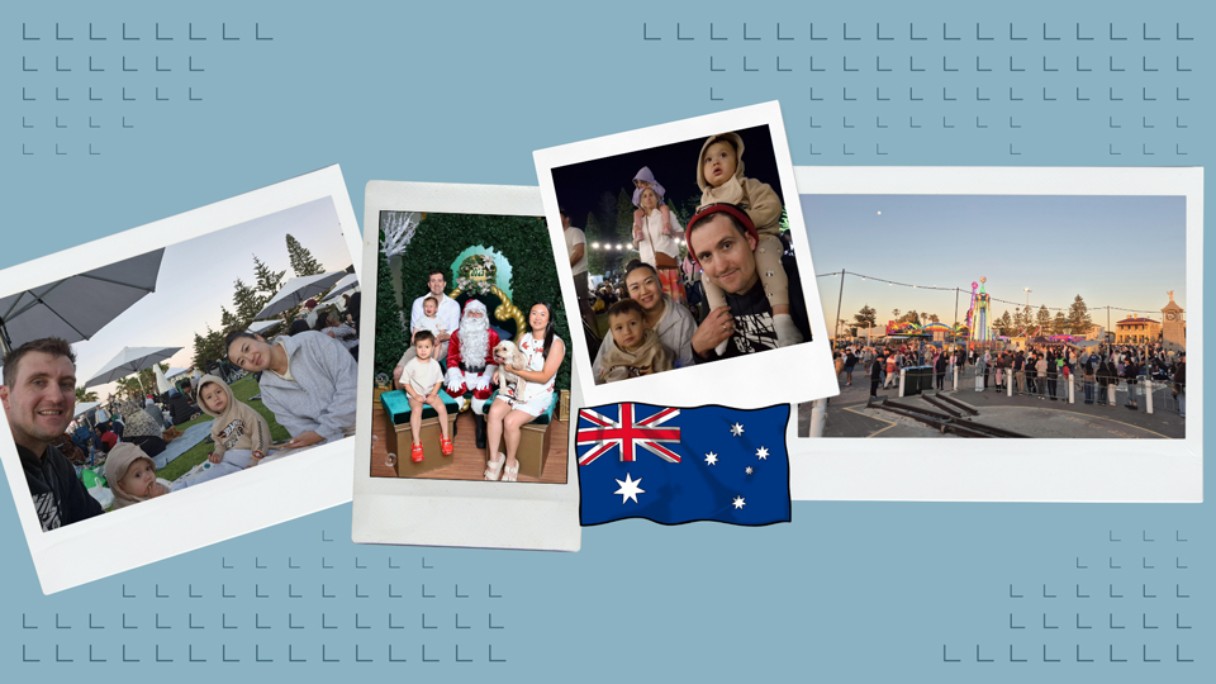
It is 31 December, the last day of the year according to the Gregorian calendar. Chris Jamieson, his wife and their two little boys, almost two and four years old, are heading to Semaphore Beach in north-west Adelaide (Australia). The beach is close to their home and not far from Liebherr-Australia Pty. Ltd., where Chris Jamieson works. He inspects the buckets of mining excavators at various points throughout the production process. Semaphore Beach has become the small family’s traditional destination for New Year’s Eve. Years ago, Chris Jamieson and his wife spent New Year’s Eve at his cousin’s cottage outside Adelaide. ‘That’s where my wife and I first met, at a different party’, he recalls. ‘So we always went back there for the New Year’s Eve party. Those parties always had a theme. One time it was Baywatch, another time superheroes.’ The cottage was eventually destroyed by floods. That’s one reason why the family now goes to Semaphore Beach in Adelaide on New Year’s Eve. And there is plenty for the children and adults to enjoy: a Ferris wheel, small and big roller coasters, and food stalls. ‘Fish and chips are a must, and so is ice cream. My kids and I prefer chocolate and my wife loves caramel’, says Chris Jamieson. At 9 p.m., the first fireworks are set off, bringing a sparkle to everyone’s eyes – kids and adults alike. Afterward, the family weaves through the crowd back to their car and heads home. Chris Jamieson starts the new year quietly, as he says: ‘The kids fall asleep on the journey home. Once we’re back at the house, my wife and I toast the new year at midnight. And of course share a New Year’s kiss. Then we go to bed too, because we know the kids will wake us at 6 a.m..’ Unlike others, however, the family doesn’t have to wait long for the next New Year’s celebrations. Since Chris Jamieson’s wife has roots in Hong Kong, the family also celebrates Chinese New Year.
Javier Garayoa in Spain: gifting happiness
Strolling through the streets of Pamplona (Spain) on the evening of 31 December, the party mood is palpable. People in costumes sip from bottles of beer or cava, dance and eagerly await the New Year according to the Gregorian calendar widely used throughout the world. Javier Garayoa used to be part of this lively crowd. But that was more than three decades ago. ‘Only the young people still head downtown to party’, he explains. Today, he prefers the peace and quiet of home, spending the evening with family and friends. Everyone brings a dish for the shared dinner and together they watch the New Year’s Eve shows on TV together.
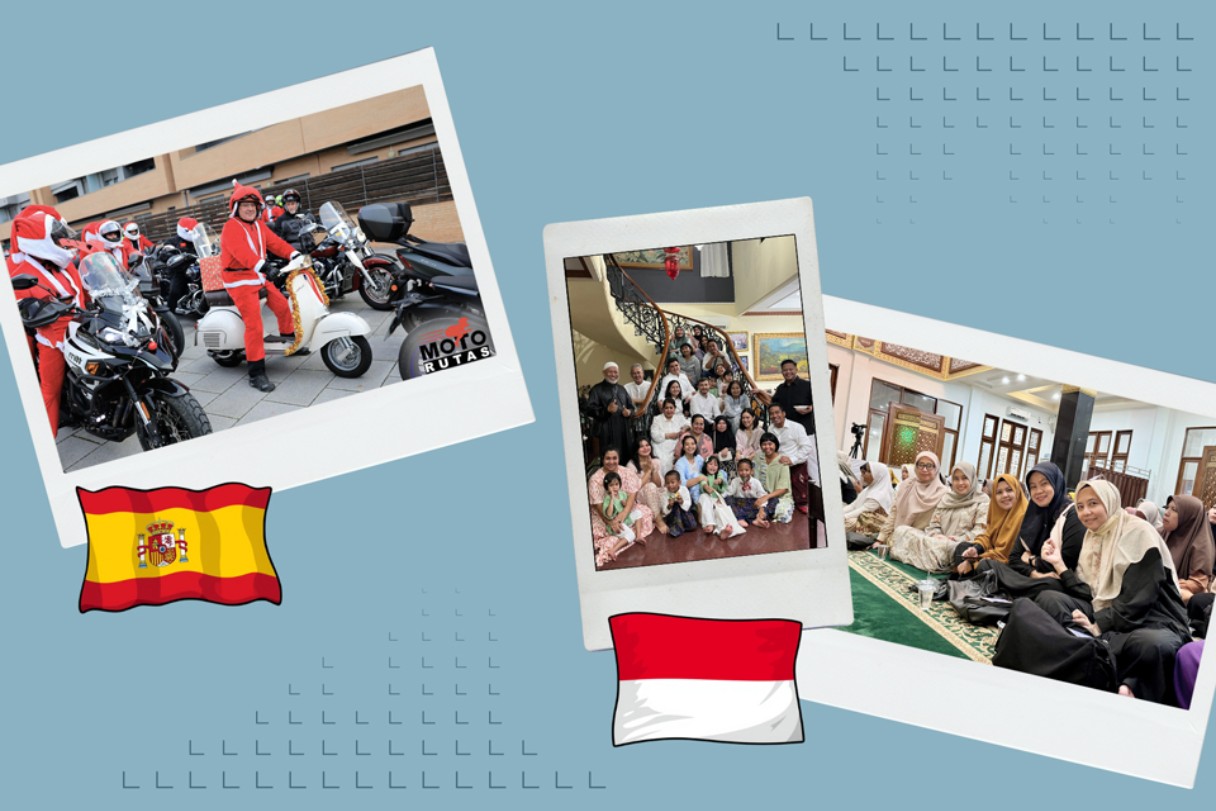
At midnight, it’s time for action again. With each of the twelve chimes of the clock, they must eat a grape. It’s a tradition that is believed to bring good luck. It’s hardly surprising that Javier prefers a quiet and relaxed celebration on New Year’s Eve. As a production engineer, he implements special projects for Liebherr Industrias Metálicas, S.A., and often has to travel. Over the New Year period, things get particularly busy for him, but not because of his work. Javier sings in several choirs, which perform concerts from late November through early January. Not only that, but on the Sunday before Christmas Eve, he also takes on the special role of Santa Clause’s helper. Together with several hundred other people, he collects gifts on his old Vespa, dressed in a Santa suit. He then brings these presents to the local children’s hospital. It’s a highlight for the kids who have to spend Christmas and New Year there. More than 700 gifts are gathered, enough to brighten birthdays throughout the year. For Javier Garayoa, it’s a project close to his heart. And proof that gifting happiness can be the most beautiful tradition.
Nadia Thalib in Indonesia: a firework for the soul
‘For me, a new year means a time for self-reflection, evaluating past actions called Muhasabah and an opportunity to begin with a good deed and inner peace’, says Nadia Thalib, describing her personal turn of the year. As finance and account manager at PT. Liebherr Indonesia Perkasa, she leads a team of nine. She has been part of the Liebherr Group since 2015 and, recently moved from Balikpapan in Borneo to the metropolis of Jakarta. As a Muslim, Nadia Thalib celebrates according to the Hijri calendar. The 354 or 355-day year begins with the first day of Muharram. Since the Hijri calendar follows the moon, the date of the first day of Muharram shifts each year in the Gregorian calendar. ‘On the evening before the first day of Muharram, we attend religious gatherings like lectures, praying together in the mosque’, Nadia Thalib explains. ‘When I’m in Jakarta at that time, I spend the evening alone at home’, she continues.
Hijri
The Hijri New Year is based on the calendar of the same name, which is a lunar calendar with twelve lunar months and a total of 354 or 355 days. The journey from Mecca to Medina by Muhammad, the founder of Islam, is considered to be the origin of the Hijri. Each new month starts as soon as the crescent moon can be seen again after the new moon. And the same applies to the first day of Muharram, the first month. In the Gregorian calendar, this means that the Hijri New Year always takes place on a different date. Muslims around the world celebrate the Hijri New Year. In some countries in North Africa and the Middle East, as well as in Indonesia and the Philippines, it is a national holiday.
But she hopes to celebrate the next Hijri New Year with her family in Balikpapan. There, they visit the mosque together and eat a stew made with coconut milk and served with rice. Followed by sponge cake for dessert. Traditions like fireworks at midnight are not part of the Hijri New Year. Instead, the focus is on self-reflection and becoming a better person, a true firework for the soul. In general, every Islamic religious celebration is accompanied by activities of sharing with others, whether in the form of money or food. This act of giving is extended to everyone without considering ethnicity, race, or religion, reflecting the universal values of compassion, generosity, and social harmony in Islam. So it’s no surprise that most Muslims perform a good deed on the first day of Muharram. And that goes for Nadia Thalib too: she distributes food at an orphanage, allowing her to start the new year with a sense of personal inner peace.
Other New Year’s traditions
Who celebrates when and why?
More New Year’s traditions and customs are observed in other individual countries, religions or cultures. For example, in some regions, the start of the new year is marked by the Hindu festival of light, Diwali. In Vietnam, Tết Nguyên Đán is celebrated according to the Vietnamese lunar calendar. According to the Persian calendar, the new year starts on the spring equinox, so on the 20 or 21 March. Jews celebrate Rosh Hashanah, the first day of the seventh month, and not of the first month, according to the Jewish calendar. And so there are countless other festivals, customs and traditions that reflect the diversity of the world population.