

4 minutes - magazine 01 | 2026
A giant on tour
When a crawler crane like the LR 12500-1.0 from Liebherr goes on a journey, it is like a logistical masterpiece. Each stage has to be planned precisely in order to get the crane to its destination safely and on time.
Shipment of the LR 12500-1.0 to South Korea – a transport of superlatives
The crane covers an impressive distance from Ehingen in southern Germany to Masan in South Korea. But how can a giant of this kind be transported across continents?
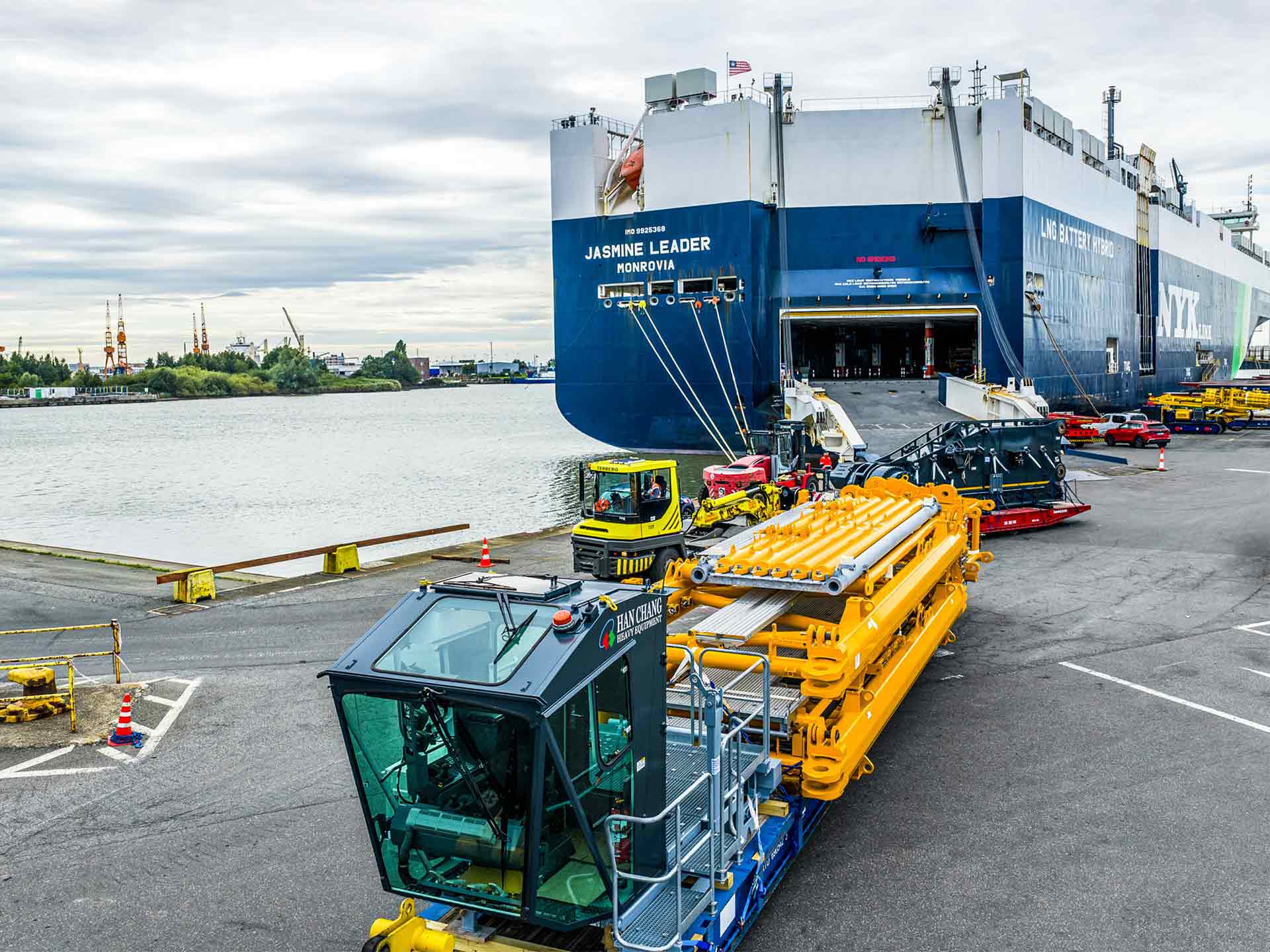
Arrival in Bremerhaven. The components of the LR 12500-1.0, weighing several tonnes, move from the quayside to the deck. Each step follows a precisely planned sequence.
By road, rail and sea
The heavy goods transporters set off with a low hum. The huge main components of the LR 12500-1.0 leave the Liebherr plant in Ehingen and travel across Germany to Bremerhaven. Due to the enormous weight and the limited load-bearing capacity of the bridges on the A7 motorway, the special transport vehicles have to divert to the A9 and A2 motorways – past Nuremberg, Leipzig and Magdeburg. While the road convoy takes its diversions, the ballast weights weighing several tonnes travel by rail from the Allgäu to the port, where they meet their companions.
There is a lot of hustle and bustle at the port. All of the crane components are prepared for shipping, trailers are carefully stowed and loaded onto the huge RoRo ship – a floating multi-storey car park that holds thousands of cars as well as heavy-duty decks for construction machines and cranes – within two days. And then: cast off! From Bremerhaven, the ship sets course for Masan in South Korea. It has around 43 days on the high seas ahead of it – a journey halfway around the world.
Mission: Port Handling
On arrival in Masan, our customer Hanchang Heavy Equipment Co., one of South Korea’s leading crane companies, takes delivery of the LR 12500-1.0. And this is where the actual work begins: for SK Oceanplant, a specialist in offshore wind turbines, steel pipe production and shipbuilding, the crawler crane works in tandem with an LR11350-P1800. Together, they load huge monopiles and tripods onto special ships – foundation parts weighing tonnes for wind farms off the Korean coast and for export worldwide. Particularly impressive is the fact that the heaviest component weighs 1,100 tonnes and is moved at a radius of 30 metres. With its enormous load capacity and large working radii, the LR 12500-1.0 is perfect for this mission.
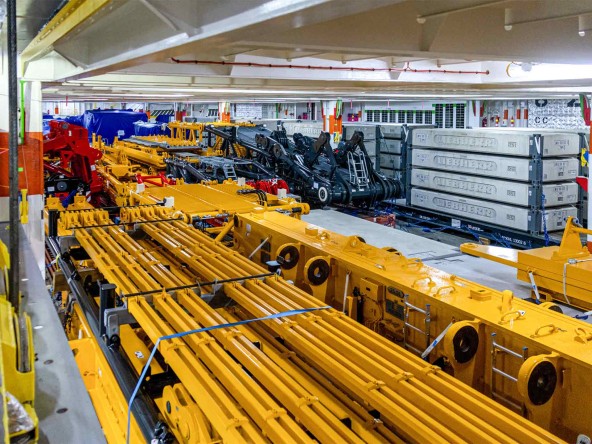
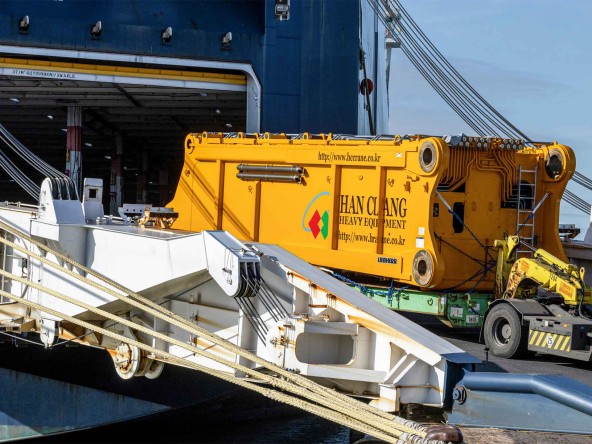
Millimetre precision: the parts are carefully positioned between markers and guides and securely fixed for the journey to Asia.
Down to the last detail
However, the journey of a giant does not begin on the road, but around the planning table. The project teams sit down together months before the first parts of the LR 12500-1.0 hit the road. Because transport of this dimension requires precision: a lead time of four to five weeks is required to ensure that everything is ready for shipping at the port.
Behind the scenes, a lot of complex interactions are happening. A project of this size could not be accomplished without close coordination between the shipping companies, suppliers and logistics partners. It’s not just about deadlines and costs. Technical details such as mass, centre of gravity, lashing points and point loads need to be taken into account precisely. Packing lists, loading plans and drawings are indispensable tools. Numerous discussions and consultations ensure that every detail is right in the end and the giant can set off on its journey.
Sustainability in mind
Even with international crane shipping, sustainability has a role to play. Wherever possible, Liebherr chooses environmentally friendly solutions. There is no alternative to road transport for the main components, but the ballast weights travel by rail – saving around 67 lorry journeys across Germany. Whenever possible, Liebherr uses the latest generation of ships for sea transport in order to reduce emissions. The shipping of a large crane such as the LR 12500-1.0 is a logistical feat. Thanks to precise planning, technical expertise and close cooperation with partners, even the greatest challenges can be mastered and the crane brought safely to its destination.
This article was published in the UpLoad magazine 01 | 2026.