


News | 25/09/2017
The 75,000th excavator at Liebherr-Hydraulikbagger GmbH, the founding plant of the Liebherr Group, has been delivered. This is a good reason for the company and its around 1,700 employees to celebrate. The anniversary machine was unveiled to the staff during a celebratory event in the production plant. The A 918 Compact Litronic wheeled excavator received a special graffiti design by Claudia Walde, aka MadC, one of the world's most well-known graffiti artists. The compact wheeled excavator will join the fleet of Liebherr Rental Services.
The properties of the A 918 Compact Litronic still correspond to the original requirements of the company's founder Dr.-Ing. E.h. Hans Liebherr for a mobile, robust and ergonomic earthmoving machine with high availability. Liebherr wheeled excavators are known all over the world for their efficiency, flexibility and performance because they combine modern technology with many years of experience in the development and production of construction machines. This linking of tradition and innovation is decisive for the success of the company.
Back in 1954 Hans Liebherr laid the foundation for a new type of machine with his first L 300 wheeled excavator which to this day is still among the best in the world. Another big innovation followed a short time later. The A 650 wheeled excavator was the first fully hydraulic wheeled excavator from Liebherr in 1960. Liebherr-Hydraulikbagger GmbH also has another anniversary to celebrate this year. In 1967 Liebherr developed a so-called railroader, the A 400 ZW, for use on railway tracks. For over 50 years now the company has been successfully offering railroaders in its range of products and it quickly gained market leadership in this segment in Germany. In 1989 the Litronic followed as another innovation highlight from Liebherr. The Litronic is a complete system of intelligent electronics and functional hydraulics for monitoring, controlling and coordinating all key systems of the excavator. The perfect interaction of machine and tool attachment plays a decisive role for successful deployment on site. This is why Liebherr also invested in this area and in 2001 was able to present its fully automatic quick coupler system LIKUFIX. With LIKUFIX the machine operator can change all mechanical and hydraulic tool attachments at the touch of a button from the cab as well as adjust the hydraulic pressures and volumes. Further developments are continually being added in all areas in line with the motto "Standing still is a step backwards". Since the beginning of the 2000s the innovations have been shaped by the topic of efficiency as well as the vision of the digital construction site.
You might also be interested in
17/11/2026
Press releases
ESBTP relies on the versatility and robustness of Liebherr machines
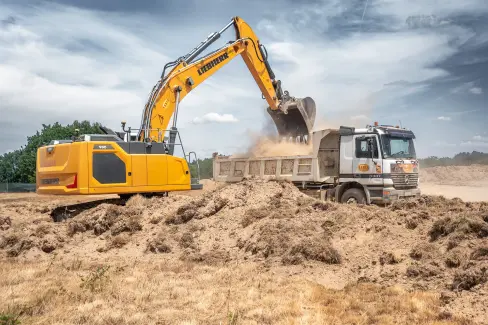
Family-run company ESBTP, based in south-west France, operates in a wide range of sectors, from the extraction and processing of construction materials to earthmoving and infrastructure works. A Liebherr customer for around twelve years, the company now operates nine machines from the construction equipment manufacturer, including a particularly versatile L 586 XPower wheel loader.
17/11/2026
News
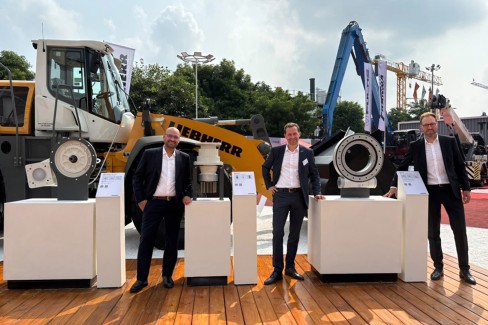
Liebherr’s slewing bearings and drive technology: face to face with the markets of the future
From dynamic growth markets in the construction industry, through the maritime transformation up to wind energy: This year’s trade fairs highlighted diverse opportunities and challenges in the core markets of the two business units of the Liebherr’s components product segment – slewing bearings and drive technology. The following trade fair reviews illustrate the issues that are currently shaping the industries.

13/11/2026
Press releases
Three Liebherr cranes support heritage-compliant renovation of the Dutch government quarter
Three Liebherr 340 EC-B 12 flat-top cranes are supporting the renovation of the historic Binnenhof in The Hague. The construction company J.P. van Eesteren has been using the brand-new cranes for material transport and assembly work at the parliament and ministry buildings. Jib lengths of up to 75 metres and a compact design make it possible to work in the confined space of the listed building ensemble.