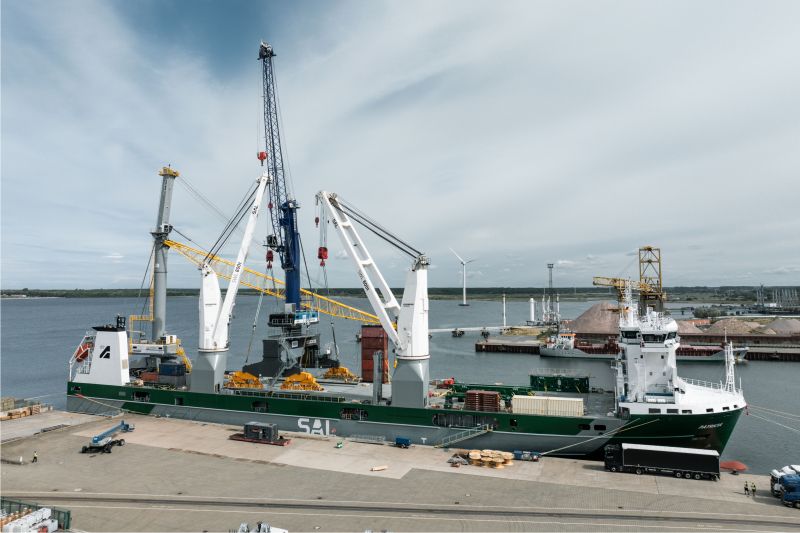
Built for the next chapter of Baltic handling. Liebherr has delivered two LHM 550 mobile harbour cranes to Baltic Container Terminal Gdynia following a tender supported by EU funding and governed by a fixed June 2026 delivery schedule, with all project milestones achieved on time according to plan. The new units are configured for container handling and complement two existing LHM 400 cranes already in service at the terminal, creating added continuity in operations, maintenance and operator familiarity. Equipped with Pactronic, the cranes are designed to improve energy efficiency during demanding handling cycles, while electric-drive readiness enables future retrofit at a later stage should operational strategy require it. The machines also feature specially dimensioned supporting pads adapted to the berth structure, reflecting the importance of precise engineering integration at quayside. Prior to handover, an eight-hour endurance test confirmed stable, trouble-free performance under continuous operating conditions.
Supporting a growing gateway in the Port of Gdynia
Container handling at the terminal began in 1979 and the site has been part of ICTSI since 2003, giving it both longstanding regional roots and the backing of a global terminal operator with operations across multiple continents. Today, the terminal serves as a key link in Polish and Baltic logistics, with excellent access to road and rail corridors and the distinction of being the only terminal in Gdynia able to accommodate full-length container trains to southern Poland and Central Europe.
Its current handling capacity stands at around 1 million TEU and recent figures underline the momentum behind that role, with total throughput reaching 558,331 TEU in 2025 and rail accounting for roughly 20 per cent of volume. Recent quay works have already enabled the terminal to receive vessels of up to 400 metres in length, while further development is expected to support berth handling capacity of between 1.2 million and 1.6 million TEU depending on final crane configuration.
Wojciech Szymulewicz, Chief Executive Officer of Baltic Container Terminal Gdynia, said: ‘These new cranes give us added flexibility exactly where it matters most: at the interface between vessel, terminal and hinterland. They support our growth plans, fit our operational model and strengthen our ability to serve customers with consistency as the terminal enters its next phase of development.’
The investment forms part of a broader programme that has included new ship-to-shore cranes, RTGs, terminal tractors and digital systems aimed at raising productivity and aligning operations with European requirements. At the same time, expanded quay infrastructure, upgraded crane rails and improved utility systems are preparing the site for larger ships and more demanding service patterns. Within that context, the arrival of the two new mobile harbour cranes is both a practical capacity enhancement and a measured contribution to the terminal’s longer-term transformation.
Engineered continuity for long-term terminal development
The LHM 550 is well suited to ports balancing scale, versatility and berth-side adaptability, and in this case the configuration has been aligned closely with local operating conditions and the terminal’s development trajectory. Alongside container handling performance, the project scope includes extended warranty coverage for key components, metal structures and paint systems, supporting long-term asset protection in a demanding maritime environment. That approach reflects a focus on dependable operation over the full service life of the cranes rather than on short-term output alone. The result is equipment designed to integrate smoothly into an established terminal while leaving room for future technical and operational evolution.
Liebherr’s sales and service network provides the framework required for high-availability port operations, with technical support structured to minimise downtime and maintain continuity in daily handling activity. For terminals operating within tight vessel windows and complex inland logistics chains, responsive service is a practical requirement that underpins performance as much as the machine itself.
Andreas Müller, Managing Director of Liebherr-Rostock GmbH, said: ‘Our cooperation with Baltic Container Terminal Gdynia is built on many years of trust, technical dialogue and shared standards in execution. Delivering this project on schedule and to the required specification is an important result in itself, and it also sends a clear signal about what strong partnerships can achieve when both sides work with consistency and long-term intent. We see this as a continuation of a successful relationship and as a sound basis for further projects in the years ahead.’
With quay expansion progressing, vessel sizes increasing and intermodal links gaining further importance, the terminal is entering a phase in which equipment choices carry strategic weight well beyond the berth. The two new cranes add capacity, continuity and engineering precision at a moment when each of those factors matters. For the customer, they support a clear ambition to grow in step with market demand and infrastructure development. For Liebherr, the project stands as a carefully executed contribution to a terminal whose role in Baltic cargo logistics continues to strengthen.