


News | 18/01/2016
One of the most impressive industrial monuments in Germany has been providing reliable service for more than 80 years: the boat lift in Niederfinow on the Oder-Havel Canal. On this waterway which connects Berlin to Szczecin in Poland, the boat lift helps traffic to overcome a 36-metre elevation. The vertical lift hoists barges up to 80 metres in length using a massive water trough which can be closed like a lock chamber. But over the decades this imposing product of German engineering has become too small. Longer inland vessels and container ships with higher superstructures will not fit into the trough whilst tug and barge combinations must be lifted separately. So for the last seven years a more powerful lift for barges has been under construction a stone's throw away. Two Liebherr LR 1600/2 crawler cranes have been fitting concrete blocks weighing a total of around 10,000 tonnes to the new lift over the last few months. These will be used in the future as counterweights for the water trough and the vessels. The cranes needed particularly long runners with a large load capacity to install the counterweights into the structure.
The standard runner for this Liebherr crawler crane has a capacity of 36 tonnes and is two metres long. For this project, however, the customer, Belgian crane and transport specialist Sarens, asked Liebherr for a runner with a length of five metres and a capacity of 104 tonnes. And the engineers from the Ehingen crane plant delivered.
Only with this angled attachment was it possible for the cranes to swing their lattice mast below an interfering edge of the building and lowered the hook block from above through the car slings for the counterweights. Each hoist raised two ballast blocks weighing a total of 89 tonnes to a height of around 40 metres into the pre-assembled frames and then attached to the lift's steel cables which are as thick as a person's arm. The car slings later surround the entire weights in the various gaps to act as safety devices. In the event of a cable tearing, the released concrete block would be held by the cables around the other weights.
The two crawler cranes and the installation teams always worked at the same level on both edges of the new boat lift. For static reasons the counterweights had to be installed almost synchronously. The boat trough on which large tensile forces act through the steel cables must not be exposed to one-sided loads for long periods of time. There are also thousands of sandbags in the belly of the 115 metre trough. The more counterweights were attached, the more of these big bags were required to keep the trough on the ground.
You might also be interested in
04/11/2026
Press releases
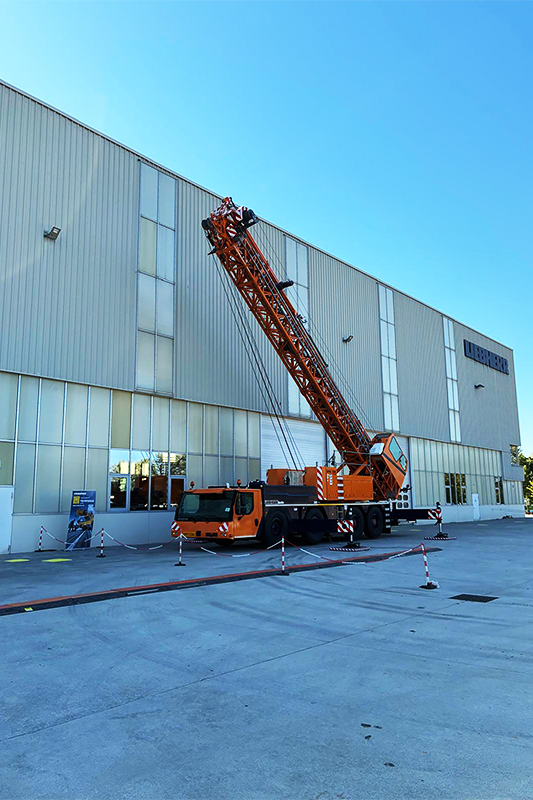
MK Week in Italy: Customers experience the Liebherr MK 88 Plus mobile construction crane in action
From 28 September to 2 October, Liebherr Italia S.p.A. organised an MK Week in Monfalcone for customers from Italy. The centrepiece of the five-day event was a used MK 88 Plus mobile construction crane.
03/11/2026
Press releases
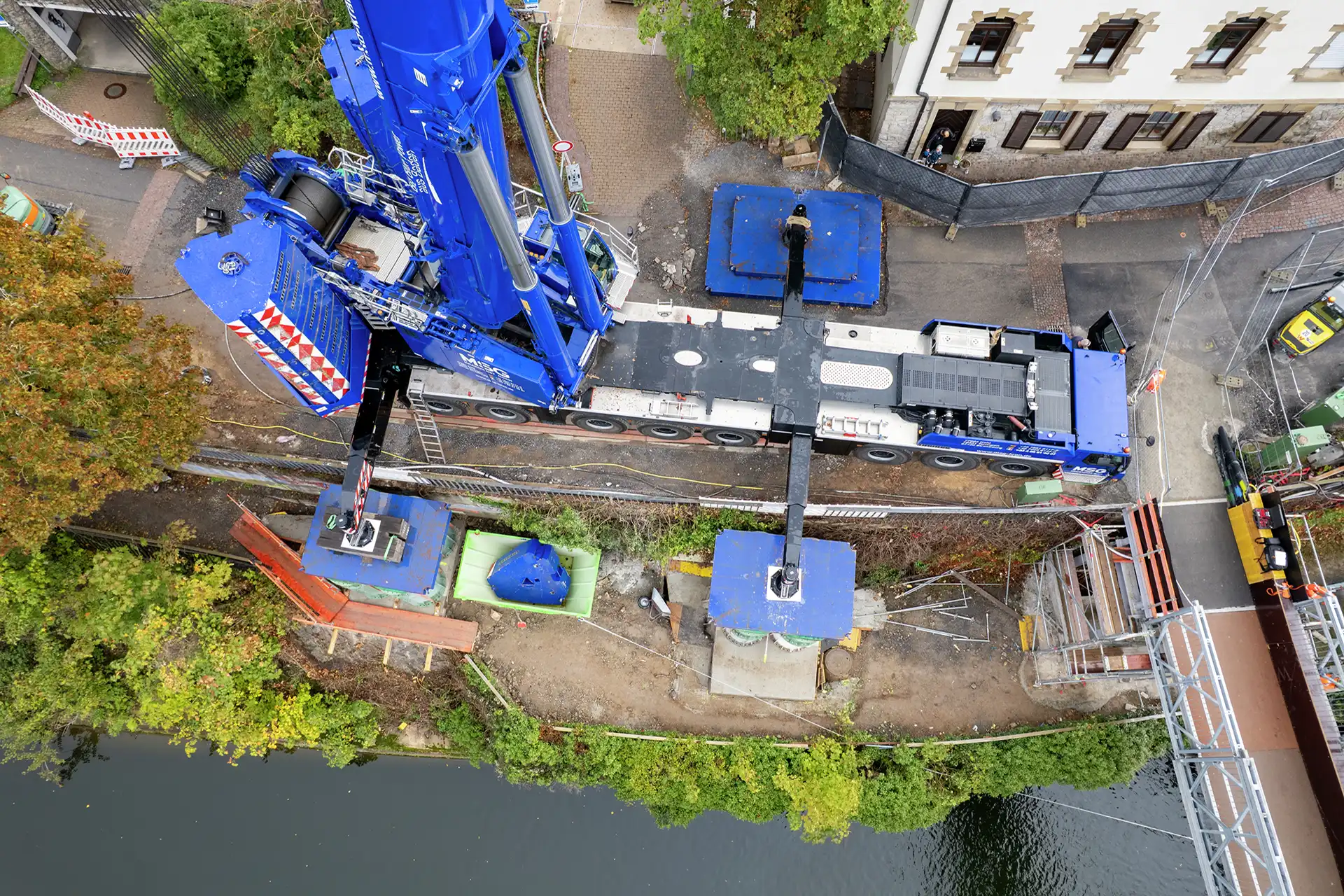
Liebherr LTM 1650-8.1 in a spectacular working position
A Liebherr LTM 1650-8.1 mobile crane from MSG Krandienst GmbH was used in Lauffen am Neckar to completely dismantle a dilapidated arch bridge dating from 1951.
02/11/2026
Press releases
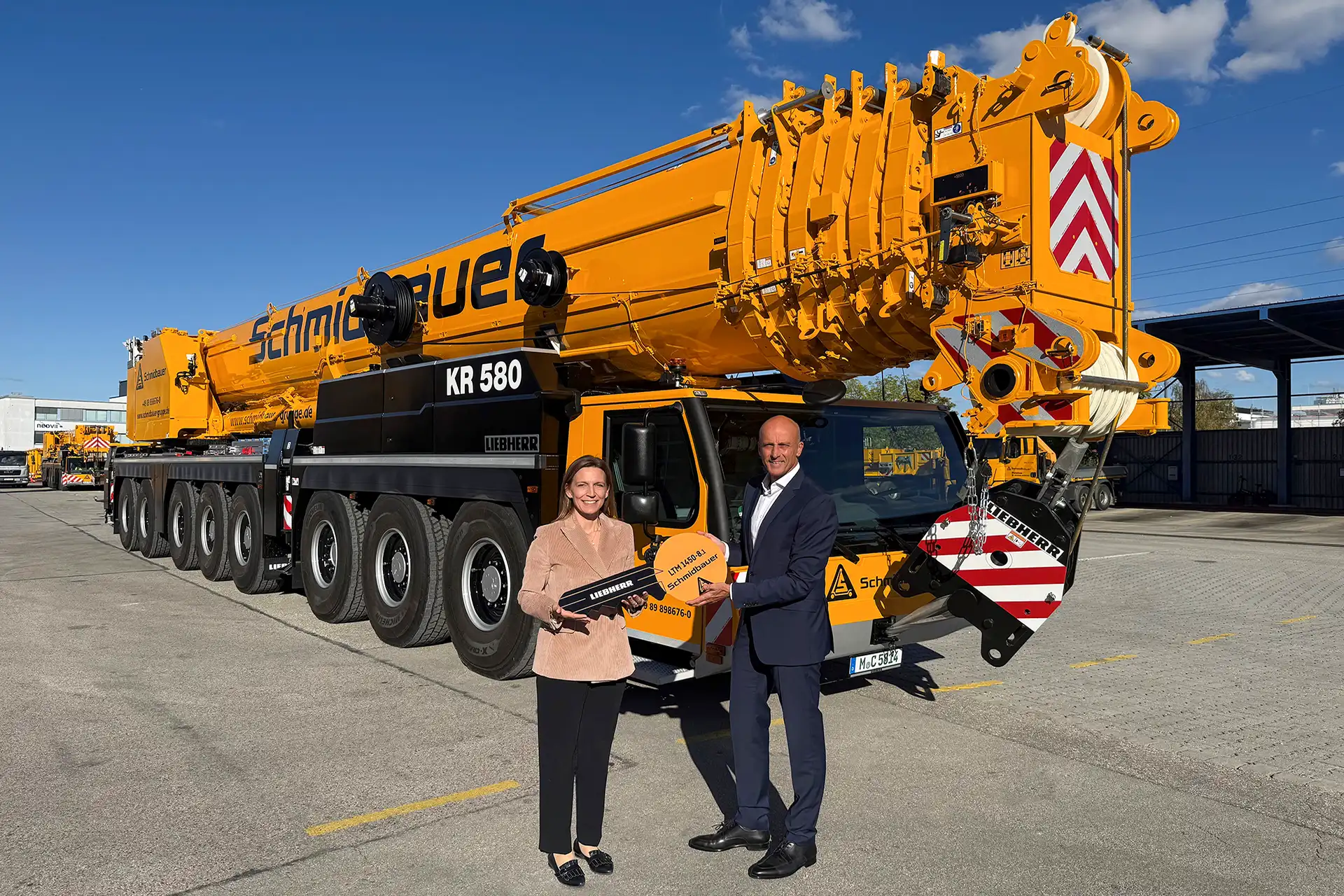
Schmidbauer invests in 17 new Liebherr cranes
Schmidbauer GmbH & Co. KG is making a major investment in the modernisation and expansion of its crane fleet and has ordered a total of 17 new cranes from Liebherr.