10 minutes reading time
Interview with the family shareholders
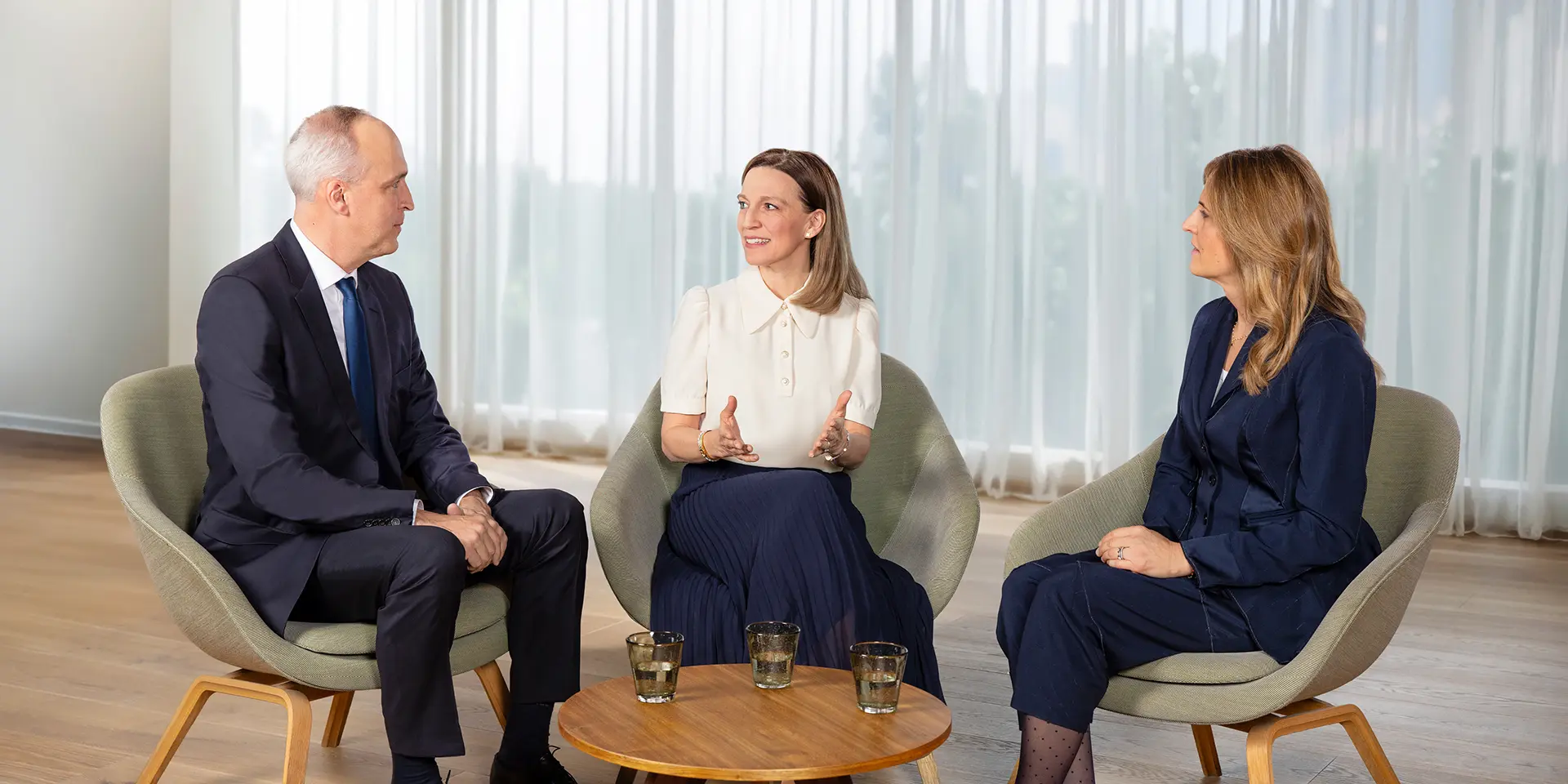
Jan Liebherr, president of the administrative board of Liebherr-International AG, and administrative board members Patricia Rüf and Sophie Albrecht look back on the 2025 business year, charting their Bauma highlights and offering insight into the Group’s long-term focus.
Which moments really stood out for you personally this past business year?
Jan Liebherr:
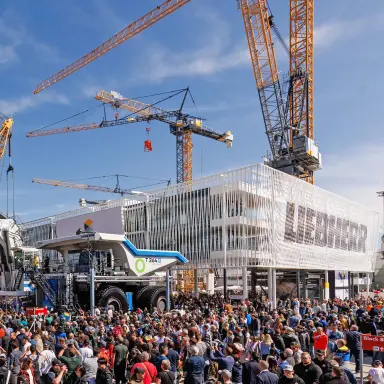
2025 was packed with moments that demonstrate just how innovative and future-focused our Group is. In particular, I’m struck by two leading international exhibitions we took part in. At the Paris Air Show, we showcased pioneering technologies and highlighted the specific role we now play as a reliable technology partner to the international aerospace industry. And it goes without saying that Bauma 2025 was a major event: with more than 100 exhibits and lots of practical innovations, we shone a light on the impact we are having on improving efficiency, safety and sustainability in the construction and mining industries.
Patricia Rüf:
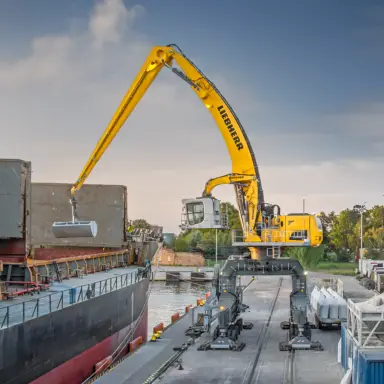
I was also really impressed with the extensive developments and milestones achieved across our various sites. In Ehingen-Berg, Germany, for instance, we broke ground on an extension to the factory, which marks an important chapter in the future of the crane business. In Brazil, we saw work start on expanding the production company facilities of Liebherr-Aerospace. In the USA, we opened a new building at our Saline, Michigan, site, further boosting our customer service capacity in aerospace technology. Meanwhile in Rostock, Germany, we celebrated production of Liebherr’s 2,000th mobile harbour crane.
You mentioned Bauma as one of the key events. Can you tell us more about the innovations that the Group presented at the exhibition? Which technologies and solutions has Liebherr been focusing on?
Sophie Albrecht:
In keeping with our ‘Hands on the future’ slogan, we presented solutions designed specifically for the construction sites and mining industry of the future, perfectly capturing our ‘doer mindset’. Never before have we exhibited such a wide range of alternative drive technologies. We presented the L 566 H hydrogen-powered large wheel loader, the HS 8100.2 dual power all-electric duty cycle crawler crane, the LTM 1150-5.4E mobile crane and the battery-electric T 264 mining truck. We also had intelligent assistance systems for fast-erecting cranes on display, alongside the new generation of the Mobilmix mixing plant series that offers reduced energy consumption. All together, these developments underpin our claim to be steadfastly improving productivity, safety and sustainability.
Patricia Rüf:
Winning the innovation award for the ‘Liebherr Autonomous Operations’ systems, developed for our autonomous wheel loader, was another clear sign that we are doing things right. For us, Bauma was so much more than just a product show: it demonstrated how we are actively shaping the technological transformation of our industry.
What was the best feedback you received from customers and partners visiting Bauma?
Sophie Albrecht:
The dialogue with our customers was hugely positive and really inspired us. We were particularly pleased to hear how often the practicality and reliability of our machines and the variety of our alternative drive concepts came up in conversation. The great interest in our digital services and connectivity solutions also indicated that the link between hardware and software plays an increasingly decisive role for many customers when choosing between us and our competitors.
2025 was a challenging year, providing proof if it were needed of just how strong and resilient our Group is.
What is your evaluation of overall business performance in 2025 and what do you think the determining factors behind that were?
Jan Liebherr:
2025 was a challenging year, providing proof if it were needed of just how strong and resilient our Group is. We had to react to trade measures, a restrained economy and increasing pressure from competitors in numerous product segments. Despite these economic conditions, we succeeded in maintaining a steady level of sales and recording a solid operating result. Parallel to this, our investments continued at the same level as the two previous years.
In which product segments did Liebherr see particularly dynamic growth?
Patricia Rüf:
Deep foundation had an especially good year, primarily thanks to the ongoing investments in the infrastructure and energy sector. The maritime cranes segment also continued its growth trajectory; demand was very stable in multiple regions. Within the aerospace and transportation systems segment, business was good, too, most recently buoyed by the growing demand for rail vehicles. And after a difficult previous year, the tower cranes segment was able to reverse its fortunes back to growth.
Sophie Albrecht:
By contrast, we registered downward trends or stagnating sales overall in the construction machine and mining industries. The global economic conditions and the knock-on effect of restrained investment had a negative impact that was directly felt by certain product segments. All in all, we are satisfied with the Group’s business performance.
Which sales markets surprised you – and why?
Jan Liebherr:
Various non-European markets saw a surprising level of growth. In Central and South America, parts of Asia and Oceania, and the Africa, Near and Middle East region, demand was stronger than anticipated. Several countries are currently showing signs of stabilising.
Patricia Rüf:
However, important core markets such as Germany, France and the United Kingdom are still suffering the effects of a weak economy. While initiatives in Germany – such as the ‘Bau-Turbo’ law to speed up construction processes or the 500 billion euro infrastructure programme – provided important momentum, it will take some time before their impact is really felt, plus they are reliant on consistent implementation. In the USA, we are feeling the effects of the measures in trade policy.
Companies are having to grapple with geopolitical tensions and trade measures. How did these affect Liebherr last year?
Jan Liebherr:
Political agendas, conflicts and the trade policy interventions that come with them have an impact on business activities across many industries. They set the framework for international trade, they can adversely affect supply chains and make it more costly to import goods. In the interim, uncertainty reigns on the markets. In a climate like this, people put investments on the back burner rather than run risks. We are seeing that with our customers, too.
Sophie Albrecht:
The latest US tariffs had a clear impact on our business activities, for instance. The United States is the second biggest sales market for Liebherr and has been a key site for 55 years with customer relations stretching back many years. For a short while, we stopped delivering certain products to the USA. Exports are back to normal now, though. Nevertheless, the additional tariffs result in additional costs, causing many customers to be more cautious with their investment plans. That is why we are adapting our processes, safeguarding our supply chains and remaining in close contact with our markets and our customers to ensure we can maintain a reliable supply for them.
Trade agreements, stable international partnerships and clear guidelines pave the way for fair competition conditions and, in turn, facilitate innovations.
As well as geopolitical factors, the sector is also feeling the effects of aggressive competition. What measures does Liebherr have planned to safeguard its market position in these complex circumstances?
Jan Liebherr:
Competition is ultimately a good thing. It gives rise to the best innovations. But it has to be fair competition. Unfortunately, that is something many markets do not currently guarantee, which can also be attributed to politically motivated trade measures. Liebherr faces these market conditions with transparency and resolve. We are consolidating the strengths that have moulded our Group for decades: reliable and durable products, innovative prowess, a global sales and service network and a strong brand. Our decentralised structure brings us close to our market and allows us to adapt to different market requirements.
Patricia Rüf:
This is possible thanks to our dedicated employees and a forward-thinking mindset that guides every decision in the company. From our perspective, national and international policy and administration is still needed to create the right conditions for economic growth. Trade agreements, stable international partnerships and clear guidelines pave the way for fair competition conditions and, in turn, facilitate innovations.
Despite this economic background, you have, as you mentioned, made significant investments again in 2025. What was the motivation behind that move and where have you invested?
Sophie Albrecht:
We are making targeted investments in our operational capacity in a bid to lay the foundations for future growth. In Ehingen-Berg, for example, we acquired a large plot to meet the increased demand for mobile and crawler cranes. At the same time, we have expanded our components production; take, for instance, the new hydraulic cylinder factory in Oberopfingen and investments in slewing bearing production at Biberach an der Riss. Outside of Germany, too, we are always increasing our capacities. Examples of this can be seen in our production and assembly capacities in Bulgaria, in the expanded production of aeroplane components in Brazil and in new logistics and service infrastructure in the USA. As an independent family-run company, we have the necessary freedom to act, enabling us to keep investing – even in a challenging market environment.
Today, digitalisation is a major driving force behind efficiency and innovation. Where and how does Liebherr utilise digital technologies and what initiatives have been launched to cement the role of pioneer in this field?
Patricia Rüf:
For us, digitalisation is a key lever for further improving efficiency, safety and sustainability. We are developing solutions that make work processes simpler and make our machines even safer and more productive. Examples of this are assistance systems, remote control solutions and autonomous products. It is against this backdrop that we are making targeted advances in the field of AI – both in order to optimise internal processes and to progress products and services for our customers.
How is the current uncertainty around the regulatory framework in the EU affecting Liebherr’s sustainability endeavours? Is it seen as a risk or as an opportunity to set your own standards?
Jan Liebherr:
We see the uncertainty as an opportunity. The demands on sustainability will keep growing all over the world, and we want to be fully prepared. That’s why we are creating transparency by voluntarily reporting on our business activities. In June 2026, we will publish our first comprehensive sustainability statement – structured around the new European reporting standards. For us, sustainability is not just a formal requirement, but an integral element of our corporate responsibility.
What progress have you made this past year in terms of sustainability?
Sophie Albrecht:
Last year, we have made great advances in our sustainability data in particular. For the first time, we now publish those greenhouse gas emissions generated not only by our own production, but also those generated throughout the entire value chain. It takes a lot of work to gather this data, since much of the information is outside our direct area of influence and we need input from our partners and customers to make it available. To approach this systematically, we have launched an overarching project to centrally pool core topics such as the European Deforestation Regulation, the Carbon Border Adjustment Mechanism and the CO2 calculation. All of this represents a lot of work, which can only be undertaken one step at a time. Over the long term, this work will help us enormously both with our sustainability management and in operational business.
People who come to work for us should be able to assume responsibility, drive forward ideas and find solutions themselves.
Which measures is Liebherr taking to attract qualified employees, and why do talented individuals choose your company?
Patricia Rüf:
The competition for qualified employees remains intense. It is therefore vital that we continue to clearly communicate what Liebherr stands for: challenging tasks and inspiring technology, reliability, strong team spirit and extensive freedom to act. This freedom opens up prospects for each individual to grow. This is why we make targeted investments in training, dual study programmes, international development opportunities and continuous professional development and targeted retraining. That way, we can create prospects and support our employees in their long-term professional development.
Sophie Albrecht:
People who come to work for us should be able to assume responsibility, drive forward ideas and find solutions themselves. This corporate culture has always been part of our DNA, and many regard this as real added value. It is what attracts many talented individuals to work for Liebherr and, in many cases, remain loyal to the Group over many years.
Lastly, let’s take a quick look at the current business year: what are your predictions for 2026?
Jan Liebherr:
Looking at our solid order book and the high volume of orders at the start of the year, we expect moderate growth for the current year.
Patricia Rüf:
In an environment shrouded by uncertainty, our strengths really come to the fore: namely, our enormous product range and our international presence. Both these strengths afford us stability and freedom to act. On this basis, we are always investing more and creating the right conditions for future growth.
Thanks so much for speaking with us.
This interview was conducted in March 2026.