



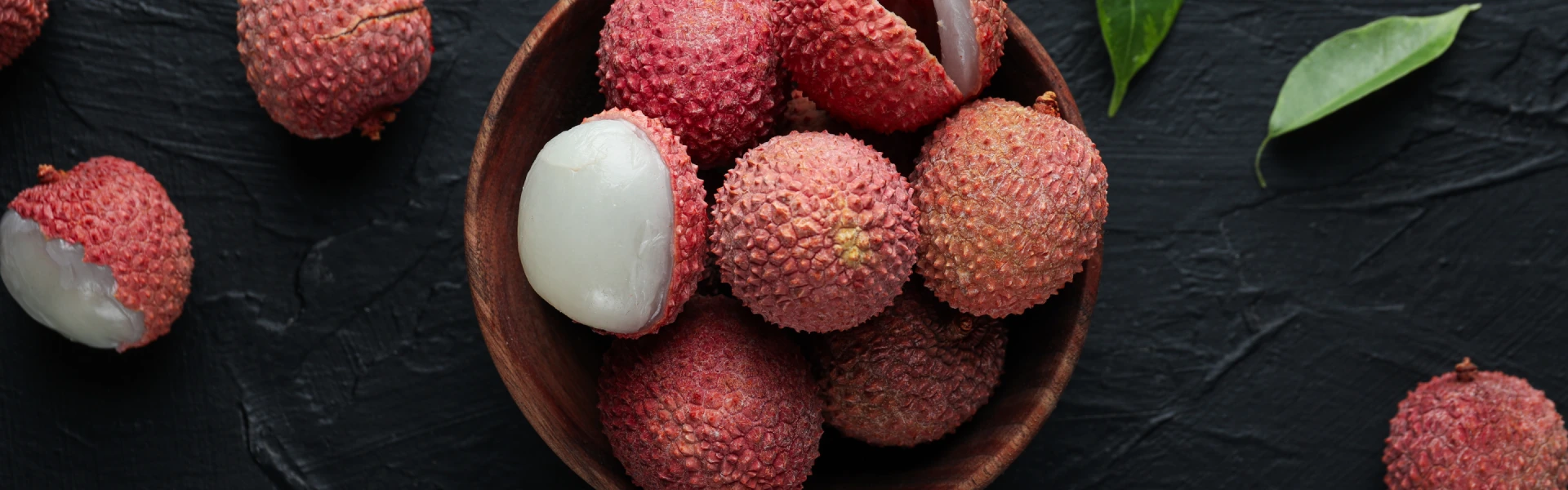
Lychee: how healthy is the fruit of love – and how much of it can you eat?
A lychee not only looks great visually, but also tastes truly wonderful. Originating from southern China, it has long since become established on international markets. Its sweet, slightly floral note and juicy bite make it a popular delicacy. But the fruit does more than just taste great. In Asia, it’s regarded as a symbol of love and passion, which is why it’s often referred to as the “fruit of love”. It boasts valuable nutrients, but is also high in sugar. If you want to know the truth about the myth of the high fructose content and why unripe lychees are indigestible, you’ll find all of the facts you need to know here.
Storage time*
| BioFresh Fruit & Vegetable safe just above 0 °C with high humidity | 24 days |
| EasyFresh safe 7 °C with air regulation plate | 12 days |
| Fridge compartment 7 °C | 10 days |
| Freezer compartment -18 °C | 6 Months |
The key points
- Lychee is considered the fruit of love, a symbol of love and prosperity in China.
- Rich in vitamin C, minerals, and antioxidants.
- The high fructose content is a myth.
- Store briefly at 10 °C or room temperature, can be kept longer by peeling, pitting, and freezing.
How healthy is lychee really?
Lychees are rich in vitamin C, contain vital minerals and antioxidants. But should lychees only be consumed in moderation because of their high fructose content?
Lychees are low in calories. 100 g of lychees will provide around 66 kilocalories and hardly any fat. In terms of minerals, they’re a good source of potassium (190 mg), calcium,magnesium, and phosphate. In addition, they contain small amounts of sodium,iron, and zinc. What’s more, lychees contain important vitamins such as vitamin C (40 mg), vitamin E, and various B vitamins, including B1, B2, B6, and folic acid.
All in all, lychees are a nutrient-rich fruit that is particularly impressive thanks to its high vitamin C content. This means they give a boost to the immune system, support heart and muscle functions, and contribute to cellular health. The polyphenols they contain have an antioxidant effect and can help to reduceinflammatory processes in the body.
Just a handful of lychees can meet a person’s daily vitamin C requirements, perfect during the winter when the immune system needs some support.
You can remove the skin of the lychee in the same way you would peel a boiled egg. The hard brownish-red skin hides the juicy white flesh of the fruit. Then chop the lychee in half so you can remove the inedible hard pit.
Serve lychees chilled as a dessert or in a fruity sorbet, a light, sweet way to round off a romantic meal. Lychees are grown around the world and nowadays they’re available almost all year round.

Should you not eat too many and only eat ripe lychees?
The natural fruit sugar content in the form of fructose is elevated at 7 g per 100 g of fresh lychees, but is comparable to that of other fruits, such as grapes. Lychees are potentially problematic for people with fructose malabsorption. For healthy people, the fructose content presents no risk when normal quantities are consumed. The notion that healthy adults should only consume ripe lychees in moderation is a myth that still persists.
However, unripe lychees contain natural non-proteinogenic amino acids that can significantly lower the blood sugar level.
These substances, hypoglycin A and methylenecyclopropylglycine (MCPG), which are found in unripe lychees, can trigger sudden hypoglycaemia. They present a particular risk to malnourished children, as has been documented in India on a number of occasions. In combination with an empty stomach, eating just a few unripe fruits can cause serious health problems.
You should therefore only eat ripe lychees with an aromatic fragrance. In addition, they must always be peeled and pitted before you eat them. Children should only eat lychees as part of a meal, not on an empty stomach.
Restaurants often serve canned lychees in syrup. They often contain a lot of sugar and are not as good a choice as fresh lychees.
Why is lychee considered the fruit of love?
The lychee is not just a sweet tropical fruit, but is also a symbol of love, passion, and prosperity. Its romantic reputation comes from Chinese culture, where it’s been revered as the “fruit of love” for centuries. Even more than 1,000 years ago, the lychee was a much sought-after gift in the imperial court.
A famous legend recounts Emperor Xuanzong of the Tang dynasty, who had a chain of riders on horseback deliver fresh lychees to his lover – a sign of real affection because the fruits only grew in certain regions of China and spoiled quickly.
Alongside its symbolic meaning, the lychee still impresses today with its delicate, sweet flesh. In Asia, it’s considered a real delicacy and is regularly served at festive occasions – often as a good-luck charm and an expression of love.
*All specifications given are to be considered as guideline values, and depend in each case on the type of food and on the proper storage without interruption of the cold chain from harvest/production through to the Liebherr appliance. Should food products have information about minimum shelf life, the date on the packaging always applies.

This text has been machine translated from English.