6 minutes - magazine 02 | 2025
Foggy mission
Last autumn, seven large Liebherr mobile cranes completed a remarkable mission in Southern Germany. The cranes – all of them LTM 1650-8.1 models – simultaneously raised four giant masts supporting an existing high-voltage power line.
18 Liebherr mobile cranes reinforce power line
The lattice towers had to be equipped with large intermediate sections at the bottom or rebuilt in order to increase the live cables’ distance off the ground and the power line’s capacity. There were numerous smaller LTM mobile cranes on standby around the construction sites to help with these assembly operations on the overhead line masts. Due to the electricity switch-off required, the work started at all four sites simultaneously. A total of 18 Liebherr cranes took part in this event, which spanned several days and was completed successfully. We accompanied this spectacular job to bring you the insights.
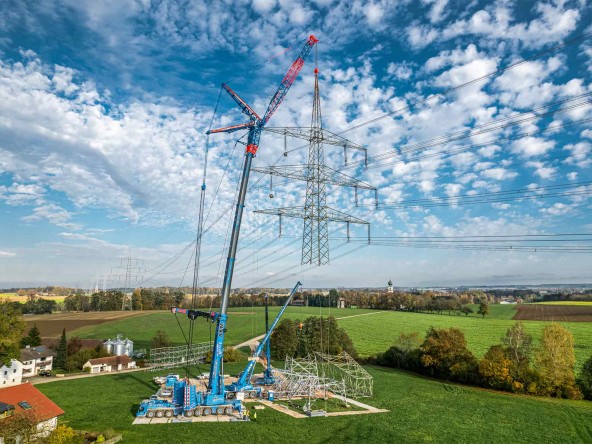
Only the LTM 1650-8.1 from AKM had to lift “its” power mast all on its own. On the other three construction sites, the large cranes tackled the project with a tandem lift. Here, smaller Liebherr mobile cranes erect a completely new base for the high-voltage mast.
A logistical challenge of the first order: that was exactly what had to be dealt with in addition to heavy loads during this operation north east of Munich. This was a challange that Sven Bauer, Managing Director of AKM Autokranvermietung in the Munich area, had to overcome. “The synchronous lifts represented the final moments of a major project during which we enlarged a total of 15 masts on this power line,” explains Bauer who, with his cranes, has been working on the high-voltage supply line repeatedly for months. “Today, I have to be at all four of the construction sites to ensure that everything is running smoothly.” This is no mean feat for Bauer, since “the biggest distance between two sites is just under 50 kilometres.”
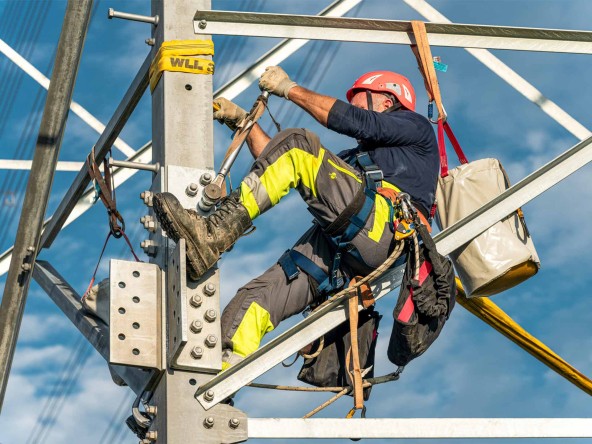
A back-breaking job: The installation work on the individual masts took up to three days. Maximum concentration was required from the crane operators and the 40 or so people working at height in their climbing harnesses.
In order to provide enough crane power for the orchestrated lifting of the four tower-height masts during the project finale, Sven Bauer called in strong reinforcements. Six large LTM 1650-8.1 mobile cranes from Liebherr travelled from Austria, Baden-Württemberg and even Northern Germany to support Bauer’s large AKM crane with the same specifications. Prangl, Felbermayr, Thömen, Hüffermann, MSG and Wiesbauer were also involved in the Bavarian project. On three sites, the 700-tonne cranes were deployed in pairs in order to deliver the lifting capacity required. Nevertheless, the job involved lifting loads of up to 95 tonnes from the power masts and the attached high-voltage cables to hook heights of up to 104 metres and holding them there securely. And in some cases for days on end.
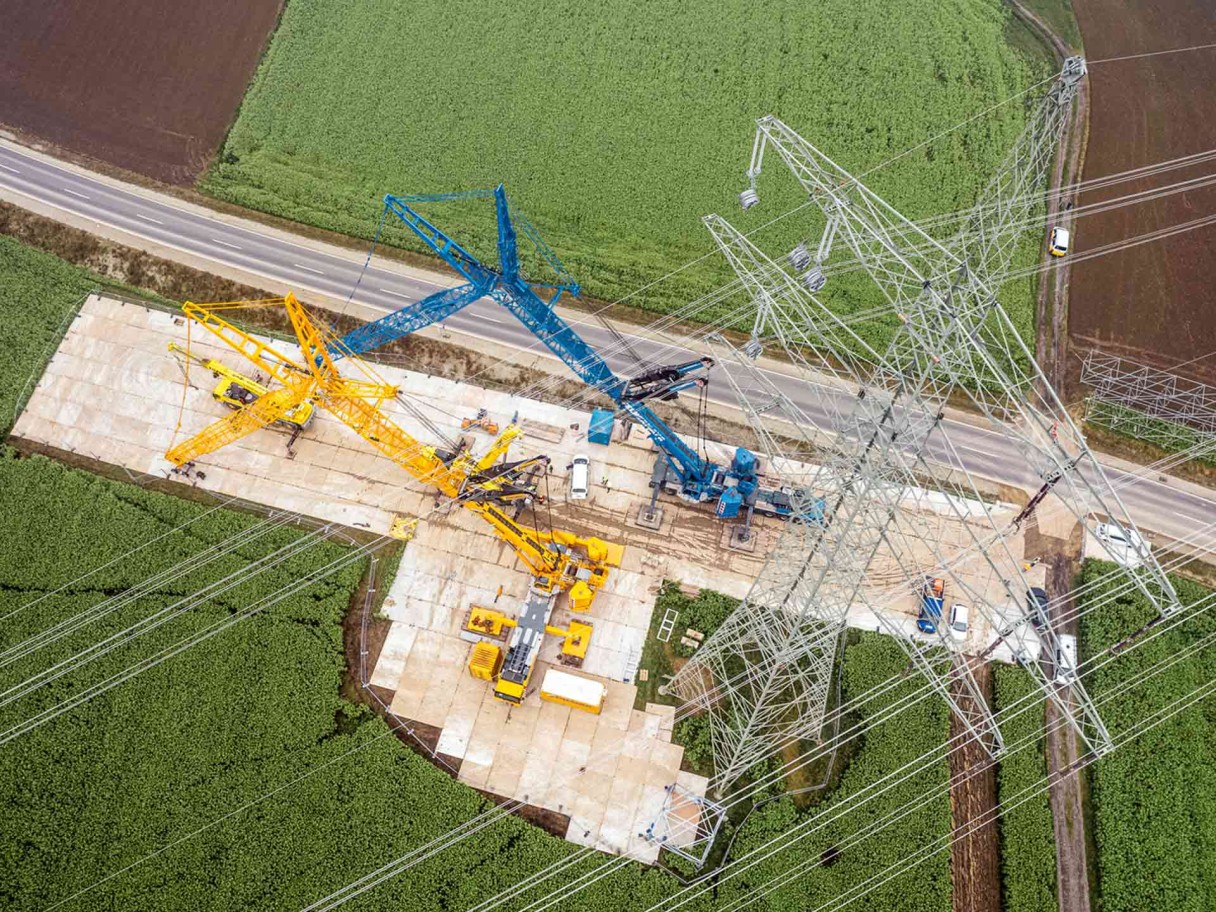
Around 20,000 plates were put down on the muddy fields in order to create site access roads and secure parking spaces for the cranes.
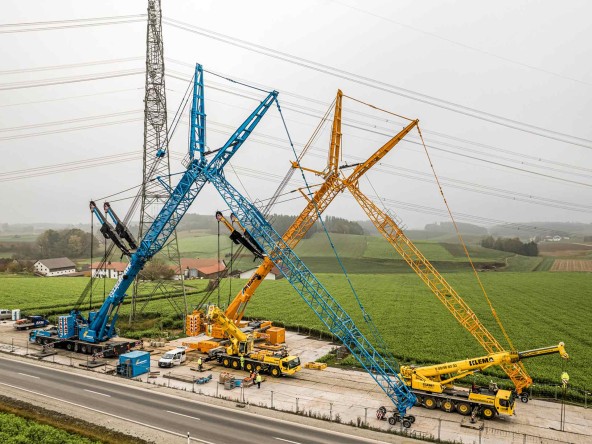
Parallel down to the last detail: From the ballast and the Y-guying to the telescopic extension and the mighty luffing jib, the two cranes from the Austrian companies Felbermayr and Prangl had virtually identical specifications. Two yellow LTM cranes from the AKM partner Klema took care of the setup work on the large cranes and the assembly work on the power mast.
Two nights on the hook
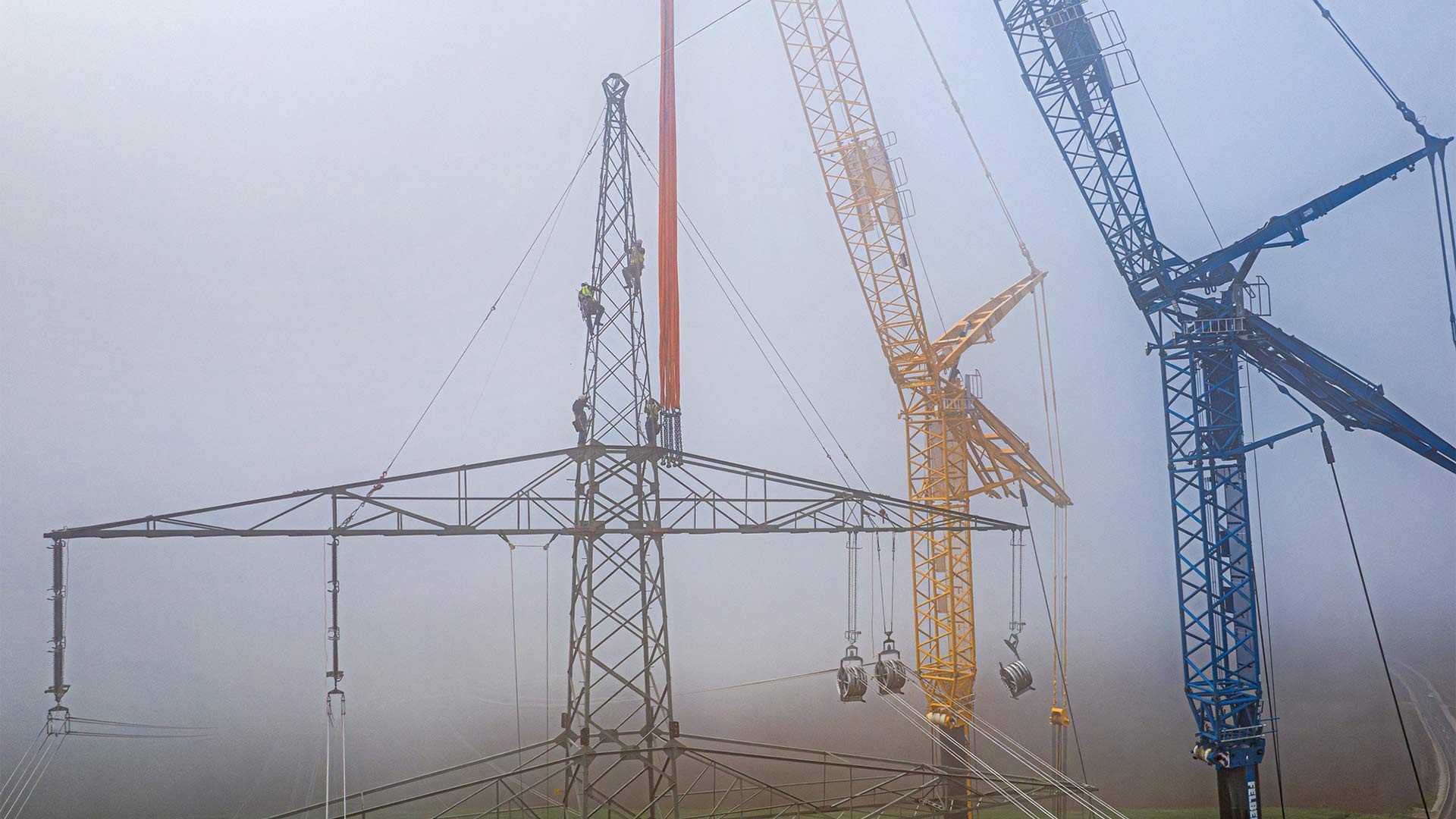
The two cranes from Wiesbauer and MSG had to keep their shared load on the hook blocks for the longest amount of time. The mast and its cables hung from the cranes’ crossbeam for two whole nights. Around 35 metres of the grid tower were built entirely from scratch below. In the large cranes, the crane operators switched cabs since the suspended power masts could of course not be left unattended overnight. For safety reasons, the 40 or so industrial climbers only carried out their installation work during daylight hours and once the usually thick ground fog had dissipated. At all four sites, large, pre-assembled mast components weighing up to 30 tonnes were installed under the suspended masts by the smaller cranes – all of them Liebherr cranes with load capacities from 90 to 250 tonnes. “Here, we often had to telescope at a fairly flat angle with an attached load in order to move the components below the raised power masts,” explains Sven Bauer.
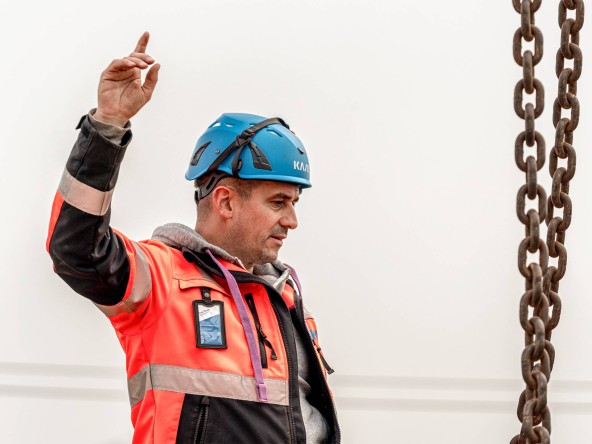
Project manager: AKM Managing Director Sven Bauer planned and took responsibility for the logistically challenging crane mission involving 18 Liebherr cranes.
20,000 steel and aluminium plates ensure solid foundations
A huge number impressively underpins the complex logistics mentioned earlier: 20,000. This is how many aluminium and steel plates were needed to make the field sites accessible and usable for the cranes. “Because of the recent rain, we had very muddy soils and therefore it took an enormous amount of effort to create safe routes and parking areas for the cranes,” explains Sven Bauer. “In some cases, 25 square metres of load distribution plates were needed for a single crane outrigger. We also had sloping terrain in some places, so we needed to shore up the outriggers significantly there.”

Midnight idyll: The picture shows the two cranes from MSG Krandienst and Wiesbauer. They are supporting the 85-tonne load while ground fog rises during the evening.
Liebherr service was guaranteed
When the last of the four power masts was set down on the third day, Sven Bauer was visibly relieved: “The meticulous planning paid off. Itʼs also thanks to the excellent service from Liebherr hat we’ve been able to complete this major mission on time. This was important so that the power could be restored to the cables within the planned deadline. This is why our customer also had clear requirements in terms of the cranes used: only cranes that guaranteed fast and reliable service were to be deployed. This is why we worked exclusively with Liebherr mobile cranes on this project, and not with cranes from other manufacturers, of which we only own a few anyway. In fact, we experienced a fault with a hydraulic hose. Liebherr’s service engineer was on site in no time and fixed the problem quickly.”
This article was published in the UpLoad magazine 02 | 2025.