

4 minutes - magazine 02 | 2025
Floating one last time
In 1913, near the northern German town of Rendsburg, a giant iron railway bridge was put into service over the North Sea Canal with a suspension ferry hanging underneath it. One night in January 2016, the ferry collided with a cargo ship. This severely damaged the transport gondola, putting it out of operation and ultimately leading to it being dismantled.
Suspension ferry from the imperial period becomes snack lounge
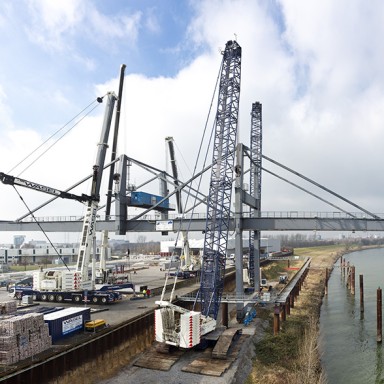
A rebuilt suspension ferry was reinstalled under the bridge a few years later using two Liebherr mobile cranes. Now, the once damaged gondola is being picked up on the crane hooks again. The historic metal housing is to be restored and in future serve as a fish snack bar and music stage on the banks of the Rendsburg Canal. The arrival of the old suspension ferry at its new location was met with great celebrations. We went along to see how the unusual method of transport got on.
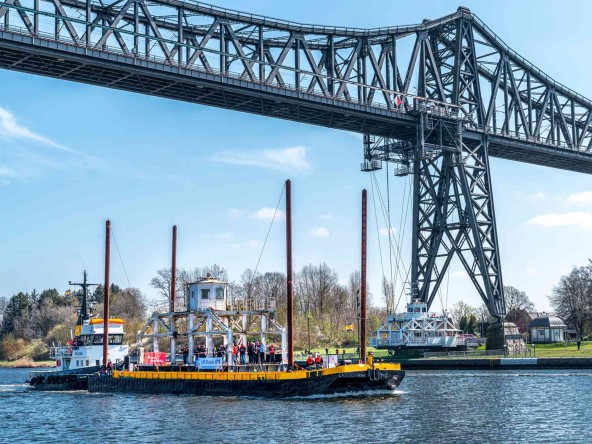
Off we go: The tug convoy passes the old site of the gondola and crosses the Rendsburg high bridge. This extraordinary monument to the art of engineering is one of the longest railway bridges in Germany.
For nine years, it lay in the dockyard of the Waterways and Shipping Office and was actually already earmarked for scrapping. Now, the original gondola of the Rendsburg suspension ferry has been given a new life. To do this, 15 men from the Kiel branch of the Ulferts & Wittrock crane company – including operations manager Michael Kulbe – travelled to Rendsburg with transport vehicles and mobile cranes. “Three months of planning,” says Kulbe, “preceded this operation. Due to the requirement to carry out the entire move on a low-loader and ship with the necessary four crane lifts within just nine hours, we came to Rendsburg with sufficient crew.”
The Kiel team brought two Liebherr cranes with them too. The first of the two LTM 1250-5.1 cranes – which had already been assembled ready for use the day before – kicked off the big gondola relocation at the shipyard. At sunrise, the old suspension ferry was placed on a 6-axle low-loader and carefully travelled the first stage to the shipyard’s harbour basin. The second mobile crane then took over and placed the steel structure on a single large pontoon for water transport.
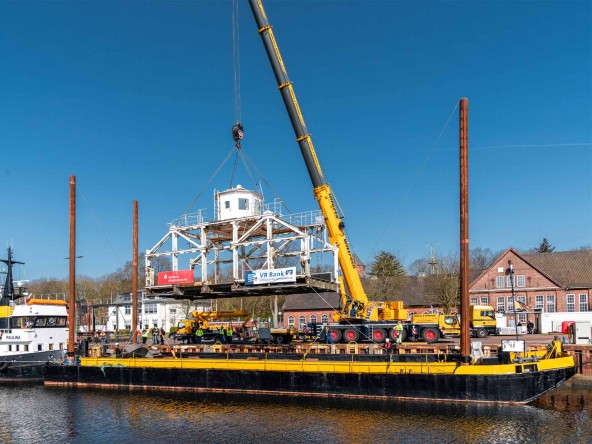
In the harbour basin operated by the canal administration authority, the old ferry housing was placed on a pontoon. An LTM 1250-5.1 holds the 40-tonne metal construction on its hook.
Fish rolls instead of passengers
This piece of industrial culture owes its rescue from the welding torch and scrap yard to Martin Sick. The entrepreneur had the idea of preserving the gondola and using the unique historical piece as a local attraction and business model on the banks of the Kiel Canal in Rendsburg. A venue with stunning views over the canal is being created here for visitors and locals alike. Fish rolls and sometimes even a few musical treats will be on offer here in future.
There was no need to wait for the fish rolls, however. They were served up for the numerous helpers, sponsors and local celebrities shortly before the tug and barge pushed off. Around 30 people on board set off together in the gondola on the two-kilometre waterway from the canal administration harbour to the destination. The short trip also took them under the high bridge, past the new ferry and thus past the former site of the old gondola. It had been in service here for more than 100 years, suspended from long steel cables. It had carried cars, cyclists and pedestrians across the 120-metre-wide waterway. The seemingly adventurous mode of transport was also a welcome change on the daily journey to school for many children.
Once at the Rendsburg district harbour, the ferry “floated” for what was probably the last time. Due to the required boom radius, the historic piece weighing around 40 tonnes was lifted from the pontoon with a tandem lift and then placed in its future position by one of the two cranes to the accompaniment of music and the gaze of numerous guests and onlookers. On the banks of the canal, the gondola will serve as both a technical monument and a lounge for visitors and locals alike. A tourism hotspot rather than scrap metal with a view of the high bridge and the passing ships and container giants on their way between the North and Baltic Seas.
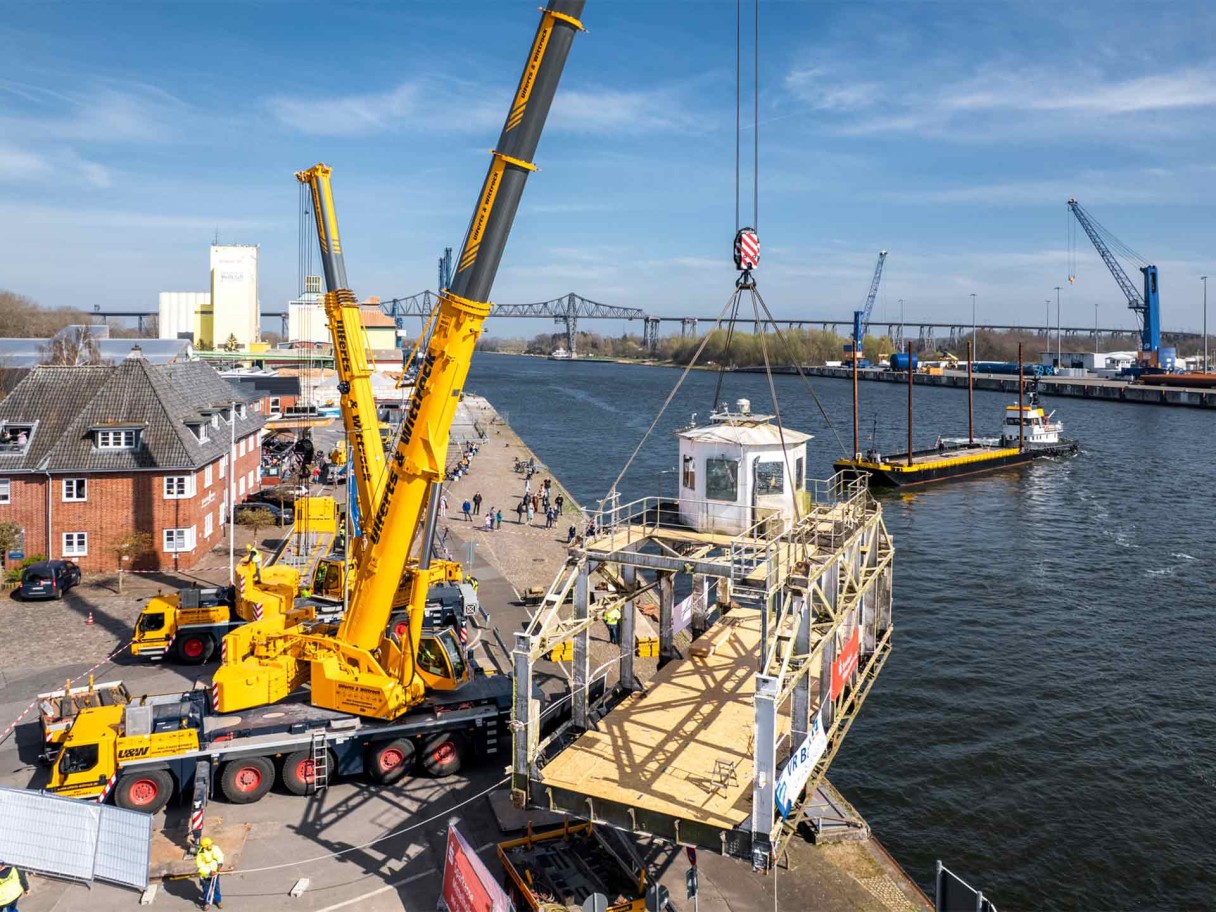
Almost there: One of the two 250-tonne cranes takes over the final piece of the mission and places the old ferry gondola in its future location on the canal bank.

This article was published in the UpLoad magazine 02 | 2025.