Relocation completed in record time thanks to efficient teamwork
In 2024, Dülmen-based gear manufacturer Kordel Antriebstechnik GmbH managed to relocate its PHS 1500 Pro pallet handling system to a new location in record time while continuing production. Thanks to careful planning and efficient support from Liebherr-Verzahntechnik GmbH, the complex system was relocated in just six months with minimal disruption to ongoing operations.
The family-owned company Kordel Antriebstechnik GmbH, based in Dülmen, Westphalia (Germany), produces around 325,000 gearboxes per year for industrial trucks, agricultural machinery, and construction machines – with a level of vertical integration that is extremely high for the industry. Every stage of production is carried out in-house, from the blank to the finished gear component, including hardening, nitriding, and assembly. Around 25,000 parts are manufactured and assembled in-house. Founded in 1879 as a blacksmith‘s shop and now in its fourth generation, the company employs around 1,000 people at five production sites inGermany and Poland. In order to expand production capacity at its headquarters, Kordel had built a new production hall in neighboring Olfen (Germany). One of the tasks at this new location was to relocate the machining of aluminum and cast parts for housings with as little disruption to ongoing operations as possible.
“It was a mammoth project and demanded a lot from us. But Liebherr always made realistic promises and kept to them.”
Two PHS 1500 Pro for high cycle frequencies
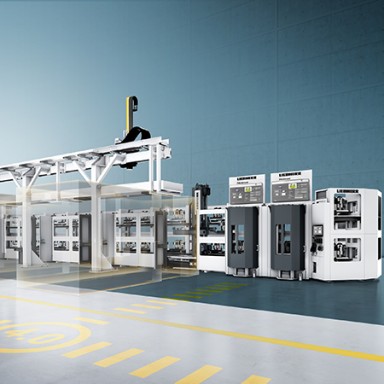
In 2019, Kordel invested in two PHS 1500 Pro linear pallet handling systems from Liebherr-Verzahntechnik GmbH for machining gear components. These systems ensure automated material supply from the warehouse to the six connected machining centers and back again – a solution that would not have been possible with a single system. Stefan Sattelmayer, Sales Director for Automation Systems at Liebherr-Verzahntechnik GmbH, explains: “The dual-system design was also a novelty for us at the time, but it has clearly proven its worth.”
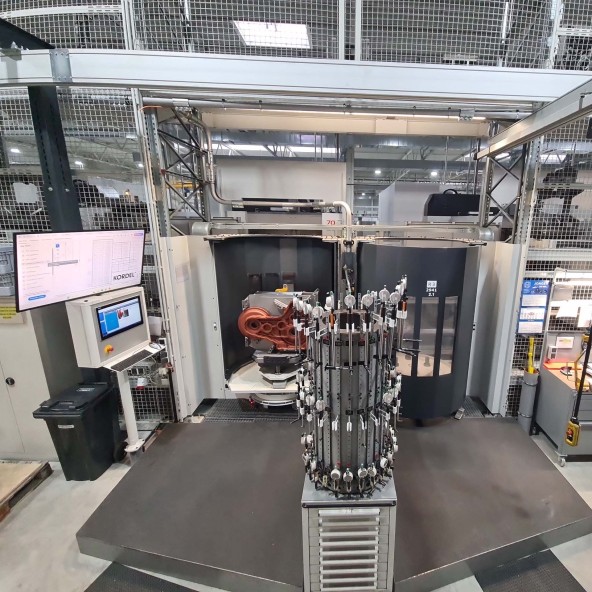
The material handling device automatically provides the required raw part and finished part box at the setup station.
Centrally controlled material and tool
The system consists of two parallel shelf magazines: one for handling raw and finished parts and one for pallets for machine loading. Both are equipped with a lift module for transporting and handling pallets and communicate with each other continuously via the shared master control system. The system supplies material to the machining centers, where gear parts made of cast iron and aluminum are drilled and milled – from the warehouse to the machine and back again. “The system is designed for small, recurring batch sizes that require frequent changeovers,” explains Dirk Strotmann, Head of the Machining Department at Kordel. The batch sizes for the approximately 50 different components typically range between 5 and 30 pieces.
The system is optimally integrated into the hall: On the material side, the system offers 188 shelf spaces for material pallets in mesh boxes on four levels, and on the machine side, 74 shelf spaces on three levels. The material handling device automatically supplies the operator at the setup station with all the necessary work equipment. At the same time, the master computer displays the test plan and the relevant drawings on a monitor. The measurement results can be transferred directly via Bluetooth. A central tool storage system supplements the machine‘s own tool magazines. The entire supply of materials and tools is controlled by a master computer from PROCAM.
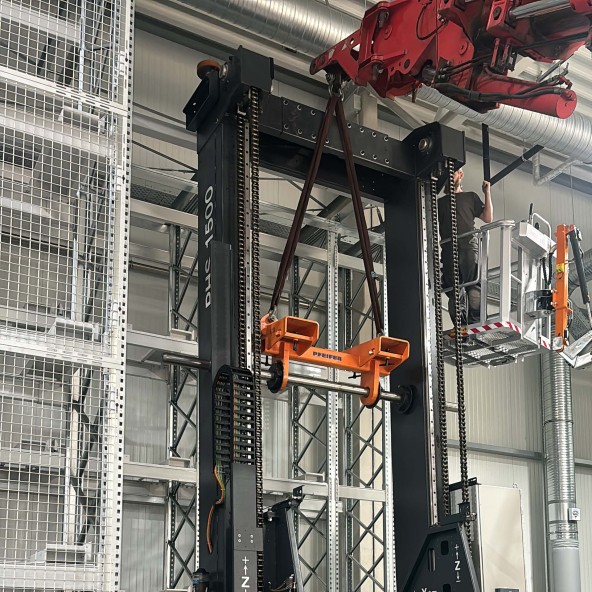
Heavyweight: The stacker crane weighs six tons.
Flexible production, optimal machine utilization
A major advantage is the elimination of setup times. “The system ensures high levels of flexibility and optimal machine utilization: controlled by the master computer, production parts can even be flexibly prioritized or inserted,” explains Dirk Strotmann. Separate setup areas are available for special cases. These ensure that the system does not become blocked even if parts are missing: the PHS simply blocks the affected item and continues to supply all other setup locations. One notable feature of the system is that the master computer even monitors and coordinates the machining of aluminum and cast parts on the same machine. This is made possible by integrated chip separation, which ensures that different types of chips are disposed of separately.
Kordel Antriebstechnik GmbH
Sector:
Mechanical Engineering
Company headquarters:
Dülmen (D)
Employees:
approx. 1,000 employees
Founded:
1879
Website:
kordel.de/en
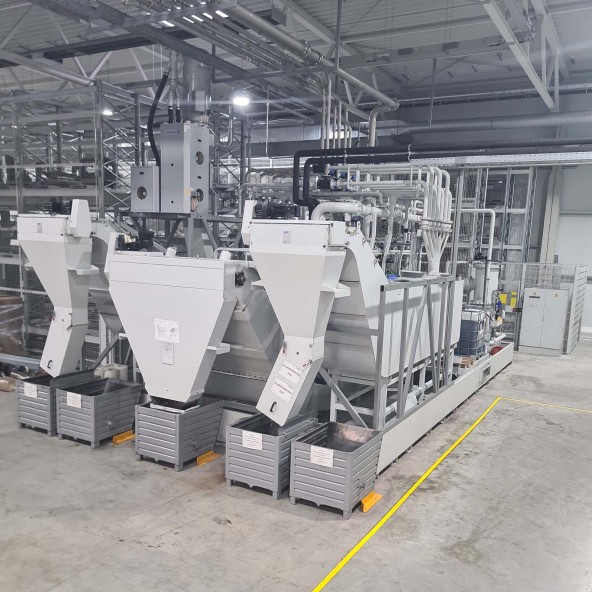
Relocation with minimal downtime
The challenge, therefore, was to relocate this smoothly functioning system to the new site in Olfen with minimal disruption and downtime to ongoing production. “Due to the complexity of the project, we had estimated that it would take around nine months,” reports Christopher Nigg, Project Manager for Automation Systems at Liebherr-Verzahntechnik GmbH.
Preparations began in mid-April 2024 with the dismantling of the material warehouse at the old site, while the machines continued to produce there. By the beginning of July, the machinery in Rödder (Germany) was starting to be dismantled and, at the same time, the materials storage facility was being set up at the new location in Olfen. The materials warehouse at the new location was already up and running again by mid-August, and the entire plant in Olfen was fully operational by the end of October 2024. The original timeframe was thus significantly reduced by almost three months – a move completed in record time.
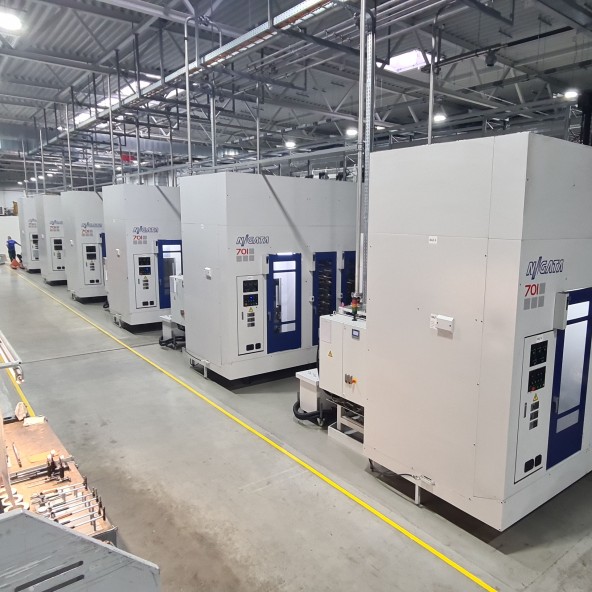
The pallet handling system supplies six machining centers.
Teamwork is the key to success
This ambitious goal was achieved through the efficient combination of resources: eight machine operators worked hand in hand with two experienced Liebherr specialists as supervisors and together ensured that the system was dismantled and reassembled to the highest standards. Thomas Schotte, Managing Director of Kordel Antriebstechnik GmbH, praises the planning and implementation of the project: “Our initial concerns about whether it would be possible to relocate the entire system within the planned timeframe and get it up and running again smoothly quickly proved to be unfounded. The entire process was handled extremely professionally.”
However, the biggest challenge was not rebuilding the new hall, but removing the material warehouse – in particular the six-meter-high, six-ton stacker crane – while operations continued. “You have to imagine it as if you were moving house and dismantling and transporting the bulkiest shelf at the back first,” explains Thomas Schotte. “We were literally maneuvering the specialist crane on the last available centimeter when lifting it out.” The running rail of the stacker crane too was removed without damage, transported to the Liebherr plant in Kempten for realignment and then back again, and finally re-concreted precisely in place at the new location. Likewise, the chip removal system was also dismantled and refitted with millimeter precision at the new location.
Highly capable project partners
The successful relocation and smooth commissioning of the plant at its new location are the result of careful planning, thorough preparation, and close, cooperative teamwork. “It was a mammoth project and demanded a lot from us,” admits Thomas Schotte. “But Liebherr always made realistic promises and kept to them.” Both project partners ultimately attribute the success to open communication, mutual trust, and a willingness to compromise on both sides.