


The Mammoet outlet in Leuna made quite an impression with a smart solution and the use of two large Liebherr mobile cranes on a site in Berlin. The positioning of lattice supports weighing around 80 tonnes for a future municipal railway bridge from just one side of the river made both financial and logistic sense compared to the use of a floating crane, which was also considered.
The installation of three lattice supports for the substructure of a bridge over a side channel of the River Spree proved to be a complicated logistical challenge as a result of the space available. One bank near the site could not be used for a crane as it was already home to a construction crane. Therefore, the contractor initially planned to erect the supports using a floating crane. However, as a floating crane was not available for some considerable time, the managers had to seek an alternative solution. The decision was made to adopt a suggestion by the crane specialists at Mammoet based in Leuna which plan to install the 40 metre lattice constructions from just one bank of the river. Furthermore, the crane job would not only be completed more quickly, the cost would also be significantly lower than the original floating crane version.
Because the company’s own mobile crane with a 1200 tonne lifting capacity was not available in the short term for the hoist, Mammoet planning staff René Xyländer and Tom Schladitz obtained a machine from Megalift based in Bremen to complete the demanding job in the German capital. This powerful Liebherr LTM 11200-9.1 mobile crane was fitted with a 48-metre luffing jib. This made it responsible for the hoists to the opposite bank and therefore for the large radii. The modern crane had to handle a gross load of 40 tonnes with a distance of around 50 metres. An LTM 1750-9.1 was assembled very close to it to take hold of the other end of the supports. Due to its significantly smaller radius, this mobile crane managed to operate with a smaller support base of ten by ten metres. In fact, there was no more space available at the extremely restricted assembly site. The ends of the supports had to be placed under the existing structure.
The steel lattice constructions were then swung over the water by the two Liebherr cranes with great care. The main difficulty involved the end phase of the hoists, as the ends of the supports had to be placed several metres under the existing bridge connection on the opposite side of the canal. However, Heiko Bischoff, at the controls of the more powerful crane, and the crane operators in the Mammoet machine, Rainer Schmidt and Daniel König, precisely followed the commands issued by the marshalling fitters and move the components accurately into their final positions.
You might also be interested in
21/10/2026
Press releases
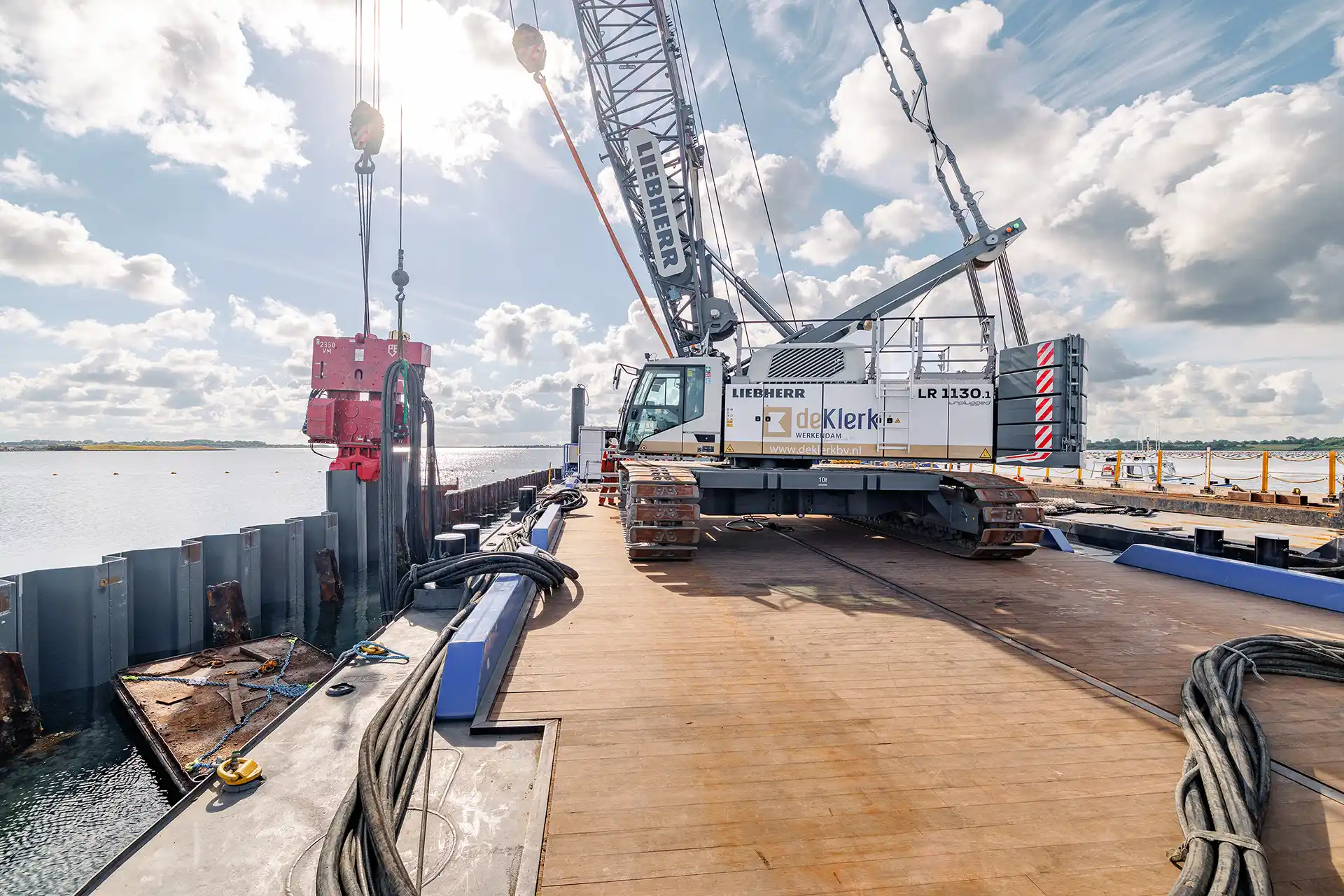
Liebherr electrifies hydraulic construction project with unplugged crawler crane
For the refurbishment of the Brouwer sluice lock complex on the Brouwersdam in the Netherlands, the company De Klerk Werkendam is relying on Liebherr’s battery-powered LR 1130.1 unplugged crawler crane. As part of this, the 50-year-old sheet pile structures are being replaced; these play a key role in regulating the flow of water between the North Sea and the Grevelingenmeer.
19/10/2026
Press releases
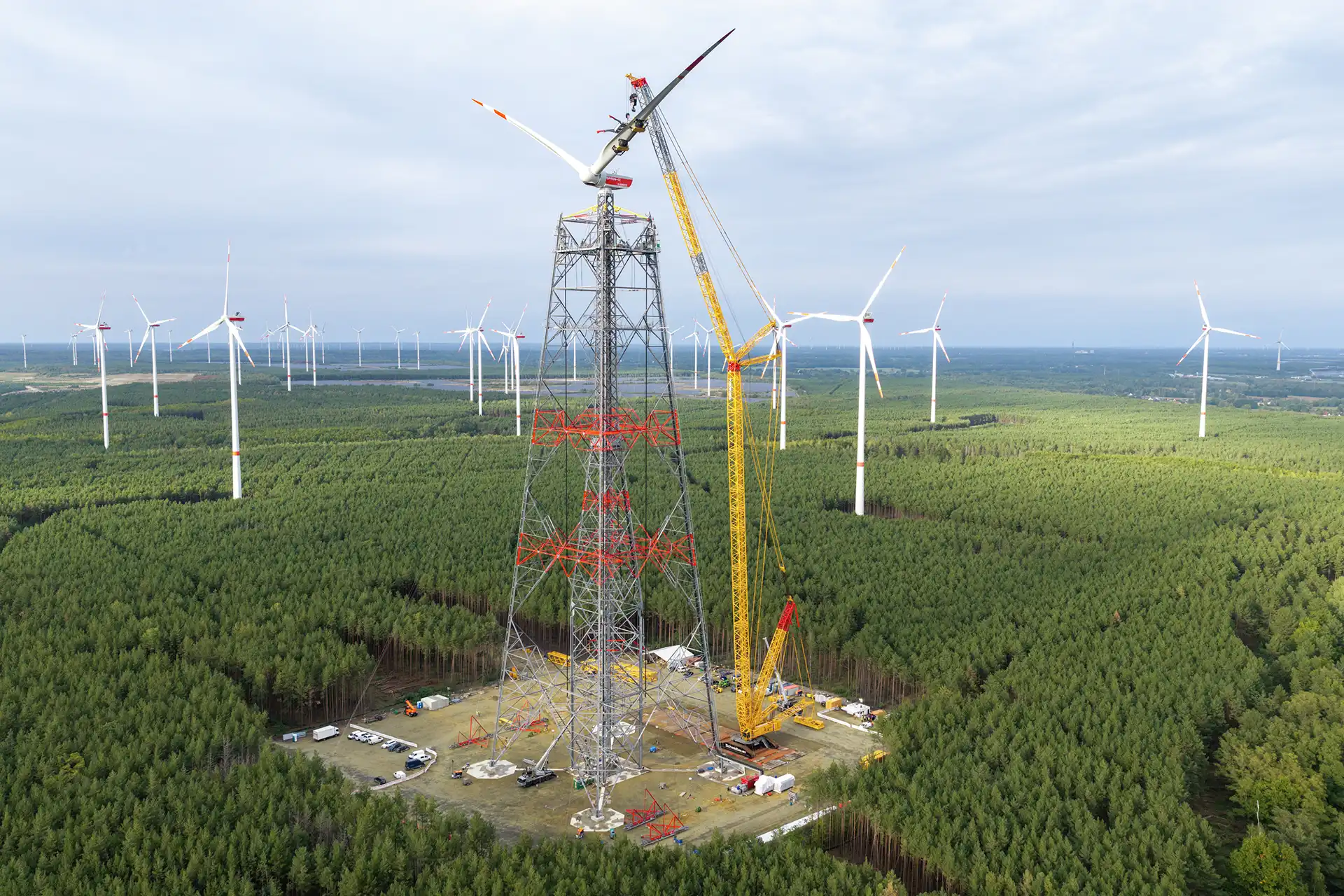
Liebherr LR 11350 erects the world’s tallest wind turbine
At the end of September, what is now the world’s tallest wind turbine was completed. A Liebherr LR 11350 crawler crane from Schmidbauer GmbH & Co. KG was used in the construction of the prototype of the so-called GICON high-altitude wind turbine in Lusatia, Brandenburg.
16/10/2026
Press releases
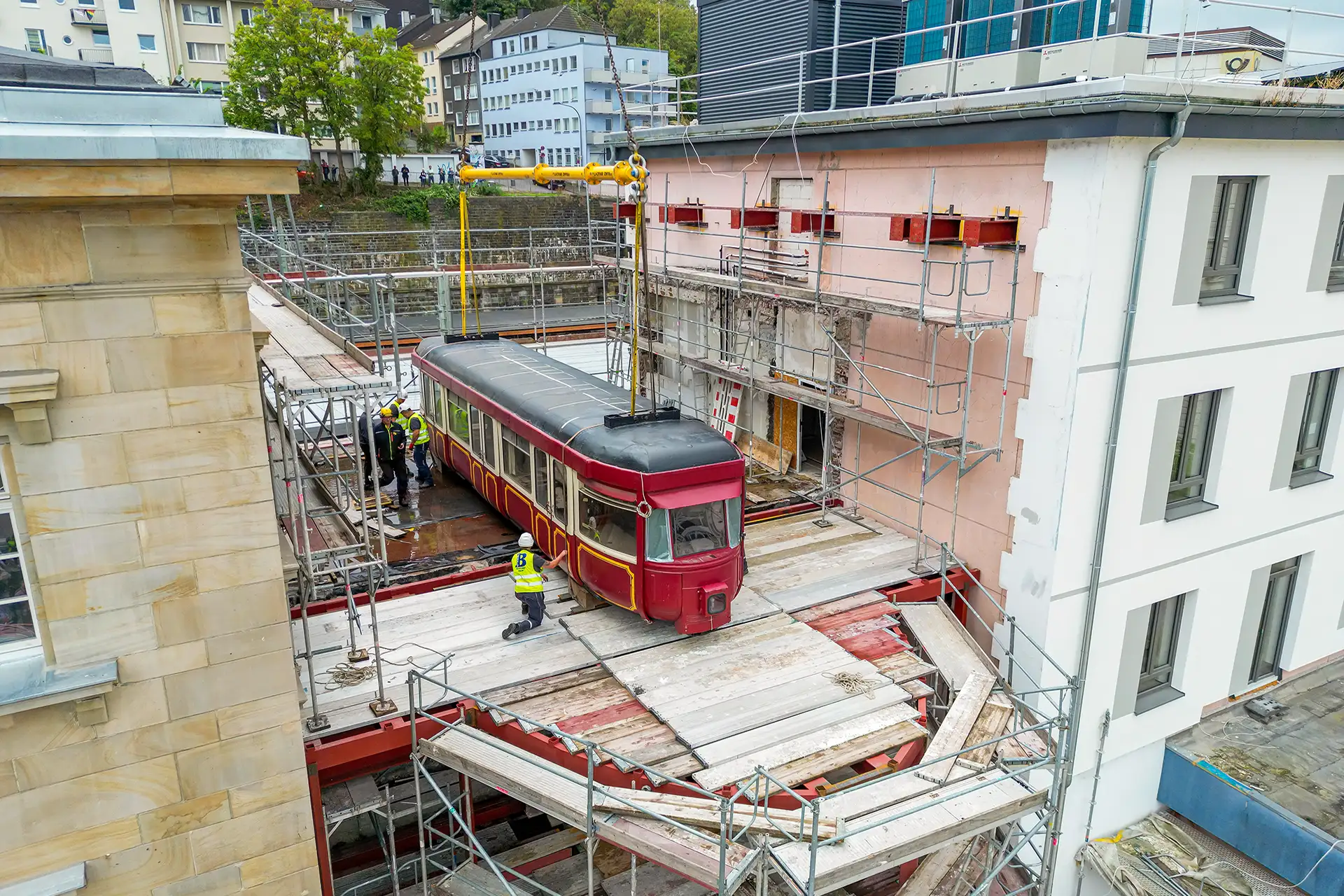
A historic suspension railway carriage is once again gliding through Wuppertal: using a Liebherr LTM 1450-8.1 mobile crane, Franz Bracht Kran-Vermietung GmbH lifted carriage 76, weighing around seven tonnes, into Wuppertal Central Station. Given the limited space available, precise operational planning and modern mobile crane technology were crucial.