


What is in-vitro meat?
In-vitro meat is a revolutionary product development that is still in its infancy. Read on for explanations of all the relevant technical terms. You can also find out about the future potential of in-vitro meat and where research is still needed.
The key points
- In-vitro meat is cultivated from animal cells in bioreactors.
- The muscle tissue produced is comparable to conventional meat.
- More than a tonne of meat can be produced from the cells of one animal.
- In-vitro meat does not require much feed, land, or water, but does need sterile laboratory conditions, which are energy-intensive.
- In-vitro meat is not yet on the cards for the refrigerated counters of the supermarket in the next few years.
What is in-vitro meat?
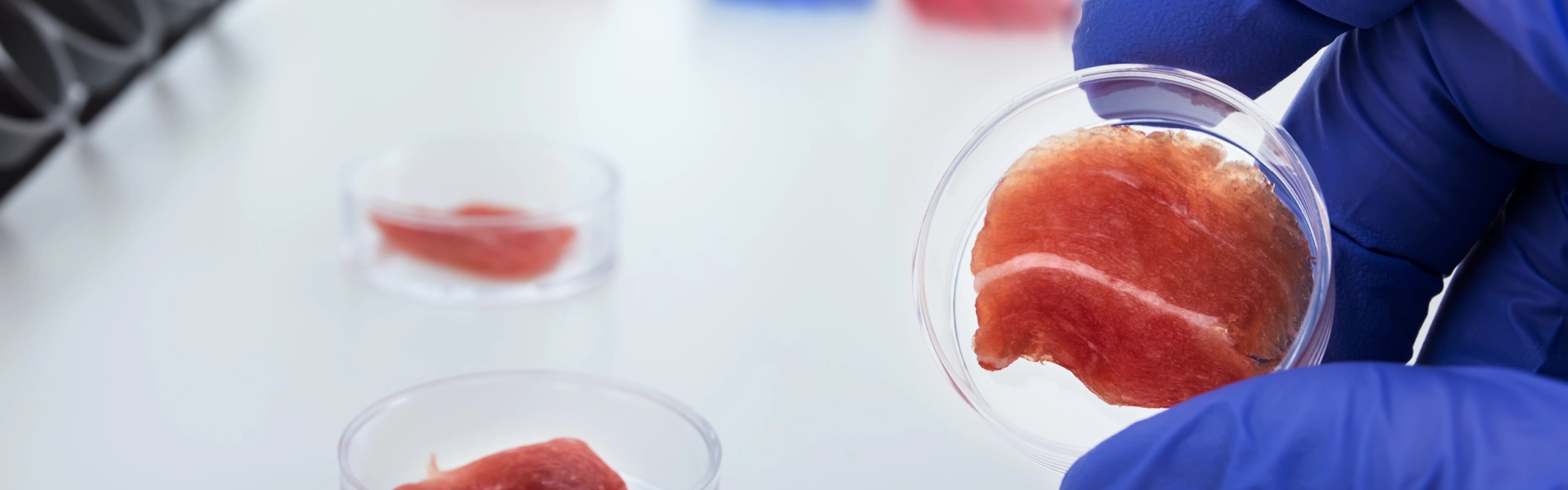
In science, ‘in vitro’ is used to describe processes that do not take place in a living organism, but in a test tube under controlled laboratory conditions. In contrast, processes that are described as ‘in-vivo’ take place in the living organism.
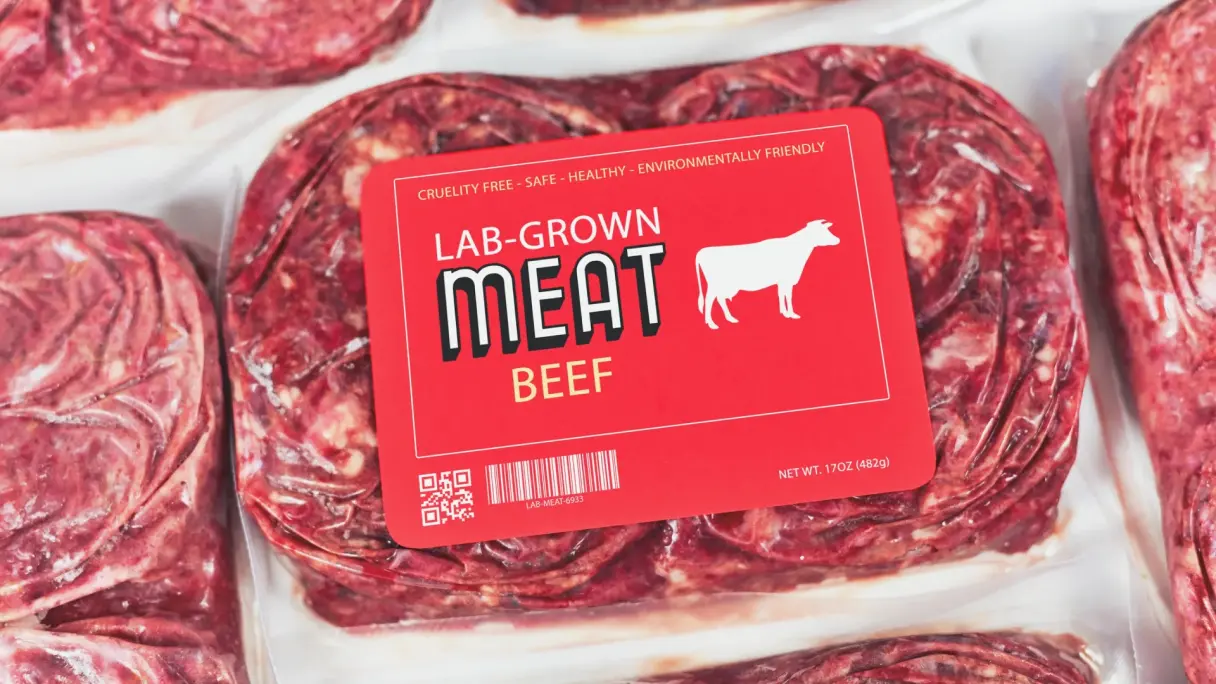
In-vitro meat is therefore meat that has not been produced by conventional animal husbandry, i.e. by rearing and slaughtering animals. Instead, in-vitro meat grows into a piece of meat in a bioreactor. More common terms for this type of meat are ‘lab-grown meat’ or ‘cultured meat’. The phrase "cultured meat" is used particularly in everyday language and by the industry.
For the production of in-vitro meat, muscle cells are taken from animals and cultivated under controlled laboratory conditions. After many years of research, these animal cells can now be grown in a culture medium. This produces muscle tissue that is identical to conventional meat from livestock farming.
The goal is to develop a substance that replicates the taste, texture, and properties of conventional meat as realistically as possible. It can therefore be cooked in exactly the same way and the refrigeration and shelf life remain the same for in-vitro meat.
The potential and challenges of in-vitro meat
Conventional meat production produces high amounts of greenhouse gas emissions. Land and water consumption is also considerable, both through the cultivation of animal feed in monocultures and through animal husbandry itself. The exact amounts vary depending on the animal species, production system, and region.
The alternative cultivation method of in-vitro meat can reduce the need for land and water by reducing animal husbandry and the need for feed.
However, the cultivation of in-vitro meat is energy-intensive. Sterile laboratory conditions are required in order to ensure there are no germs in the cultivated meat so it can be safely consumed afterwards. To achieve this, the appropriate buildings and facilities must be constructed and regularly inspected. The extent to which this production is ultimately more climate-friendly will also depend on the type of energy used. Renewable energies are necessary if production is to be climate-friendly on a large scale.
Actual data from conventional meat production is currently being compared with estimated values from in-vitro meat production. This is because there is no data available for the production of in-vitro meat on a large scale.
Ethical issues surrounding in-vitro meat
In-vitro meat does not require factory farming. However, the killing of animals is still necessary at present, as the basis for in-vitro meat remains animal cell material. Such cattle, pigs, or chickens will therefore continue to be bred and kept. The stem cells required for in-vitro meat must be taken from living animals. Subsequently, more than a tonne of meat can be produced from one cell sample. This means that fewer animals need to be kept and an improvement in husbandry conditions can also be achieved.
It remains to be seen whether animal husbandry will actually be improved in favour of the animals and how painful cell removal is for living animals. Tests are also being carried out on animals in the current research phase.
Until now, the culture medium that promotes the growth of in-vitro meat has also been of animal origin. A suitable culture medium must contain important vitamins, proteins, and growth factors, among other things. One solution used to date is what is known as foetal calf serum. The serum is obtained from the blood of calf foetuses, an unborn calf in the early stages of development. The foetus dies after the blood is drawn. This means that current in-vitro meat production practices are not free from animal suffering.
Alternative culture media are currently being researched. For example, fungi, yeasts, or algae could be used to produce suitable culture media. However, there is currently no suitable formulation that can be used for every cell type.
Research into in-vitro meat
The idea of in-vitro meat is not new. The artificial production of meat was already discussed in the 1930s. However, significant progress in the development of cultivation methods has only been made in recent years. Various products have been authorised, particularly in Singapore and the United States.
So far, in-vitro meat is not available on the German and European markets. There are individual companies and research institutions that have taken on the task of further development. There have already been various burger patty tastings around the world.Individual beef steaks with pronounced marbling were also tested. However, production has so far only been successful on a small scale and cannot yet be ramped up.
In the near future, in-vitro meat will not yet be available in the refrigerated counters of our supermarkets, as research and production with permanent refrigeration is too expensive and cannot yet be carried out on a large scale.
This might also interest you
Sustainable nutrition: protect the climate and resources
Eat and enjoy in an environmentally friendly way: find out which foods are suitable for a sustainable diet and how to store them properly.
Vegetarian minced meat
What is vegetarian minced meat? Is it healthy? What ingredients should you pay attention to? Find out now.
Veganuary – try going vegan this January
Go vegan for one month? We’ll show you how to make Veganuary a reality.
This text was machine translated from English.