Bin picking made easy
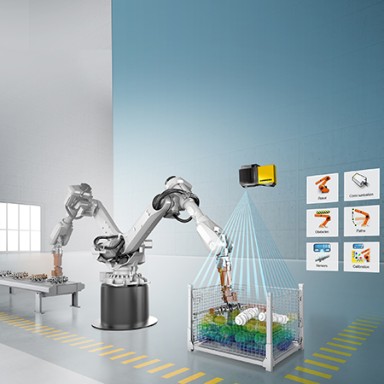
Reliable, automated handling of randomly arranged parts is one of the most challenging tasks in industrial automation. It requires precise coordination of vision systems, software, and robotics. The LHRobotics.Vision software makes bin picking possible for a wide range of applications and now has an expanded set of functions.
Bin picking refers to the automated removal of randomly oriented workpieces from a container. What humans do intuitively presents robots with complex challenges: they must identify parts, pick them without collision, align them, and place them in a precise orientation. Achieving this requires perfect coordination between image processing, software, gripper technology, and robotics. The benefits are clear: higher productivity, lower unit costs, and a significant reduction in monotonous tasks for operating personnel.
Technology package for bin picking
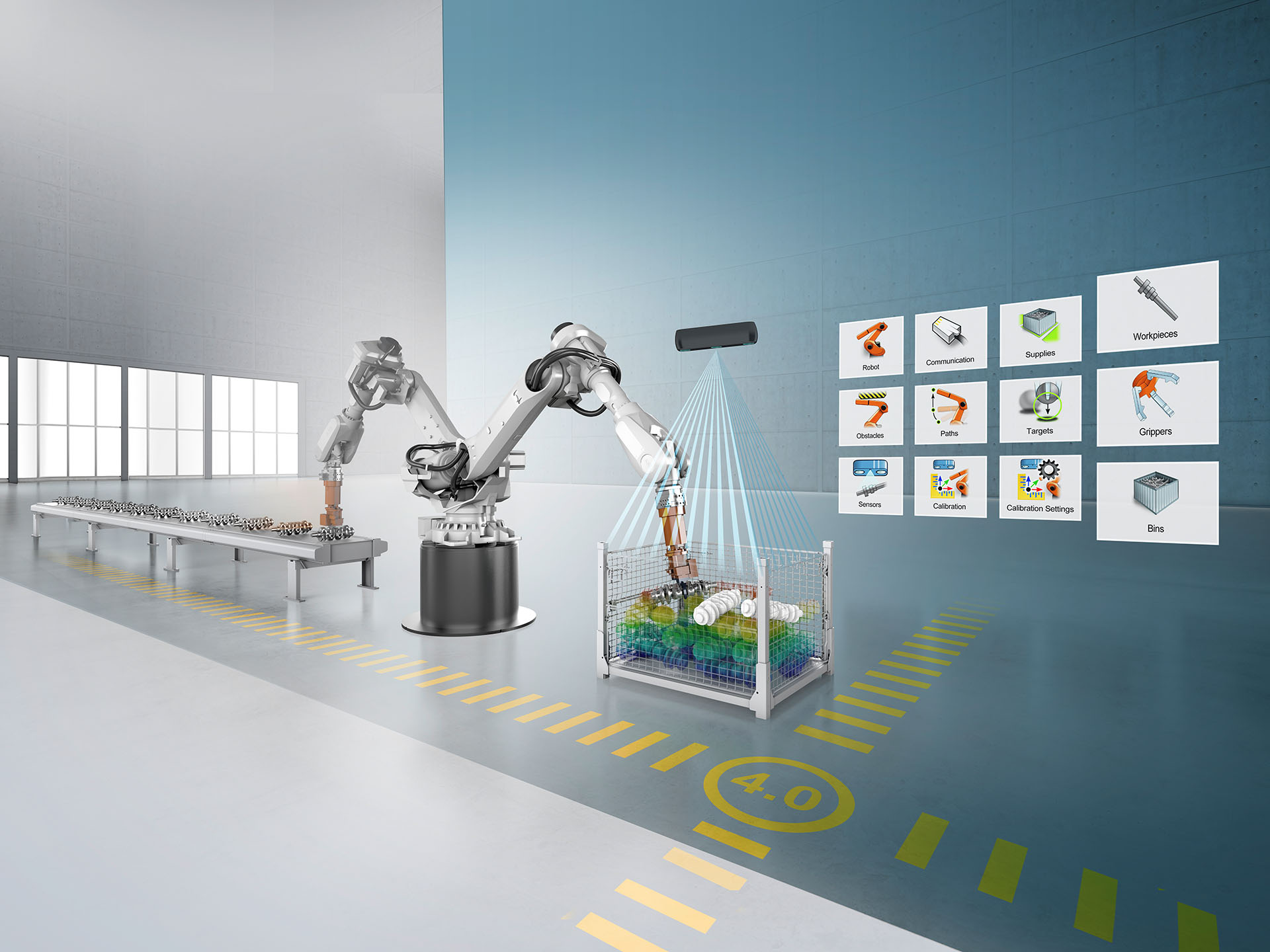
At the core of the technology package from Liebherr-Verzahntechnik GmbH is the LHRobotics.Vision software, which controls the precise identification and selection of objects as well as collision-free removal. Depending on the chosen functional scope, the software also supports robot path planning up to a defined placement position and – optionally – the simulation of entire systems. A projector-based 3D vision system is required to capture the image data.
LHRobotics.Vision software Functional scope
NEW: Also includes the robot, environment, and placement position, enabling evaluation and optimization of the emptying rate.
Simple setup and scalable functions
The application is configured via an intuitive, graphically guided user interface with clearly structured steps – from defining workpieces and picking positions, through configuring the gripper, container, and robot model, to accounting for obstacles and potential collisions in the entire work area.
The modular software concept means it is available in several expansion levels (see above: Functional scope): from basic workpiece detection functions, through advanced path planning functions, to optional simulation of complete cells. There is now a Detect function for simple depalletizing tasks, making it even easier to get started with automated processes.
This creates a seamless workflow for reliable part removal and – depending on the license scope – also for placement and path planning (see above: Bin picking in four steps). Feasibility studies and support during system design further contribute to safe and reliable implementation.
Bin picking in four steps
NEW: Covered or overlapping parts are identified, and the gripping strategy is automatically adapted to avoid misgrips and damage.
Additional functions for enhanced process reliability
The latest enhancements take process reliability to a new level. AI-based point cloud segmentation selectively filters out irrelevant areas to speed up object recognition. The simulation capabilities have also been expanded: in addition to the gripper and container, the complete cell is now taken into account, including the robot, environment, and placement position. This allows even more realistic mapping of processes and material flows – from the initial grip to final positioning. Risks can be identified at an early stage, alternative concepts can be tested before commissioning, and applications can be optimally validated.