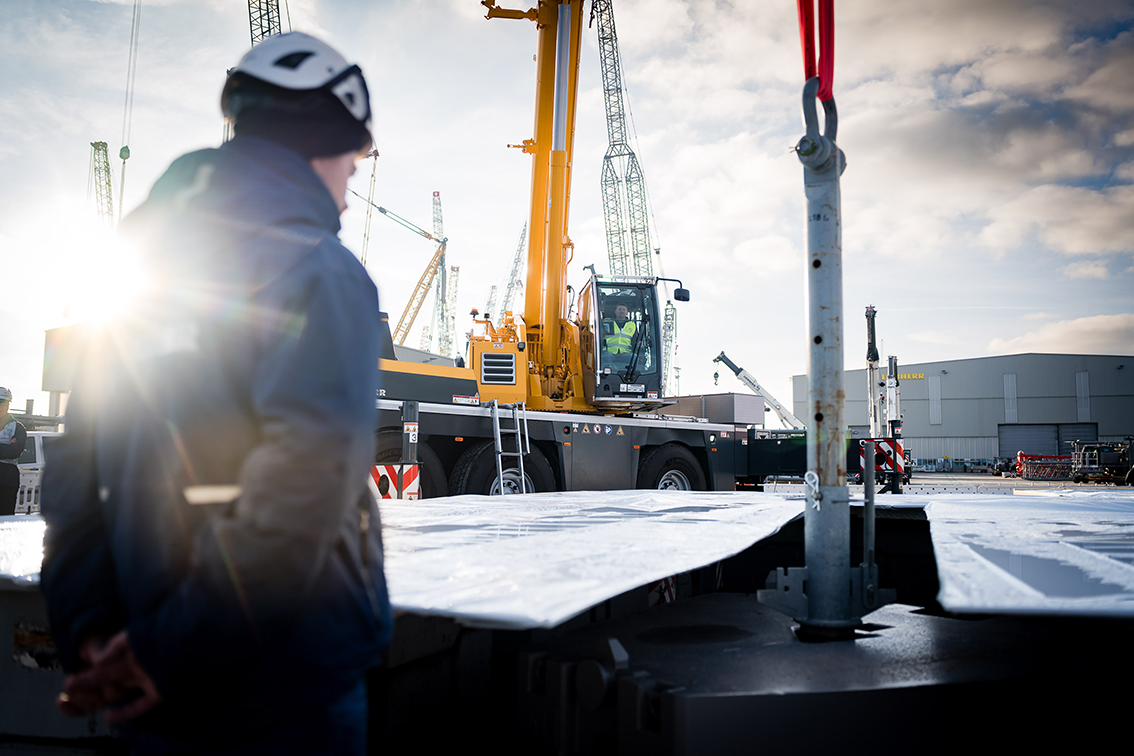
In Ulm in southern Germany, a dilapidated, two-lane prestressed concrete bridge on the B10 federal highway was dismantled after around three years of planning. The railway tracks running underneath, with a width of over 100 metres, and the associated overhead lines did not allow for demolition by explosion or conventional excavation. Instead, the bridge structure was cut into individual segments and lifted out in a controlled manner using a crawler crane. The Swiss crane and logistics company Emil Egger AG, or ETE for short, brought its LR 11000 crawler crane to the city on the Danube for this challenging task. Around 40 heavy transports and four days of assembly were required before the powerful crawler crane could begin its round-the-clock operation against the impressive backdrop of Ulm Minster.
The tricky bridge dismantling was carried out by the crane in two phases: for the first and heaviest lifts over shorter distances, the crawler crane was configured with an 84-metre-long lattice main boom (SL2DBV). The boom was then extended to 128 metres in order to reach the more distant sections. The large crane operated with a maximum ballast of up to 750 tonnes. The derrick ballast alone accounted for 450 tonnes, which was extended to a radius of 30 metres for some lifting operations using the hydraulically adjustable V-frame folding frame.
Weight determination crucial
"We developed the dismantling concept together with the construction and logistics company Max Wild," says Michael Egger, Managing Director of Emil Egger AG, who was on site on the first day of operation of his crawler crane. "A major challenge in this large infrastructure project here in Ulm was the segmentation of the bridge sections." The demolition was carried out in sections and followed a clearly defined procedure. First, the respective carriageway segment was attached to the hook of the crawler crane. After the load was picked up by the LR 11000, the concrete saws began their work on the bridge. The diamond-tipped wire saws ran in a circle for about five hours until the approximately 17-metre-wide and over 2-metre-high prestressed concrete structure was cut through. "It was crucial to determine the weight of the individual segments as accurately as possible. Only then could we compensate for the expected load via the extendable derrick ballast and safely lift the component after it had been completely cut through," explained Egger.
"V-Frame and VarioTray make work easier"
"The V-Frame and VarioTray were of course extremely useful and made the work much easier," says Egger. "This was particularly true for the lifts where we had to bring the bridge sections in from a greater distance and place them near the crawler crane, where the demolition excavators were breaking up the concrete elements. Thanks to the separable derrick ballast, there was no need for time-consuming reballasting with an auxiliary crane. The crane achieves its full performance thanks to the 30-metre derrick radius. We have been using the V-Frame for six years now and would not want to do without this feature."
The crawler crane was also supported by a Liebherr LTM 1650-8.1, which had also come to Ulm from Switzerland. Initially, the powerful mobile crane helped to set up the LR 11000. It then moved to the opposite side of the track and took over the dismantling of an access ramp to the old bridge structure. Similar to the use of the large crane, individual ramp segments weighing up to 110 tonnes were hooked up, the concrete structure was sawn apart and finally removed piece by piece.
If everything goes according to plan, the new bridge in Ulm should be completed in autumn next year. After that, the opposite direction will follow. Then Egger's red cranes will return to the Danube and once again play a central role in dismantling the remaining federal highway bridge.