

Precision into space: Liebherr Components as the key to the latest generation of radio telescopes
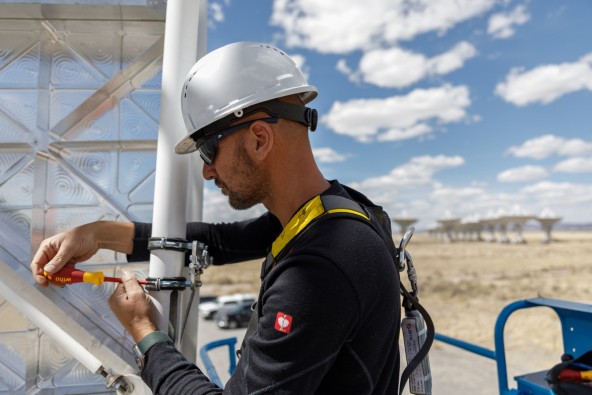
There is just a small, inconspicuous plaque at the base of the enormous structure. This makes the story it tells all the more significant. It focuses on Dr Karl-Heinz Stenvers, the radio telescope and antenna pioneer who passed away last year. In the 1980s, the German engineer designed some of the first movable parabolic antennas for astronomical purposes. It was largely thanks to his developments that the first photo of a black hole was taken in 2019 – an image that amazed the world. Black holes and the still unexplored secrets of the universe are also the focus of the prototype of a completely new radio telescope dedicated to Dr Karl-Heinz Stenvers here in the desert of New Mexico (USA).
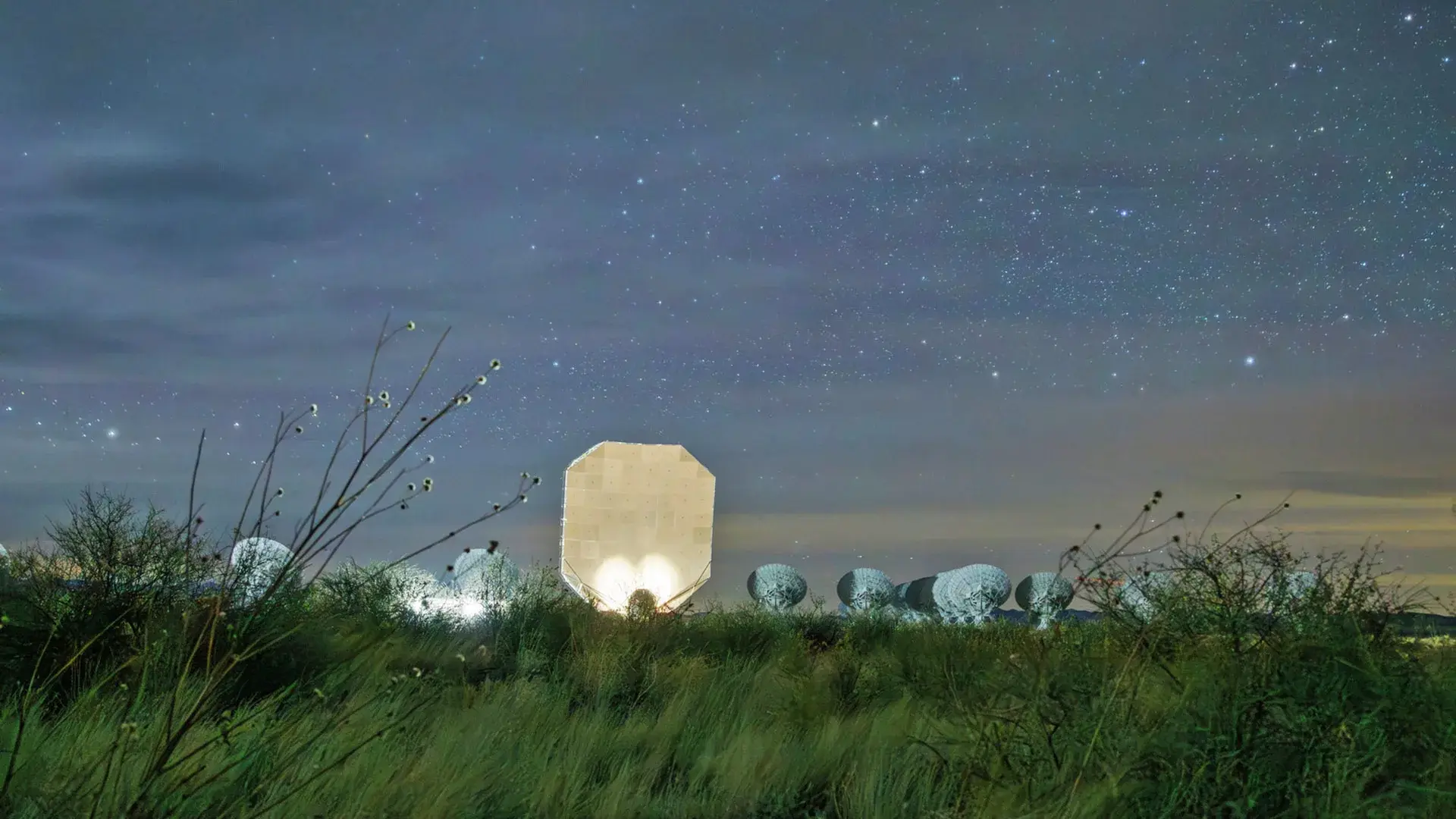
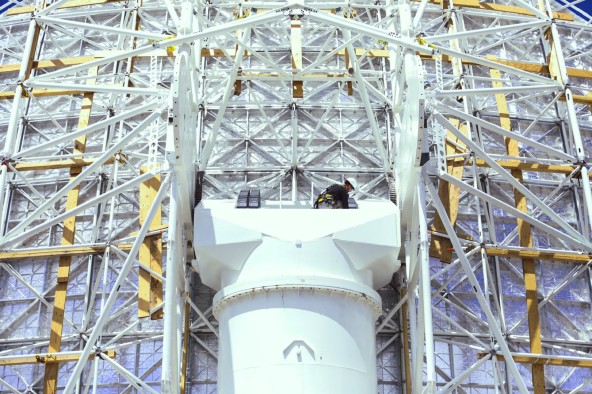
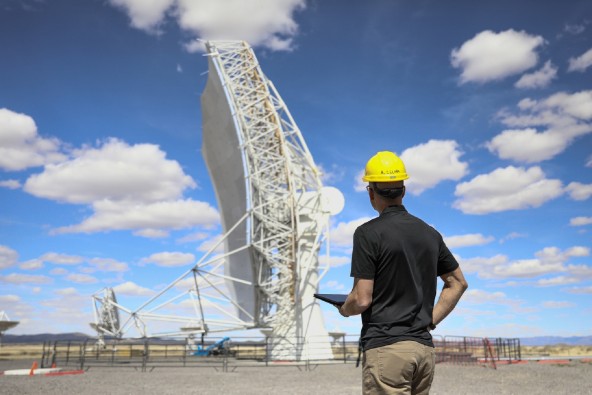
The 18 metre parabolic antenna, with its 76 aluminium panels assembled into an octagonal shape, is pointed toward the sky. In super slow motion, barely visible to the human eye, it rotates in the opposite direction to the Earth’s rotation. This millimetre-precise mobility is the result of the highest level of engineering expertise: 143 tonnes of steel, aluminium and CFK must be guided with such precision that the antenna remains precisely aligned with an object in space. A true mechanical masterpiece. This is made possible by a combination of play-free slewing bearings and drives from the Liebherr Components product segment. This bearing has a diameter of over three metres, and the fits are machined to micrometre precision. This is the only way to achieve the necessary rigidity to move huge radio telescopes in wind and changing temperatures without significant play.

Lutz Stenvers, CEO and managing shareholder mtex antenna technology gmbh
From father to son – a family project with infinite dimensions
Dr Karl-Heinz Stenvers was not only a technical visionary, but also a family man. His son Lutz grew up surrounded by scaffolding, steel rings, technical sketches on pink graph paper and fascinating celestial atlases. ‘I was literally born into this niche,’ he explains. Even as a teenager, he helped his father build antennas and was drawn to astronomy and engineering. ‘My father was a mechanical engineer; I studied electrical engineering. At home around the table, we would always discuss radio telescopes, new technologies or mechanics, and the latest discoveries in the universe. It must be in our genes.’
After completing his studies and gaining experience in the antenna construction business, Lutz Stenvers ulitmately joined his parents' company and took over as managing director in 2019. From the small consulting firm founded by his father in 2014, it has grown into the highly specialised telescope manufacturer mtex antenna technology GmbH with locations in Wiesbaden (Germany), Schkeuditz (Germany), and Albuquerque (NM/USA). They call the combination of craftsmanship, modern engineering, and family continuity ‘German Family Engineering.’
An array of superlatives
The name Stenvers is well known in the world of high-tech astronomy and opens doors for the start-up. ‘The fact that the director of the US National Radio Astronomy Observatory (NRAO) approached us just six weeks after the company was founded was remarkable in itself. It came as a big surprise when, at a time when some of us were still sitting on camping chairs, he told us about his vision of a new generation of radio telescopes. It became even bigger when, shortly afterwards, the order for a revolutionary telescope development actually came in.’
It is important to note that the NRAO is recognised worldwide as the premier institution for radio astronomy. It designs, builds and operates radio telescopes on behalf of the US government to enable research into the universe at radio frequencies. In addition to cutting-edge research, the NRAO helps train future scientists and engineers, and stimulates public interest in science and astronomy. The NRAO telescopes are open to all astronomers, regardless of their institutional or national affiliation.
Today, mtex is implementing the prototype for the most ambitious radio telescope project of our time on behalf of the NRAO: the Next Generation Very Large Array, or ngVLA for short. The plan is to install an antenna array with 244 parabolic antennas – like the prototype on the San Agustin Plateau in New Mexico, each 18 metres in diameter – positioned in a clearly defined pattern across North America. ‘This allows us to create radio images that are hundreds of times sharper than the optical images from the Hubble Space Telescope (HST) and the infrared images from the James Webb Space Telescope (JWST),’ explains Lutz Stenvers.
On the trail of planet formation
From a scientific point of view, the ngVLA is a quantum leap. Astrophysicist Tom Maccarone from Texas Tech University expects this to yield new insights into black holes and gravitational waves in particular. ‘With the ngVLA, we can observe structures near black holes that were previously invisible,’ he explains. ‘It will help us to understand how matter behaves under extreme conditions, and how stars and planets are formed.’ Science also hopes to gain new insights into the search for extraterrestrial life. ‘With the help of data provided by the new radio telescopes, we can analyse the chemical composition of gas clouds and therefore draw conclusions about biological processes,’ says the astrophysicist.
For Lutz Stenvers, this also fulfils a lifelong dream inspired by his father: ‘The ngVLA will be the most powerful radio telescope in the northern hemisphere and a kind of Swiss Army Knife for astrophysics. It can simultaneously investigate the environment of black holes, measure magnetic fields in galaxies and observe the formation of stars.’ It is precisely this diversity that makes the project so exciting for him and his team – and so complex.

Black holes – mysterious gravitational traps
Perfect mechanics for the perfect image
In order to move an 18 metre antenna with such precision over decades that objects the size of a golf ball on the moon, for example, can be reliably fixed and observed, every component must meet the highest standards. For the ngVLA, Liebherr manufactures both the large slewing bearings for azimuth adjustment and gear ring segments for elevation, as well as the azimuth and elevation drives that support the dish and mirror and continuously align them with the targeted fixed point in the universe. The dimensions are extraordinary: the bearing has an outer diameter of 3.3 metres. It is designed as a three-row roller-bearing slewing ring to absorb enormous forces while ensuring the required maximum rigidity.
‘It must be possible to position the antennas precisely. We can only achieve this maximum level of precision if the bearings and drive are perfectly matched,’ explains Oliver Friedrich, sales manager Europe at Liebherr-Components Biberach GmbH: the Biberach plant needs five to six months to produce such a high-end bearing and drive concept. Each component undergoes a comprehensive testing programme upon completion, including rigidity tests, to ensure that the azimuth and elevation drives not only meet but exceed the highest industry standards. To ensure the precision of the azimuth bearing, selected positions are approached several times in the so-called ‘wobble test’, for example, in order to measure and ensure the greatest possible accuracy during operation.

Eva-Maria Steibel-Wahl, development engineer for application technology Liebherr-Components Biberach GmbH
Teamwork across borders
The engineers at mtex work closely and trustingly with Liebherr to tailor the antenna design to the components. Lutz Stenvers sees this as a special opportunity for the project to succeed and progress further: ‘The development of high-precision components for radio telescopes requires a great deal of interaction. Our engineers held numerous technical meetings with Liebherr’s engineers in order to push the components to their physical limits. For us, as well as for Liebherr, this meant pushing ourselves to our limits.’
Stenvers is particularly pleased that Liebherr brings ‘a wealth of experience gained over decades across the entire Group to the project. ‘Together, we have succeeded in optimising the slewing bearings and drives in such a short time that they now meet the unusually high requirements of the ngVLA and the National Radio Astronomy Observatory. That makes my engineer’s heart sing.’ Once again, it has become clear how important sharing knowledge between family-run companies can be in such extraordinary technology projects,’ says Lutz Stenvers. ‘Without the collaboration between mtex and Liebherr’s various sites and areas of expertise, the ngVLA project would not be possible. I am certain of one thing: my father would have been delighted with this engineering achievement.’
‘Interdisciplinary collaboration is the key to success’
Liebherr and the universe: the plant in Biberach is continuing to expand its manufacturing horizons for the development of components for a new generation of radio telescopes. ‘We can do pioneering work at Liebherr,’ says Eva-Maria Steibel-Wahl, development engineer for application technology at Liebherr-Components Biberach GmbH. She worked closely with mtex to meet the challenging requirements. We asked her about this.We were able to contribute the full range of our expertise to the ngVLA project at Liebherr. We were able to draw on our expertise in the areas of calculation and design (calculation of torsional stiffness), testing (test setup and measurement of torsional stiffness) and production and assembly (ensuring the lowest possible backlash).
With mtex, we have a customer who has taken advantage of this opportunity and accessed the combined knowledge of several Liebherr business areas, large slewing bearings and drives. And all this has been achieved at a very demanding and high level. The aim of the collaboration was to design a solution that could guarantee the highest possible technical quality in antenna adjustment. To this end, we were given the freedom to recommend a gearing solution that was not necessarily in line with the customer’s specifications, allowing us to fully exploit our potential.
It was important to thoroughly understand the application and the customer’s requirements and to take these into account in the design and construction. Gear solutions with minimised backlash are nothing new to us and are in demand for many technical applications. However, the decisive factor here was that we designed the gearbox for exceptionally high torsional rigidity and very low backlash. Furthermore, as Liebherr-Components Biberach GmbH, we had the opportunity to geometrically align the slewing bearing and the rotary drives, thereby optimising the interface. This was the only way we could ensure that the entire antenna could be adjusted smoothly and securely in the micrometre range.
Personally, I was particularly impressed by the passion and expertise with which mtex operates. During the ngVLA project, I worked with various people at mtex, and everyone was clearly enthusiastic about the project, so that our technical comments were always quickly reviewed and implemented. A genuine partnership has developed over the course of the project. It was a special experience to be part of this team. I had a lot of fun working on a project in which both companies showed great enthusiasm and passion.
Even better images through transatlantic cooperation
To make the images of the ngVLA even better and sharper, German astronomers want to expand the US network with their own telescopes. In the so-called LEVERAGE concept, additional radio telescopes of the ngVLA type are to be built in Germany and Europe. "With relatively little effort, the image quality of the ngVLA can be significantly improved at the highest resolutions," explains Matthias Kadler, Professor of Astrophysics at Julius-Maximilians-Universität Würzburg. "In addition, the German telescopes can also be used in conjunction with other networks, such as those in South Africa or Asia, giving Germany a strategic advantage in international scientific competition." The first step in this direction is to be achieved with the Wetterstein Millimeter Telescope, which is to be built soon on Germany's highest mountain, the Zugspitze. At an altitude of 2650 meters, the Bavarian Environmental Research Station "Schneefernerhaus" offers an ideal infrastructure for operating such a large telescope. The construction of an 18-meter telescope mirror in this extreme alpine environment, as well as the transport of the large and heavy highly sensitive components, such as the 4.2-ton and 3.3-meter Liebherr azimuth bearing to the summit of the Zugspitze, poses a particular challenge. The Wetterstein Millimeter Telescope will certainly be one of the most spectacular construction projects on Germany's highest mountain in the coming years.